Pages

Saturday, December 2, 2017

What Robert Mugabe’s fall tells us about China China is now capable of fomenting regime change in distant countries, and it may be increasingly willing to exercise this option

Image result for pic of zimbabwe with flagImage result for pic of robert mugabeImage result for pic of china flag
Robert Mugabe, the nonagenarian dictator of Zimbabwe, has finally been thrown out of power after 37 years. Zimbabwe’s army had a crucial role to play. But army chief Constantino Chiwenga knew that he needed the blessings of China, Zimbabwe’s largest investor, for the transition process to be smooth. Indeed then, the plot to overthrow Mugabe—as revealed by Reuters—was hatched in faraway China.
Mugabe, a long-time friend of China, was becoming a liability for Beijing. His indigenization law, which required majority control of foreign companies in the country by black Zimbabweans, had angered China. Zimbabwe under the new regime of Emmerson Mnangagwa, Beijing is certain, will be more open to business. “He will limit or even revoke the indigenization law,” says Wang Hongyi of the Chinese Academy of Social Sciences. While it is nothing new for China to interfere in the domestic affairs of other countries, the recent episode in Zimbabwe goes well beyond China’s own historical record.
It was in 1954 that the Indian and Chinese governments together set out the famous “five principles of peaceful coexistence” that included a commitment to mutual non-interference in each other’s internal affairs. A year later, Zhou Enlai, the then Chinese premier, would go on to affirm these principles as the basis of establishing relationship with Asian and African countries, at the Bandung Conference. These principles were, however, in direct contradiction of the belief that the revolution in China that brought Mao Zedong and Zhou to power was a part of the global revolutionary struggle. In the next decade particularly, China supported revolutionary movements in many countries of Asia, Africa and Latin America. But ideology was merely a cover for strategic objectives. As studies by scholars like Peter Van Ness and Melvin Gurtov have shown, the Communist movements in countries with friendly rulers were not supported as generously as in countries with rulers hostile to China.
The era of Deng Xiaoping was different. His mantra of “hide your strength, bide your time” predicated utilization of domestic resources for China’s internal transformation. The support for revolutions abroad was mostly given up. But as Deng’s policies ushered in a structural transformation of the Chinese economy, the country began to need a constant supply of energy and raw materials and an international market for its manufactured goods. Chinese companies began to acquire assets abroad. Chinese nationals started working on these offshore sites. This meant doing business with rulers known for a horrible track record on human rights. Such rulers, many of them in Africa, loved the “no strings attached” Chinese money as opposed to Western aid that was conditional on political liberalization and economic reforms.
China’s foreign policy could not remain unaffected. In UN resolutions against these dictators, China either abstained or exercised its veto. Dictators were rewarded for voting with China through enhanced aid. Beijing also supplied weapons to regimes embattled by civil war, like the one in Sudan. In Libya, China stood by Muammar Gaddafi in the face of widespread international condemnation. Similarly, it has supported Bashar al-Assad in Syria. In most of these cases, China supported the dictator in power over the uncertainty that would follow. The US and its allies, for all their good intentions, did hardly better in terms of achieving peace through their interventions. Iraq and Libya are the two best examples.
Beijing’s support for Mugabe was in line both with its solidarity with revolutionary struggles—Mugabe had led a liberation struggle against white minority rule before taking over as the prime minister in 1980—and the defence of tyrants in countries where China has significant economic interests. The decision to let Mugabe go is, therefore, surprising and perhaps indicative of things to come. China may now, going forward, be more flexible in choosing favourites in other countries—the incumbent can even be disposed of, if required. In Nepal too, China has recently brokered an alliance of the left parties to fight the India-backed Nepali Congress currently in power.
The far more important implication is that China is now capable of fomenting regime change in distant countries in far-off continents. And it may be increasingly willing to exercise this option. While powers like India and Vladimir Putin’s Russia have interfered in the domestic affairs of nearby countries, instituting regime changes in countries across the world has been the domain of superpowers. Dov Levin of Carnegie Mellon University has calculated that the US interfered more than 80 times in other countries’ elections between 1946 and 2000. The estimate for Soviet Union/Russia during the same period is 36. These numbers do not include coups or regime changes like the one US executed in Iran in 1953 and Guatemala in 1954.
These interventions by superpowers came at a cost. The creation of Al Qaeda, Taliban and Islamic State can partly be attributed to America’s unpopular interventions. The costly invasion of Afghanistan had a role to play in the Soviet Union’s eventual demise. At a time when China feels it is within reach of superpower status, it would do well to learn from history. But history also doesn’t lend itself to too much optimism about the learning capacity of superpowers.
Will China’s meddling in other countries grow as it approaches superpower status? Tell us at views@livemint.com

Govt proposes jail term for triple talaq in draft law Draft law classifies triple talaq as cognizable and non-bailable offence and proposes three years’ imprisonment and a fine PTI

The proposed law seeks to ban and criminalize triple talaq conveyed through any means—written, spoken or electronic. Photo: PTI
New Delhi: The government has framed a draft law to end the practice of instant triple talaq under which a Muslim man trying to divorce his wife by uttering the word “talaq” three times would face three years’ imprisonment and a fine.
The draft, which classifies the offence as cognizable and non-bailable, has been circulated to states for consultations. The law seeks to ban and criminalize triple talaq conveyed through any means—written, spoken or electronic.
The draft legislation framed by a ministerial panel is expected to be taken up during the winter session of Parliament. The proposed law will, however, not be applicable to the state of Jammu and Kashmir.
The Supreme Court had on 22 August declared instant triple talaq unconstitutional in a 3-2 majority verdict. The 395-page ruling held the practice to be “violative of the fundamental right under Article 14 (equality before law) of the Constitution of India”.
The verdict added that provisions of the Muslim Personal Law (Sharia) Application Act, 1937, insofar as they seek to recognize and enforce triple talaq, must be struck down as being void.

ART OF LEARNING :-HOW TO TALK?

👍How to TALK
Talk to *Mother* _lovingly,_
Talk 2 *Father* _respectfully,_
Talk 2 *Brothers* _heartfully,_

Talk 2 *Sisters* _affectionately,_
Talk 2 *Children* _enthusiastically,_
Talk 2 *Relatives* _empathetically,_
Talk 2 *Friends* _jovially,_
Talk 2 *Officials* _politely,_
Talk 2 *Vendors* _strictly,_
Talk 2 *Customers* _honestly,_
Talk 2 *Workers* _courteously,_
Talk 2 *Politicians* _carefully,_
Talk 2 *GOD* _silently,_

Talk to *WIFE*
~no no~ ......
*KEEP QUIET & LISTEN ONLY...!!!*

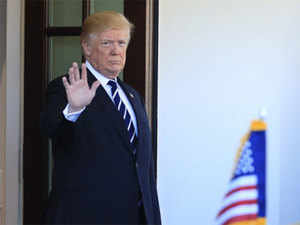
Donald Trump weighs recognizing Jerusalem as Israel's capital: Officials


Donald Trump is weighing a plan under which he would declare Jerusalem the capital of Israel, the officials saidImage result for pic of jerusalem

WASHINGTON: President Donald Trump is considering recognition of Jerusalem as Israel's capital, a move that could upend decades of American policy and ratchet up Middle East tensions, but is expected to again delay his campaign promise to move the U.S. embassy there, U.S. officials said on Thursday.
After months of intense White House deliberations, Trump is likely to make an announcement next week that seeks to strike a balance between domestic political demands and geopolitical pressures over an issue at the heart of the Israeli-Palestinian conflict - the status of Jerusalem, home to sites holy to the Jewish, Muslim and Christian religions.
Trump is weighing a plan under which he would declare Jerusalem the capital of Israel, the officials said, deviating from White House predecessors who have insisted that it is a matter that must be decided in peace negotiations.
The Palestinians want East Jerusalem as the capital of their future state, and and the international community does not recognize Israel's claim on the entire city.
Such a move by Trump, which could be carried out through a presidential statement or speech, would anger the Palestinians as well as the broader Arab World and likely undermine the Trump administration's fledgling effort to restart long-stalled Israeli-Palestinian peace talks.
It could, however, help satisfy the pro-Israel, right-wing base that helped him win the presidency and also please the Israeli government, a close U.S. ally.
Trump is likely to continue his predecessors' policy of signing a six-month waiver overriding a 1995 law requiring that the U.S. Embassy be moved from Tel Aviv to Jerusalem, the officials said.
But among the options under consideration is for Trump to order his aides to develop a longer-term plan for the embassy's relocation to make clear his intent to do so eventually, according to one of the officials.
However, the U.S.officials, who spoke on condition of anonymity, cautioned that the plan has yet to be finalized and Trump could still alter parts of it.
"No decision has been made on that matter yet," State Department spokeswoman Heather Nauert said on Thursday.

CAMPAIGN PLEDGE 
Trump pledged on the presidential campaign trail last year that he would move the embassy from Tel Aviv to Jerusalem.

But Trump in June waived the requirement, saying he wanted to "maximize the chances" for a peace push led by his son-in-law and senior adviser, Jared Kushner.
Those efforts have made little if any progress.
The status of Jerusalem is one of the major stumbling blocks in achieving peace between Israel and the Palestinians.
Israel captured Arab East Jerusalem during the 1967 Middle East war and later annexed it, a move not recognized internationally.
Palestinian leaders, Arab governments and Western allies have long long urged Trump not to proceed with the embassy relocation, which would go against decades of U.S. policy by granting de facto U.S. recognition of Israel's claim to all of Jerusalem as its capital.
However, if Trump decides to declare Jerusalem as Israel's capital, even without ordering an embassy move, it would be certain to spark an international uproar.
A key question would be whether such a declaration would be enshrined as a formal presidential action or simply be a symbolic statement by Trump.
Some of Trump's top aides have privately pushed for him to keep his campaign promise to satisfy a range of supporters, including evangelical Christians, while others have warned of the potential damage to U.S. relations with Muslim countries.
REUTERS|
Updated: Dec 02, 2017, 01.51 AM IST


HERO-SUNG BY CA VARUN SINGHAL


MY FAVOURITE SONG BY MY SON CA VARUN SINGHAL


Friday, December 1, 2017


December 01, 2017 14:47

Update on the terror attack in Pakistan. 

Five burqa-clad Taliban militants today stormed an agriculture training institute in Pakistan's northwestern city of Peshawar and opened fire, killing at least nine persons, including students, before being shot dead by security forces. 
The militants, who arrived in an auto rickshaw, attacked the students' hostel of the Directorate of Agriculture Extension on the University Road in the city, the capital of the restive Khyber-Pakhtunkhwa province. The institute was closed for the Eid-e-Milad holiday, but about 100 students were present in the hostel. 
The militants stormed the building by firing automatic weapons, creating panic, officials said. The Tehreek-i-Taliban Pakistan claimed responsibility for the attack.  -- PTI


'Terrorists don't come from India's Muslims'


December 01, 2017 08:23 IST
'They are not affected by ISIS' sentiment of avenging the suffering of the global ummah.'
'They have a huge ummah of their own in India, a huge Muslim population.'
'And because of that, they have to take into consideration the political and social conditions of Muslims in India.'
'They have to express themselves in a more political way and not through terrorism.'

A boy holds a protest banner during an anti-ISIS march in central London, October 1, 2017. Photograph: Tom Jacobs/Reuters
IMAGE: A boy holds a protest banner during an anti-ISIS march in central London, October 1, 2017. Photograph: Tom Jacobs/Reuters
"The fact that al-Qaeda and Da'esh might disappear doesn't solve the issue of Muslim youth radicalisation," believes Dr Olivier Roy, one of the world's leading experts on political Islam.
Instead, homegrown terrorism might evolve, Dr Roy -- professor of social and political theory at the European University Institute, Florence, Italy -- tells Rediff.com's Vaihayasi Pande Daniel in the concluding part of an exclusive interview.
 
Part 1 of the Olivier Roy Interview: Why ISIS fascinates young Muslims
There is concern about Muslims being attacked in India for their beliefs, eating habits etc.
Could anger at this narrative bring about the rise of lone wolf attackers and such like? Or do you not think so?

It is possible.
But see, the big difference is the people in India -- the Muslims -- who have seen, at times, their neighbours suffering, who could become radicalised, have social connections with their Muslim community. (By definition) they cannot be (or are not) lone wolves...
Their (experience) of this suffering of the Muslim community, that they have in India is a real part of their life (unlike the lone wolves who committed terrorist attacks in the West).
But I think the (affected in India) might try to go the more organised and (find) politically minded means of defending themselves.
Of course, we may have lone wolves.
But we may have also people who try to create political parties or social movements, because they have social bridges, which is lacking in Western Europe.
A Muslim woman holds a sign that reads 'ISIS is not Islam' as she takes part in a gathering of Muslim, Christian and Jewish communities in Fuengirola, southern Spain, August 20, 2017, to protest the ISIS attack in Barcelona a few days earlier. Photograph: Jon Nazca/Reuters

IMAGE: A Muslim woman holds a sign that reads 'ISIS is not Islam' as she takes part in a gathering of Muslim, Christian and Jewish communities in Fuengirola, southern Spain, August 20, 2017, to protest the ISIS attack in Barcelona a few days earlier. Photograph: Jon Nazca/Reuters
Let me return to the London/Manchester attacks earlier this year since they are so representative of youngsters getting affected by hate preachers.
Documentaries like The Jihadis Next Door or My Brother the Terrorist have shed light on extremist Islamic groups that have thrived in Britain and spread their tentacles elsewhere.
Have these people been given too much latitude and space in Britain to practice and preach their death cult or whatever violent extremism they are practicing?

Yes! That is the specialty of Great Britain!
We don't have (this case) in France. In France, a guy like Anjem Choudary (the now jailed hate preacher, who is UK-born but of Pakistani descent) would not have been allowed to speak out.
In Britain he would be allowed to speak/preach in the name of free speech. It is a particularly British exception.
In Germany, in Belgium, in Italy, he would have been jailed a long time before. Now in Britain the mood has changed.
There is now public opinion, and from the authorities, there is a new will to (ban) hate speech.
So it only happened because Britain believes so strongly in free speech?
There might have been a tradition (in Britain) of not really asking for integration and for (allowing) foreign immigrant communities (to remain) foreign.
There is this idea (that the attacks happened) because of (allowing) multiculturalism.
I am a bit doubtful, sceptical, about that.
If we look at those (British) terrorists now, the five guys who killed themselves or got killed in the three attacks (London in March; Manchester in May; London in June) recently, there is only one whose family is from Pakistan.
All the others -- the Moroccan, Italian-Moroccan, the Libyan and the convert from Jamaica -- (were from Europe).
So clearly these guys are not the expression of the mood of the traditional Muslim population.
And they were brainwashed?
I am sceptical about the concept of brainwashing.
I think these guys are, for different reasons, seeking attention.
They are not nice people, who slowly, under influence, become radical.
Many of these guys went to jail. They have a past of delinquency, of violence.
Many of them had a past of family violence, with their wives and so on.
I think these guys were rebels without a cause, who found a cause with ISIS.
So then it is absolutely no surprise that some of them didn't have to go to Syria or anywhere else to get radicalised.
They were radicalised right in the centre of London.

Ya, ya. Some of the jihadis would go to Syria. They are already radicalised when they go.
You don't have nice people going to Syria, just to do humanitarian work! No!
When they go to Syria, they go to fight. And many of them go to be killed.
They know they will die in Syria.
If we look, for instance, which is very fascinating, at the girls. Many of them are converts...
This leads to an unsuitable controversy that they want to marry a mujahid (a person engaged in jihad) who will die in the jihad and so... they are not accidentally pregnant.
They have what they want to have. It is huge. And very pessimistic.
Of course, the parents don't accept that their children choose radicalism.
So all the parents say: My son or my daughter has been brainwashed. I can understand that, of course. But it is not the case.
Ninety percent of the time it is not the case.
Ameen Mukdad, a violinist from Mosul, Iraq, who lived under ISIS rule for two-and-a-half years where they destroyed his musical instruments, performs at the Nabi Yunus shrine in eastern Mosul, April 19, 2017, after the town was liberated. Photograph: Muhammad Hamed/Reuters
IMAGE: Ameen Mukdad, a violinist from Mosul, Iraq, who lived under ISIS rule for two-and-a-half years where they destroyed his musical instruments, performs at the Nabi Yunus shrine in eastern Mosul, April 19, 2017, after the town was liberated. Photograph: Muhammad Hamed/Reuters
You have spoken a lot about the importance of laïcité -- the French concept of secularism and liberalism.
You are against the banning of the head scarf and hijab in France.
Do you feel that in order to make second generation Muslims feel at home in a European country and not be get radicalised, it is important not to remove their familiar customs and to not have the community Westernise or secularise too quickly?

They (the jihadis) are Westernised. These guys are born again. They cannot express the traditional version of Islam. That is why they are so strong.
Then why are you against the banning of the head scarf?
The head scarf in France is not an adaptation/manifestation of traditional Islam. The head scarf we have now is a Western form of the head scarf. It is worn by the educated, middle class segment of immigrants here.
So why hurt them, right?
The head scarf has nothing to do with the influence of the parents and grandparents. It is an innovation.
I am saying that we should be more open to visible signs of religious beliefs, because if we ban all kinds of religious attitudes, dress (etc) in the public space, we give religion to the radicals.
That is the big danger to give the keys of the religion to the radicals.
So we should accept to have visible forms of religious beliefs in the public space.
Former Islamic State members in a classroom at the Syrian Centre for Combating Extremist Ideology in the town of Marea in northern Aleppo, Syria, November 2, 2017. Photograph: Khalil Ashawi/Reuters
IMAGE: Former Islamic State members in a classroom at the Syrian Centre for Combating Extremist Ideology in the town of Marea in northern Aleppo, Syria, November 2, 2017. Photograph: Khalil Ashawi/Reuters
Several years ago, you said that al-Qaeda kind of attacks were going to diminish.
Could the recent number of attacks on Muslims make India a target for al-Qaeda/ISIS?

In India the Muslim community is taken hostage by the conflict between India and Pakistan.
The Muslim community in India does not (commit) terrorist attacks. Terrorism is an (import) from Pakistan.... It allows the Indian government to say they are fighting terrorism.
Terrorists do not come from the Indian Muslim community. This Indian Muslim community has legitimate grievances, especially now with the present government.
So tensions will rise. It is obvious.
The problem for the Muslim community is how to adapt its reaction in a political way. Because that is a political issue. And how to avoid being trapped in the conflict between India and Pakistan.
I am not an expert on India, so I don't know enough about the sociology of the Muslim community in India, but they have a problem of leadership clearly.
In fact, it is not a Muslim community, but a Muslim population, because the situation in Hyderabad is not the same as it is in Kashmir and so forth. It is a very fragmented community.
It is very difficult to make predictions, but it is clear that the present aggression against the Muslim population will raise tensions and might lead to some sort of non-violent reactions.
Muslim women stage a protest against ISIS in Mumbra, outside Mumbai, January 25, 2016. Photograph: PTI Photo
IMAGE: Muslim women stage a protest against ISIS in Mumbra, outside Mumbai, January 25, 2016. Photograph: PTI Photo
But you don't believe these events will lead to Islamic radicalisation in India.
No. No.
There are less chances of that?
You have huge political and social issues in India.
People might be (affected) by violence, but they are not (affected) by this kind of (sentiment of defending and avenging the suffering of the) global ummah of ISIS.
They have a huge ummah (of their own) in India and a huge Muslim population.
And because of that they have to take into consideration the political and social conditions of the Muslims in India.
They have to express themselves in a more political way and not through terrorism.
You have studied why youngsters from second generation Muslim families join ISIS and take to terrorism.
When it comes to white converts who join ISIS, could it be that they don't have enough of their own religion -- Christianity or whichever -- in their life that leads them to go astray.
If they were anchored better in their own faith, then perhaps they would not convert or be drawn to ISIS?

Of course, that would be what the religious authorities would say! I think it is not a problem of religion as such.
Many of these converts, I would say, 30 years ago, they would have become extreme left radicals. They would have joined the extreme left.
In the 1960s in Western Europe we had a tradition of youth radicalisation from the Marxist revolution. Suddenly around the 1990s, the dream of the Marxist revolution disappeared and al-Qaeda and ISIS filled the vacuum.
The problem here is not so much a religious issue. It is one of lack of radical alternative.
The only radical alternative now is Da'esh (Islamic State.
ISIS' Uyghur recruits in China's volatile Xinjiang province.
IMAGE: ISIS' Uyghur recruits in China's volatile Xinjiang province.
You said that these youngsters, who committed terrorist acts in Britain, Europe or America, were often outcasts from their communities and embraced ISIS, then this whole romance with dying.
Do you think they are really, really, aware of what dying is going to mean for them?

Actually, it is difficult to answer that because we cannot think the way they think.
But it is clear that they are looking for death.
In most of these terrorist attacks (they) didn't need to die. (They) could have kept explosives in a bag or organised the escape of the terrorist.
But strangely enough -- it is true from Bombay to London -- when they attacked, they all know they are going to die. They don't try to escape. And they were quite happy to die.
So, of course, when they (opt for radicalisation) they are believers. They do believe they will go to paradise... That's why I use the term apocalypse.
Except they don't believe they are going to establish a just Islamic society. They don't care with civil society. They want to die.
It is why the ISIS sermonising is so fascinating and it makes people so scared. Because there is something fascinating about this kind of Salafism.
That's why I use the term nihilistic, which is not necessarily a very good term, but the idea is that (only) death stops the project.
In coming years, you said al-Qaeda type terrorism will decrease. Have you revised your view?
Do you think homegrown terrorism will be a bigger danger all over the world?

I think homegrown terrorism might evolve.
Because if everybody dies, well, then there will be no more militants. And they don't claim reincarnation.
There will be a change now. It is not sustainable, this kind of radicalisation. It is not sustainable.
But we are not rid of this belief of the youth. We have to solve the issue of why so many youth are fascinated by death...
The fact that al-Qaeda and Da'esh might disappear doesn't solve the issue of youth radicalisation.

Vaihayasi Pande Daniel / Rediff.com

Manufacturing back in business, shrugs off GST, demonetisation blues

By 
R Sriram
, ET Bureau|
Updated: Dec 01, 2017, 01.51 AM IST

Small businesses still facing demonetisation after-effects suffered even more and that was fully reflected in the data captured by government’s statisticians.

Stunning. That was the only word to describe the number flashing on television screens on the evening of August 31 this year. The first-quarter GDP numbers had just been released and growth had slipped to 5.7%, a three-year low. 

While that in itself was shocking, what was even more stupefying was the collapse of manufacturing. Quarterly gross value added (GVA) growth for the sector slipped to 1.2% compared with 10.7% in the previous year. 1.2%!, that’s it. 


Private sector growth, deduced from the data available from listed companies on the stock exchanges was even more stunning. 

A negative 0.9% compared with a 10.2% growth in year-ago period! It took some time for the numbers to sink in. But when it did, the full extent of the problems in manufacturing induced by GST rollout became apparent. Businesses had stopped or sharply cut back production of goods in May-June ahead of the GST rollout on July 1. Small businesses still facing demonetization after-effects suffered even more and that was fully reflected in the data captured by government’s statisticians. 

Cut to November and the picture has changed. On Thursday, the second quarter GDP estimates were released showing a smart bounce in GDP and manufacturing. GVA for manufacturing rose 7% in the quarter compared with 1.2% in April-June, while private sector corporate growth was a healthy 11.4%. Of course, the numbers were still lower than 7.7% manufacturing growth in second -quarter of 2016/17 when the economy was humming along before the demonetisation shock in November last year. So there is a lot of room to do more. This is obviously not the best performance and one should refrain from celebrating too much or calling this a spectacular turnaround. But there is no doubt that the woes caused by GST and demonetisation, at least for big and medium manufacturers, have ebbed and that they are on the cusp of faster growth. 

Consider the following: GVA for mining and quarrying grew 5.5%, the highest growth rate the sector has posted in the first-half of the fiscal year since 2015/16. Electricity, gas water supply and utilities recorded a growth of 7.6% in GVA compared with 5.1% in the year-ago quarter. 


The star performer here was electricity which grew by 6.1% in July-September compared with 3.1% last year. 

Commercial vehicle sales jumped 21% in the second-quarter, while cargo handled by civil aviation grew by 18.9%; railway freight growth measured by net tonne kilometres was up 5.0%. Construction has been having a bad time but second-quarter numbers show that it has actually held up quite well. Now, construction here covers cement production, consumption of finished steel. These haven’t grown as much as the previous year but the category has grown 2.6%, which is up from 2.0% growth in the first-quarter. 

An interesting anomaly needs to be mentioned here and that is the discrepancy between the cement production data and the actual volume growth reported by major cement companies in the three-months ended September 30. 


Almost all the big cement firms reported double-digit volume growth in the second-quarter with ACC and UltraTech volumes rising 18% followed by Gujarat Ambuja’s 12% growth. Smaller JK Lakshmi Cement too reported 10% volume growth. New capacities through mergers helped support this growth but still this is surprising as the second-quarter is generally weak for cement companies due to monsoon and dull construction activity across the country. So one shouldn’t read too much into the dip in cement production and I think a fuller analysis is needed to understand the demand conditions for cement companies. 

On Thursday, we had another interesting data release and that was the performance of core industries. The eight core industries, that is cement, steel, fertiliser, natural gas, crude oil, refinery products, coal and electricity grew by 4.7%, compared with 7.1% last year. The figure was the same as previous month and the joint highest growth for this fiscal year. Once again, it shows a revival in manufacturing led by steel, refinery products, coal and electricity.


IMPORTANT EXCEL SHORTCUTS

No automatic alt text available.Image may contain: text
No automatic alt text available.No automatic alt text available.
Image may contain: textNo automatic alt text available.
No automatic alt text available.No automatic alt text available.
Image may contain: textNo automatic alt text available.
No automatic alt text available.Image may contain: text
No automatic alt text available.No automatic alt text available.
Image may contain: text

contributed by CA Hitesh Shah thru FB