Pages

Saturday, February 3, 2018

Analysis of Changes in Service Tax and GST through Finance Bill, 2018 and GST Council 25th Meeting


Dear Professional Colleague,
Finance Bill 2018 has been presented by the honble Finance Minister on 1st February 2018 which has put forward some changes in indirect taxation regime. Also, in recent days, several modifications have been made under GST after recommendations of 25th GST council meeting. 
The changes recommended by GST council have been notified by the Ministry of Finance vide issue of Notification No. 3/2018-Central Tax dated 23rd January 2018 with regards to procedural modifications. Such changes have been made by way of amendments or additions to CGST Rules, 2017. Further, the suggested revision of rates has been notified vide Notification No. 1/2018-Central Tax (Rate) to 9/2018- Central Tax (Rate) dated 25th January 2018. 
For clear understanding, we have divided the amendments under 2 categories-
I.     Applicable on the date of enactment of the Finance Bill, 2018:
A.    Changes related to Service Tax;
B.     Changes related to Customs affecting IGST;
C.     Change in CGST Act.
II.    Applicable w.e.f. 25th January 2018:
A.    Change in rates/exemption;
B.     Changes related to Reverse Charge Mechanism;
C.     Changes related to Time of Supply;
D.    Procedural modifications.
I.       Applicable on the date of enactment of the Finance Bill, 2018:
A.    Changes related to Service Tax:
(i)     Services provided or agreed to be provided by the Naval Group Insurance Fund by way of life insurance to personnel of Coast Guard, under Group Insurance Schemes of Central Government, are proposed to be exempted from service tax for the period commencing from 10th September 2004 and ending with 30th June 2017 both days inclusive).
Refund of any service tax paid can be claimed after filing of refund application within a period of 6 months from the date on which Finance Bill, 2018 receives assent of the President.
(Clause 103 of Finance Bill, 2018)
(ii)   Services provided or agreed to be provided by the Goods and Services Tax Network to Central Government or State Government or Union Territory administration are proposed to be exempted form service tax for period commencing from 28th March 2013 and ending on 30th June 2017 (both days inclusive). 
Refund of any service tax paid can be claimed after filing of refund application within a period of 6 months from the date on which Finance Bill, 2018 receives assent of the President.
(Clause 104 of Finance Bill, 2018)
(iii) Consideration paid to the Government in the form of Government’s share of profit petroleum in respect of services provided or agreed to be provided by Government by way of grant of license or lease to explore or mine petroleum crude or natural gas or both, is proposed to be exempted form service tax for period commencing from 1st April 2016 and ending with 30th June 2017 (both days inclusive).
Refund of any service tax paid can be claimed after filing of refund application within a period of 6 months from the date on which Finance Bill, 2018 receives assent of the President.
(Clause 105 of Finance Bill, 2018)
B.     Changes related to Customs affecting IGST
Exemption has been proposed of integrated tax leviable under section 3(7) of Customs Tariff Act, 1975 on aircrafts, aircraft engines and other aircraft parts imported under cross-border lease during the period from 1st July 2017 to 7th July 2017 subject to payment of IGST leviable under section 5(1) of IGST Act, 2017 on the said supply.  Through this proposal the exemption is being given retrospective effect as Notification No. 50/2017- Customs, amended by Notification No. 65/2017- Customs had already provided such exemption w.e.f. 8th July 2017.  
Refund of any integrated tax which has been paid can be claimed after filing of refund application within a period of 6 months from the date on which Finance Bill, 2018 receives assent of the President.
(Clause 99 of Finance Bill, 2018)
C.   Change in CGST Act:
In CGST Act, 2017 under section 2(16), for the words Central Board of Excise and Customs, the words Central Board of Indirect Taxes and Customs has been proposed to be substituted.
(Clause 218 of Finance Bill, 2018)
II.  Applicable w.e.f. 25TH JANUARY 2018
A.    Change in rates/exemption
(i)     GST rates of several services have been reduced vide Notification No. 1/2018- Central Tax (Rate). The list of services whose rates have been revised are provided below
S. No.
Description of service
Old rates
New rates
1.
Construction Service –
  1. EWS houses, constructed under Affordable Housing in partnership by state or UT or local authority or urban development authority,
  2. Houses constructed or acquired under credit linked subsidy scheme for EWS/ Lower Income Group/ Middle Income Group-1/ Middle Income Group-2,
under Housing for All (Urban) Mission/ Pradhan Mantri Awas Yojana (Urban).
·        a building owned by an entity registered under section 12AA of the Income Tax Act, 1961, which is used for carrying out the activities of providing, centralised cooking or distribution, for mid-day mealsunder the mid-day meal scheme sponsored by the Central Government, State Government, Union territory or local authorities;

18%


12%


  1. monorail and metro;
  2. low-cost houses up to a carpet area of 60 square metres per house in an affordable housing project which has been given infrastructure status vide notification of Government of India vide F. No. 13/6/2009-INF, dated the 30th March,2017;
18%12%
(iii)    Composite supply of works contract by a sub-contractor to the main contractor providing works contract service to Central Government, State Government, Union territory, a local authority, a Governmental Authority or a Government Entity, which attract GST of 12%;18%12%
(iv)    Composite supply of works contract by a sub-contractor to the main contractor providing works contract service to Central Government, State Government, Union territory, a local authority, a Governmental Authority or a Government Entity, which attract GST of 5%;18%5%
(v)      Services by way of house-keeping, such as plumbing, carpentering, etc. supplied through e-commerce operator and supplier is not liable for registration18%5% without ITC
2.
Transportation of petroleum crude, petrol, high speed diesel or aviation turbine fuel through pipeline
18%
5% without ITC
3.
Leasing/ Rental services of Time charter for transport of goods

18%
5% without ITC of goods (other than on ships, vessels including bulk carriers and tankers)
4.
Real Estate Services –
  • Services of lease of land by central government, state government, UT or local authority to government authority/ entity;
  • Supply of land or undivided share of land by way of lease or sub-lease where such supply is part of composite supply of construction of flats etc.

Not specifically mentioned

Nil
5.
Tour Operator Services
5% without ITC
5% without ITC (except ITC of input service in same line of business)
6.
Fumigation of agricultural produce in a warehouse
Not specifically mentioned
Nil
7.
Service of exploration, mining or drilling of petroleum crude or natural gas or both
Not specifically mentioned
12%
8.
Job work –
  • Manufacture of leather goods or footwear falling under Chapter 42 or 64 of First Schedule of Customs Tariff Act, 1975 respectively; and
  • Tailoring services

18%

5%
9.
Services of treatment of effluents by a common effluent treatment plant
18%
12%
10.
Admission to amusement parks
28%
18%
(ii) Notification No. 2/2018- Central Tax (Rate) has been issued to extend benefit of exemption w.r.t. following services-
1.
Educational Institutions –
The following services have been exempted :
  • Giving on hire a motor vehicle for transport of student, faculty and staff to a person providing service of transportation of students, faculty and staff upto a higher secondary school or equivalent;
  • Services provided by an educational institution by way of conduct of entrance exam against an entrance fees;
  • Supply of online educational journal or periodicals to an educational institute, however the exemption is not applicable to an institution providing services by way of pre-school education and education upto higher secondary school or education as a part of an approved vocational education course.
  • Services by an educational institute relating to admission to or conduct of examination has been exempted for all educational institutions.
2.
Composite supply of goods and services in which value of supply of goods constitute not more than 25% of value of said composite supplyprovided to Central Government, State Government or Union territory or local authority or a Governmental authority by way of any activity in relation to any function entrusted to a Panchayat under article 243G of the Constitution or in relation to any function entrusted to a Municipality under article 243W of the Constitution, has been exempted from levy of GST.
3.
Service of life insurance by Naval Group Insurance Fund to personnel of coast guard has been exempted.
4.
Service of Re-insurance of specified insurance schemes which have been exempted under Notification No. 12/2018-Central Tax (Rate) have also been exempted.
5.
Services by an intermediary of financial services located in SEZ with IFSC status to a customer located outside India for services in currencies other than INR have been exempted.
6.
Legal services to Central Government, State Government, UT, local authority, Government authority/ entity have been exempted.
7.
Services by way of providing information under RTI Act, 2005 have been exempted.
8.
Transportation of goods by an aircraft/ vessel from customs station of clearance in India to a place outside India have been exempted till 30thSeptember 2018.
9.
Limit of exemption on contribution received from members by RWA increased from Rs. 5,000/- to Rs. 7,500/-.
10.
The limit of exempted cover for Life insurance services provided under Life micro-insurance product as approved by IRDA, has been increased from Rs. 50,000/- to Rs. 2.5 lakh.
11.
Time period for exemption of Viability Gap Funding (VGF) has been increased from 1 year from date of commencement of operations of regional connectivity scheme airport to 3 years.
12.
Exemption limit of consideration for right to admission to events or places increased from Rs. 250/- to Rs. 500/- for the following events :
  • circus, dance, or theatrical performance;
  • award function, concert, pageants, any sporting events;
  • planetarium (here planetarium has been added vide Notification No. 2/2018-Central Tax (Rate) itself)
(iii) In addition to the aforementioned services, several changes have been introduced in GST rates of goods as well. Said changes have been notified vide Notification No. 5/2018-Central Tax (Rate) to 9/2018- Central Tax (Rate) dated 25th January 2018. The revision of rate which is most note-worthy is related to old and used vehicles which has been notified vide Notification No. 8/2018-Central Tax (Rate). It has been provided in the said notification that the value on which tax is to be charged shall be the margin of supplier on supply of such goods. The new rates have been provided below-
 Description
New GST rates

Old and used petrol, LPG, CNG driven motor vehicles of engine capacity 1200 cc or more and length 4000 mm or more.
18%

Old and used diesel driven motor vehicles of engine capacity 1500 cc or more and length 4000 mm.
18%

Old and used motor vehicles of engine capacity exceeding 1500 cc popularly called SUVs including utility vehicles.
18%

All motor vehicles other than mentioned above.
12%
The notification also highlights the following points-
  • In case of registered person who has claimed depreciation on said goods, margin of the supplier shall be (Consideration received minus Depreciated value of goods on date of supply), and where the margin is negative, it shall be ignored;
  • In any other case margin shall be (Selling Price minus Purchase Price), and where the margin is negative, it shall be ignored;
  • This notification shall not be applicable where the supplier of such goods has availed ITC under CGST Act, 2017 or CENVAT credit under CENVAT Credit Rules, 2004 or ITC of VAT or any other tax paid on such goods.
B.     Changes related to Reverse Charge Mechanism:
Vide Notification No. 3/2018- Central Tax (Rate) services by Central Government, State Government, UT or local authority by way of renting of immovable property to a registered person has been brought into the ambit of Reverse Charge. Therefore, w.e.f. 25th January 2018, a registered person shall be liable to pay GST on such service.  
C.    Changes related to Time of Supply :  
Vide Notification No. 4/2018-Central Tax (Rate) the specific case of Transfer of Development Rights (TDR) has been handled. It is specified that in case of supply of services by transferor of development rights who received consideration in form of construction service of complex etc. and the developer who supplies construction service against consideration in form of TDR, the liability to pay GST shall arise for both parties at the time when the said developer transfers possession or the right in the constructed complex, building or civil structure, to the person supplying development rights. 
D.    Procedural modifications : 
The following procedural amendments have been notified vide Notification No. 3/2018-Central Tax, dated 23rd January 2018-

S. No.
Description
Amendment/Addition
1.
Composition Scheme
  • Time limit for filing of FORM GST ITC-03 has been increased from 90 days to 180 days from the day when person opting for composition scheme commenced payment of tax under the scheme;
  • For a manufacturer, other than notified, rate of tax shall be 1% of turnover;
  • For restaurants, the rate of tax shall be 5% of turnover;
  • For other suppliers, the rate of tax shall be 1% of turnover of taxable supplies of goods.
2.
Cancellation of registration
  • The restriction to not apply for cancellation of voluntary registration before expiry of 1 year from effective date of registration has been removed;
  • The last date for filing of FORM GST REG- 29 for cancellation of registration obtained by a person who was registered under erstwhile act, but was not liable to be registered under GST, has been extended from 31stDecember 2017 to 31st March 2018.
3.
Value of supply in case of lottery, betting, gambling and horse racing (Newly added)
  • Value of supply of lottery run by state government: 100/112 of face value of ticket or price as notified in official gazette, whichever is higher;
  • Value of supply of lottery authorized by state government: 100/128 of face value of ticket or price as notified in official gazette, whichever is higher;
  • Value of supply of chance of win in betting, gambling or horse race: 100% of face value of bet or amount paid into the totalisator. 
4.
Exclusions from meaning of aggregate value of exempt supplies for the purpose of reversal of ITC
In addition to previous exclusions, the following have shall also be excluded when computing exempt supplies for the purpose of reversal of ITC:
  • Value of service by way of accepting deposits, extending loans or advances, where the consideration is represented by way of interest or discount (not applicable on banking company, financial institution, NBFC, engaged in supply of services as mentioned above);
  • Value of supply of services by way of transportation of goods by a vessel from the customs station of clearance in India to a place outside India.
5.
Transfer of credit from a registered person to an Input Service Distributor (ISD) (Newly added)
It has been notified that a registered person having same PAN and state code as an ISD may transfer the credit of common services to ISD.
6.
Tax invoice or bill of supply to accompany transport of goods (Newly added)
The person-in-charge of a conveyance shall carry a copy of tax invoice or bill of supply in a case where such person is not required to carry an e-way bill.
7.
Extension of benefit of refund on ITC availed for export of goods
The benefit of refund of ITC availed in respect of inputs received for export of goods and ITC in respect of other inputs and input services to the extent used in making such export of goods has been extended to supplies received on which supplier has availed benefit of Notification no. 78/2017-Customs and 79/2017-Customs. Earlier, refund of ITC on supplies received from the supplier claiming benefit of only Notification no. 40/2017-Central Tax (Rate) and 41/2017- Integrated Tax (Rate) were allowed.
8.
Amendment regarding application for refund of IGST paid on services exported
In regards to services, it has now been provided that application for refund of IGST paid on services exported shall be filed in FORM GST RFD-01. Earlier, there was no specific mention of services under the rules. 
9.
Extension of restriction on refund of IGST paid on export of goods or services
A restriction has been put into place for any exporter of goods or services claiming refund of IGST paid on such exports that such exporter should not have received supplies on which the supplier has availed the benefit of Notification no. 48/2017-Central Tax, 40/2017-Central Tax (Rate) and 41/2017-Integrated Tax (Rate). Now Notification No. 78/2017-Customs and 79/2017-Customs have also been added to the list of such notifications. Therefore, if an exporter of goods or services has received supplies on which supplier has availed benefit of the aforementioned notifications, then such exporter shall not be allowed refund of IGST paid on such exports.
10.
Substitution of Rule 138, i.e. information to be furnished prior to commencement of movement of goods and generation of e-way bill
The previous rule has been substituted with updated rule after recommendations of GST council. FORM GST EWB-01 and FORM GST EWB-02 have also been substituted with new forms. 
11.
FORM GST RFD-01A
It has been provided in the notification that Statement-2, Statement-3 and Statement-4 shall be inserted under FORM GST RFD-01A. Such statements are same as those provided in FORM GST RFD-01.


contributed by CA Atul Kumar Gupta

Market crash: What should you do?


February 02, 2018 19:10 IST
'It is only fear and speculation, without much substance, that has led to the fall.'

IMAGE: Stunned bystanders watch the screen displaying the Sensex numbers on the facade of the BSE building in Mumbai on Friday, February 2, 2018. Photograph: Shailesh Andrade/Reuters

'Remain committed to the Indian stock market.'
'The correction will taper off by next Wednesday.'
'Do not panic. The India story is intact and going ahead. It will grow bigger and better. On the contrary, any further correction will be seen as a buying opportunity.'
This is what stock market experts told Rediff.com's Prasanna D Zore after the stock markets crashed 2.3% on Friday, February 2, a day after Finance Minister Arun Jaitley unveiled Budget 2018.
 
More correction going ahead?
Deven Choksey of KR Choksey Securities expects more correction in the next few days, but is sure that it won't be as sharp as the one the investors saw on Friday.
While the 30-stock bellwether BSE Sensex tanked 840 points, the broader NSE Nifty, comprising of 50 blue chip companies, crashed 250 points, the biggest single day fall in recent times, the market crash coming a day after Jaitley introduced a 10 per cent long term capital gains tax (LTCG) on profits above Rs 100,000 on equities as well as mutual fund returns.
"I am expecting this correction to last till (next) Wednesday. It will not be as sharp as the one today; it will taper off just like the strength of a cyclone tapers off over time. The pace of correction won't be so severe, but it will continue," says independent investment advisor S P Tulsian of sptulsian.com.

LTCG to blame?
Tulsian is categorical, unlike a majority of market experts, that the introduction of LTCG had nothing to do with the market crash.
"It is only fear and speculation, without much substance, that has led to the fall today. Generally, the fear that most investors have is that this (LTCG tax) is going to affect their investment returns. So, perhaps there could be some redemption pressure on mutual funds," says Choksey.
Ambareesh Baliga, another independent investment advisor, believes that the LTCG tax just added to the correction that was waiting to happen.
"LTCG just added to this mix already building up," says Baliga.
What roiled the markets then?
Both Baliga and Choksey are unanimous that a spike in bond yields in the domestic market as well as in Japan could have added to the "high valuation" nervousness already roiling traders and investors.
"I see this sharp reaction because of the rise in the bond yields. More importantly, when the bond yields start going up, the gap between bond and equity valuations narrow down. The markets would probably shift money into bonds and give a miss to the equity," says Choksey.
"Even the international markets were comparatively weak after the Japanese rate hike. In India, there was a rally in the bond yield with interest rates expected to move further up," adds Baliga.
"Operator play, long position margin liquidation, but LTCG is not the reason for this fall," is what Tulsian offers as explanation for Friday's crash.
What's for the markets in this Budget?
"Apart from the LTCG there was nothing in this Budget for investors or the middle class. It was meant basically for the poor and the farmers," says Baliga.
He also wondered how the government was going to fund its ambitious Rs 2 lakh crore health insurance scheme unveiled for India's poor.
"Even in that there was no clarity as to how the government would fund their health insurance plan," he says.
"People have not read the fine print," says Choksey.
"According to me the finance minister has clarified this issue. The healthcare budgetary provision of Rs 2 lakh crore is a master stroke," he says.
"Rs 1.1 lakh crore will come from the increase in cess on education and the balance would probably come from private sector insurance companies. I don't think one should be unduly worried about the government's ability to raise the resources needed," adds Choksey.
Choksey is also gung-ho about the government's proposal to invest Rs 14 lakh crore into the rural economy.
"If the rural economy is flush with money and they (the government) are looking to pump in Rs 14.5 lakh crore investments into the rural economy this will put a lot of money into the hands of people which will lead to higher demand and consumption," he says.
This in turn, Choksey believes, will spin the multiplier effect wheel of the rural economy and boost consumption and demand.
Baliga, though, offers this as a counter to a spike in inflationary demands, especially with respect to the government's announcement to pay 1.5 times the cost of production to farmers as the minimum support price.
"Even if the government is planning to pump in huge money into the rural economy, the hike in the MSP to 1.5 times (the cost of production) is inflationary and could lead to higher food inflation," Baliga argues.
Investor advice
"The Budget is excellent for the capital market," says Tulsian and believes that buying will soon emerge because of the strong macro economic fundamentals one is witnessing in India.
"After 4, 5 days," says Tulsian, "all people who are predicting doom today will start saying that it (the fall) was a buying opportunity."
His advice to investors: "Remain committed to the Indian stock market."
Choksey has this to say: "Do not panic. The India story is intact and going ahead it will grow bigger and better. On the contrary, any further correction will be seen as a buying opportunity."
Baliga, however, has been asking his clients to go light since the last 18 months.
"Last couple of months I have been asking investors to book profits. I was getting very sceptical about the market valuation," says Baliga.
"I have been advising them not to go by the index but look out for specific stocks. There are number of stocks that are quoting as if the Nifty is at 9500 levels," adds Baliga.
"An experienced investor will probably invest more if the market cracks further. But a new investor will panic and that could lead to more correction," he says.
Sectors and stocks to watch out for
Baliga, who has been advising his clients to nibble on quality stocks selectively, is betting on stocks like Cummins India and Gujarat Gas.
Choksey spoke broadly about the sectors that look good to him.
"The insurance segment looks very interesting now. It has huge growth built into it with the sector likely to see 30 to 35 per cent CAGR (compound annual growth rate). One must not miss out on this sector," says Choksey.
"Huge money is also coming into the infrastructure sector by leveraging the balance sheets of public sector undertakings.
Prasanna D Zore / Rediff.com in Mumbai

Friday, February 2, 2018

Foreign investors to get relief on profit despite new equities tax As far as grandfathering and the limit for levy of tax is concerned it applies to both residents and non-resident investors, finance secretary Hasmukh Adhia says

Last Published: Fri, Feb 02 2018. 08 38 PM IST
The fine print of the long term capital gains tax seemed to apply only to domestic investors, sparking fears that foreigners may be taxed retrospectively on gains. Photo: Hemant Mishra/Mint
New Delhi: The government has clarified rules around the taxation of foreign investors, as the benchmark stock index fell on the re-introduction of a tax on prospective profits.
Foreign investors in India don’t need to pay tax on past gains on investments in the equity market, finance secretary Hasmukh Adhia said in an interview with Bloomberg in New Delhi.
India’s S&P BSE Sensex equity index dropped 2.3%, a day after finance minister Arun Jaitley said India would end a tax break on equity investments. The fine print of the tax seemed to apply only to domestic investors, sparking fears that foreigners may be taxed retrospectively on gains.
“As far as grandfathering and the limit for levy of tax is concerned it applies to both residents and non-resident investors,” Adhia said.
The new measure aims to tax profits exceeding Rs1 lakh from shares held for more than a year at the rate of 10%. Earlier, gains from equity investments held for more than 12 months were tax-exempt. India in July 2004 abolished long-term capital gains tax on shares and replaced it with a securities transaction tax. The government decided to retain the securities transaction tax (STT) despite the move to tax capital gains.
“STT will stay until we come to a regular regime of capital gains tax for every asset class,” Adhia said. ”There is no double taxation because today on any other class of investment including debt instrument or on the immovable property the present holding period is two years and the gains are taxed at higher rates.”
India has budgeted for Rs200 billion from the capital gains tax in the first year. The collections are expected to double in the following year if the current stock market trends continue. He said the taxation proposals would not lead to flight of capital. Bloomberg

Government defers compulsory E-way bill application, trial to continue

E-way Bill

With the E-way bill generation platform facing technical glitches, the Government on Thursday said it is extending the trial period for e-way bill. However, the government has not clarified how long the trial will run. 

"In view of difficulties faced by the trade in generating e-way bill due to initial techglitches, it has been decided to extend the trial phase for generation of e-way bill, both for inter and intra-State movement of goods. It shall be made compulsory from a date to be announced," said a Governmnet tweet. E-way bill became mandatory from today (February 1, 2018) but throughout the day there have reports of the platform crashing. Some companies have complained that moving goods had come to a complete standstill. 


The trial period of E-way bill had started on January 15. 

"The GST server was unresponsive since morning and gave unnerving moments to the logistics teams of the taxpayers who were apprehensive on movement of goods without E-way bill. Availability of system 24X7 on real time basis is crucial, unlike monthly return filing system. Otherwise it will either result in non compliance of law or restricting the trade," says KPMG India, Partner, Priyajit Ghosh. 

Pratik Jain, Partner & Leader, Indirect Tax - PwC India says this is precisely what Industry was concerned about. "It's good that Government has been quick to defer it. It might be better to first start with E-way bill only for interstate transactions before moving to Intra State. Hopefully, the trial period will also provide the Government an opportunity to test the system and fix the technical glitches," says Jain. 


Thursday, February 1, 2018

India unveils 'world's largest healthcare programme'

Feb 01, 2018, 05.02 PM IST

Towards a healthy India

India announced a national healthcare scheme for half a billion of its poorest citizens in a major giveaway to voters in the final budget before a general election.

Finance Minister Arun Jaitley said India's most vulnerable families would be able to access up to Rs 500,000 a year for hospital cover through the initiative.
1/5
Reuters

Flagship protection shceme

Flagship protection shceme

India spends a little over one percent of its GDP on public healthcare -- one of the lowest proportions in the world -- a sum the government is aiming to increase to 2.5 percent by 2025.

"We are now launching a flagship national health protection scheme to cover 10 crore poor and vulnerable families. This is approximately 50 crore beneficiaries, by providing them up to Rs 5 lakh per family per year for secondary and tertiary care hospitalisation," Jaitley said.
2/5
AP

Taking the pulse of rural India

Taking the pulse of rural India

The government currently provides Rs 30,000 towards healthcare for poor families, but that sum is insufficient to cover most medical procedures.

Terming the scheme as the world's largest government funded healthcare programme, Jaitley said it would take healthcare protection to a new aspirational level.

Budget 2018: How LTCG tax on shares, equity MF units will be calculated as per proposed rules

tax-0-thinkstock

Here's how the new long term capital gains tax regime will work for individuals selling equity or equity MF units or units of business trust 

The Budget 2018 proposes to change how long term capital gains (LTCG) on equity shares and units of equity oriented mutual funds are taxed in your (an individual's hands). But there are two escape windows and one mitigating factor. 
Escape window 1: If you sell your equity or equity MF units (held for more than one year) before 31.3.2018, you can still claim tax exemption on long term capital gains from these. The new tax regime for LTCG is effective for transactions done from April 1, 2018, says Pinky Khanna, Tax Director, EY. 

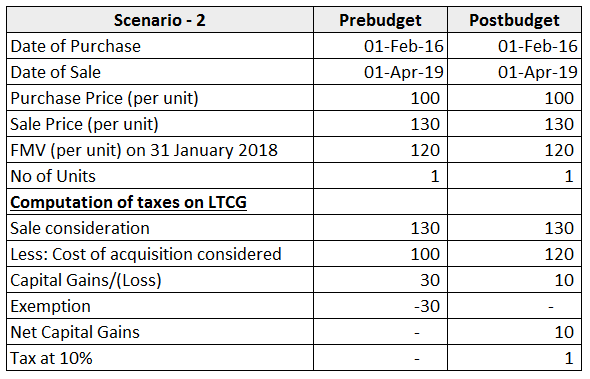
Escape window 2: LTCG on these instruments realised after 31.3.2018 by an individual will remain tax exempt up to Rs 1 lakh per annum i.e. the new LTCG tax of 10% would be levied only on LTCG of an individual exceeding Rs 1 lakh in one fiscal. For example, if your LTCG is Rs 1,30,000 in FY2018-19 from these two instruments then only Rs 30,000 will face the new LTCG tax, she explains. 

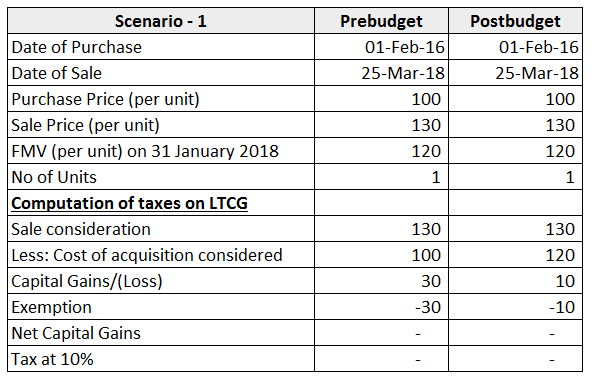
If you sell after 31.3.2018 the LTCG will be taxed as follows: (Also refer to tables at the bottom) 
1. The cost of acquisition of the share or unit bought before Feb 1, 2018, will be the higher of : 
a) the actual cost of acquisition of the asset 
b) The lower of : (i) The fair market value of this asset(highest price of share on stock exchange on 31.1.2018 or when share was last traded. NAV of unit in case of a mutual fund unit) and (ii) The sale value received/accrued when the share/unit is sold.
Let us take an example: If you bought a share for Rs 100 and have held it for more than 12 months (to qualify for LTCG) ; and say the fair market value of the asset on 31.01.2018 is Rs 120 and you sell it for Rs 130 on 1.5.2018 then the cost of acquisition of this share would be Rs 120. You would (for tax purposes) have realised LTCG of Rs 130 minus Rs 120 i.e. Rs 10. 

If you sold the share for Rs 110 on 1.5.2018 then your cost of acquisition would be Rs 110. 

If you sold the share for Rs 90 on 1.5.2018 then your cost of acquisition would be Rs 100. 

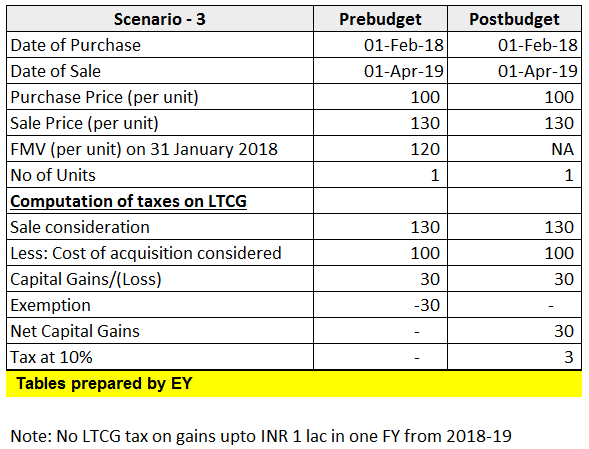
For shares or equity MF units bought after 31.1.2018, capital gain would be computed as = Selling price - actual cost of acquisition (without indexation). 

2. Indexation of the cost of acquisition (determined as per above formula) will not be allowed. Setting off cost of transfer or improvement of the share/unit will also not be allowed. 
3. Therefore, cost of acquisition is determined as per formula explained above, this cost will be subtracted from the sale value and the LTCG will be arrived at. 

4. This LTCG will be taxed at 10% for all listed equity shares where STT is paid on purchase and sale and at 10% for units of equity oriented MFs where STT is paid on the sale of these units . As STT is paid/deducted if you sell your equity MF units back to the MF or on the stock exchange the new LTCG regime would apply to these. 

This means that the LTCG tax regime would be unchanged for unlisted equity shares where STT is not paid on purchase or sale. 

Impact: 
According to Khanna, the impact is not as bad as first glance because of provision which allows the cost of acquisition to be taken as the market value on 31.1.2018 (as per formula above). This is because this provision in a sense indexes the actual cost of acquisition up to this date despite removing the indexation of the actual cost of acquisition, she says. This reduces the amount of capital gains that would face the 10% tax. Essentially for a person selling after 31.3.2018, only the actual gains after 31.1.2018 would be taxed, she adds. However, obviously a 10% tax has been levied on the capital gains calculated as above which was not there earlier. 

LTCG tax calculated as per the new regime proposed in Budget 2018 
1
2
3

By 
Pragati Kapoor


Key Highlights from Budget 2018


8
1
Fiscal Situation
* Fiscal deficit is 3.5% of GDP at Rs 5.95 lakh crore in 2017-18. Projecting fiscal deficit to be 3.3% of GDP in the next fiscal 


* Rs 21.57 lakh crores transferred as net GST to states as against projection of Rs 21.47 lakh crores 
Tax
7
* 85.51 lakh new tax payers filed income tax returns in FY17 
NO PERSONAL INCOME TAX CHANGES PROPOSED IN BUDGET 

* Growth in direct taxes (till Jan 15) is 18.7 % 

* Surcharge of 10 pc on income above Rs 50 lakh but less than Rs 1 cr to be continued next year; ..
15 pc on income above Rs 1 cr to also continue. 

* 100% tax deduction is allowed to co-operative societies 

* Corporate Tax of 25% extended to companies with turnover up to Rs 250 cr in financial year 2016-17 
* Incentives for Senior citizens: Exemptions in income of Rs 10,000 from Banks FD and post offices

* Senior citizens to get Rs 50,000 per annum exemption for medical insurance under Sec 80D

* Rs 7.5 lakh per senior citizen limit for investment in interest-bearing LIC schemes doubled to Rs 15 lakh 

* Standard deduction of Rs 40,000 allowed for transport, medical reimbursement for salaried tax payers 

* Govt to reduce hardships faced in realty deals; no adjustment to be made in case circle rate does not exceed 5 pc of sale consideration 

* Rs 8,000 crore revenue lost due to standard deduction allowed to salaried employees

* Rs 7,000 cr revenue forgone on account of lower corporate tax for Rs 250 cr turnover cos

* Rs 19,000 cr revenue loss on direct tax in last fiscal 
* LONG TERM CAPITAL GAINS EXCEEDING RS 1 L AKH WILL BE TAXED AT 10% WITHOUT INDEXING 

* Short term capital tax remains at 15% 

* A tax on distributed income at 10% 

* Education cess increased to 4 pc from 3 pc to collect additional Rs 11,000 cr 
* GST revenue will be received only for 11 months, that will have an effect on balance sheets 

* GST collections projection pegged at Rs 7.43 lakh crore in full year 2018-19 as against Rs 4.44 lakh crore in nine months of current fiscal. 
* Govt makes PAN mandatory for any entity entering into a financial transaction of Rs 2.5 lakh or more.

Imports and Exports 
* Customs Duty on certain products, such as mobile phones and televisions has been increased, to provide a fillip to ''Make in India' 

* Social welfare surcharge of 10% on imported goods. 

* Central Board of Excise and Customs renamed as Central Board of Indirect Taxes and Customs 
2* The government's emphasis will be on generating higher incomes for farmers, by helping them produce more with lesser cost, and in turn, earn higher income for their produce. 

* Jaitley stressed on the fact that India's agricultural production is at a record high level today. 275 million tonne foodgrains and 300 million tonne fruits and vegetable have been produced in the country. 

* The FM said the government wants farmers to earn 1.5 times the production cost, and the Minimum Selling Price (MSP) for the Kharif Crops has been set at 1.5 times the produce price. Jaitley said the Centre will work with states to ensure that all farmer get a fair price. 

* Agricultural market and infra fund of Rs 2000 crore fund will be set up to strengthen the market connectivity. 

* A sum of Rs 500 cr will be allocated for Operation Green to be launched. It will promote agricultural products. 
* Extend the facility of Kisan credit card to fisheries and for animal husbandry 

* Rs 10,000 crore set aside for Fisheries and Aquaculture Development Fund 

* Rs 10,000 crore set aside for animal husbandry infra fund 
* Propose to launch a restructured bamboo mission with a fund of Rs 1200 crore . "Bamboo is green gold," Jaitley said. 

* Agricultural credit target increased from Rs 8.5 lakh crore to Rs 11 lakh core

* Special scheme to manage crop reduce in Haryana, Punjab and Delhi to reduce pollution 
Rural Economy 
* 8 crore poor women will get new LPG connections. 

* PM Saubhagya Yojana: 4 crore poor people will get power connection. 

* The government will spend Rs 16,000 crore on this scheme.

* Govt plans to construct 2 crore toilets in next fiscal year under Swach Bharat Mission

* Government target house for all by 2022. 51 lakh houses have been constructed affordable
houses in rural and further 50 lakh houses in urban areas. 

* 1 cr houses to be built under Pradhan Mantri Awas Yojana in rural areas 

* National livelihood scheme gets Rs 5,750 crore . 

* In 2018-19, ministries will be able to spend Rs 14.34 lakh crores for creation of livelihood in rural areas. 
* Govt gives Rs 9,975 crore for social security schemes for the next fiscal year. 

Education 
* Govt to increase digital intensity in education. Technology to be the biggest driver in improving quality of education: FM Jaitley 
* Rs. 1 lakh crore allocated to revitalisation and upgradation of education sector. Promoting learning based outcomes and research.

* By 2022, every block with more than 50 per cent ST population will have Ekalvya school at par with Navodaya Vidyalayas 

* Aims to move from black board to digital board schools by 2022. 

* PM reasearch fellows: Govt will identify 1000 Btech students each years and provide them to do PHDs in IIT and IISc, while also teaching undergraduate students once a week at that time. 
HEALTH
5
* Aayushman Bharat programme: 1.5 lakh centres will be set up to provide health facilities closer to home. Rs 1,200 crore to be allocated for this programme 

* Flagship National Healthcare protection scheme, with approximately 50 crore beneficiaries. Up to Rs 5 lakh per family per year for secondary and tertiary care hospitalisation. World's largest government-funded healthcare programme. 
* Universal health coverage will be expanded after seeing the performance of the scheme

* Rs 600 crore allocated for tuberculosis patients, at the rate Rs 500 per month during the course of their treatment. 

* Jaitley announces setting up of one medical college for every three parliamentary constituencies, with 24 New government medical colleges also being envisioned. Government also will work on upgrading hospitals to medical colleges 
Social Security
* PM Jivan Bhma Yojana has benefited 5.22 crore families 

Govt will expand PM Jan Dhan Yojana: Al 16 crore accounts will be included under micro insurance and pension schemes

* 1.26 cr accounts opened under Sukanya Samriddhi Scheme

* Social inclusion schemes for Scheduled Castes - Rs 52,719 crore 

* Social inclusion schemes for Scheduled Tribes Rs 39,139 crore 
MSME 
* Rs 3,794 crore allocated to the MSME sector in the form of capital support and interest subsidy By 2022, every block with more than 50 per cent ST population will have Ekalvya schools at par with Navodaya Vidyalayas 

* Rs 3 lakh crore target has been set for the Mudra Yojana

* Rs 4.6 lakh cr sanctioned under MUDRA Yojana 

* Rs 4.6 lakh cr sanctioned under MUDRA Scheme 

Petroleum/ Diesel Sector 
* Excise on unbranded diesel cut by 2 rupees to 6.33 rupee/ltr 

* Excise on unbranded petrol cut by 2 rupees to 4.48 rupee/ltr 
Employee-centric schemes 
* Govt will contribute 12% of the wages of new employees in EPF in all sectors for next 3 years

* Women contribution to EPF reduced to 8% for first 3 years 
Infrastructure


1
* India needs investment of Rs 50 lakh crore in the infrastructure sector 

* Construction of new tunnel in Sera Pass to promote tourism 

* Out of 100 smart cities 99 cities have been selected, with an outlay of Rs 2.04 lakh crore 

* 10 prominent tourist sites will be made iconic tourist destinations, with an amalgamation of private funding, marketing and branding .
* Bharatmala project: To develop 35,000 KM under phase 1 with an outlay of Rs 5.35 lakh crore 

* Govt to introduce pay-as-you-use system for toll payments

Railways
3
* Railway capex has been pegged at Rs 1.48 lakh crore , up from Rs 1.31 lakh crore last year

* Eliminate unmanned railway crossing

* All stations with footfall of greater than 25,000 will have escalators. 
More stations and trains will progressively be built with WiFi and CCTV camera 

* Govt to eliminate 4267 unmanned rail crossing in broad gauge in 2 years

* Allocates Rs 11,000 crore Mumbai rail network and Rs 17,000 crore for the Bengaluru metro 

* 150 km of additional suburban railway networks to be set up in Bengaluru at the cost of Rs 17,000 cr. 
Aviation
4
* Airport Authority of India (AAI) has 124 airports. Propose to increase the number by at least 5 times 1 billion trips a year, Rs 60 cr has been allocated to kickstart the initiative 

* UDAN Scheme to connect 64 unconnected airports across the country 

Markets 
* Govt to take additional measures to strengthen environment for venture capitalists and angel investors.

* SEBI to consider mandating large corporations to meet 1/4th of their debt needs 

* SEBI to mull asking large cos to meet 25% debt from bond market 
* RBI norms to nudge companies to access bond market for funds 

Technology
* Allocation to Digital India scheme doubled to Rs 3073 cr

* 5 lakh WiFi HotSpots to provide Broadband access to 5 crore rural citizens, at the cost of Rs 10,000 cr.

** Government will take measures to stop cryptocurrency circulation, as it is not considered legal tender 

* Government will explore the usage of Blockchain technology. 
Companies 
* AADHAAR FOR CORPORATES? Govt will evolve a scheme to assign a Unique ID for cos 

* Disinvestment target of Rs 80,000 crore for FY19 

* National Insurance Co, Oriental Insurance Co and United Assurance Co to be merged into one entity and subsequently listed 


* Govt revises divestment target for the current fiscal to Rs 1 lakh crore for FY 18.

Banking
* Recapitalisation will pave the way for public banks to lend an additional Rs 5 lakh crore

Industries 
* Rs 7,148 cr allocated for textile sector 
Miscellaneous 
* Defence outlay raised to Rs 2.82 lakh crore in 2018-19 from Rs 2.67 lakh crore in current year 

* Food subsidy to rise to Rs 1.69 lakh crore in 2018-19 from Rs 1.4 lakh crore in current year.  .. 

Emoluments for President set at Rs 5 lakh, Rs 4 lakh for Vice President, Rs 3.5 lakh for governors 

* Emoluments for Parliamentrians: Law for increase in pay based on index to inflation 

* Govt earmarks Rs 150 cr to commemorate 150 years of birth of Mahatma Gandhi 


Why Finance Minister Always Carries a Briefcase on Budget Day?

Although FM Shanmukham's Budget Box has not been passed on to his successors; the Indian Finance Ministers have followed this colonial footprint and kept the tradition alive by carrying a briefcase on the budget day.

FMbudget
The French Connection
The word Budget is derived from the French word 'Bougette' which means a leather bag, and that's why you'd see every Finance Minister carrying a leather briefcase on the Budget Day. The tradition to carry a bougette started over one and a half century ago, when in 1860, the then Britain's Chancellor of the Exchequer Chief William Ewart Gladstone carried a red suitcase for his bundle of financial papers with the Queen's monogram embossed in gold over it. Gladstone was known for lengthy budget speeches that required a lot of financial documents and papers; and the Queen herself presented this Budget Box to ease his purpose. The Red Gladstone Budget Box was carried with equal pride since 1860 on every Budget Day until 2010 when the Red Gladstone Budget Box was officially retired in the UK, placed into a museum and replaced by a fresh Red Leather Budget Box.

Britain's Colonial Footprint
So as you now know the history of the Budget aka 'Bougette' in the United Kingdom, Britain's colonial footprint led to this Leather Bag's debut in the Independent India when India's first Finance Minister RK Shanmukham Chetty presented India's First Budget on 26th November 1947 and arrived with a leather bag carrying his set of Financial Papers that presented India’s Financial Innings. Apart from India, other British colonies like Uganda, Zimbabwe & Malaysia too follow carrying a briefcase to deliver the budget speech.

Different Strokes
Although FM Shanmukham's Budget Box has not been passed on to his successors; the Indian Finance Ministers have followed this colonial footprint and kept the tradition alive by carrying a briefcase on the budget day. The leather bags and brief cases used have differed in shades in the past, the most interesting being the one carried by President Pranab Mukherjee during the UPA rule when he was the then Finance Minister, he carried a Red Budget Box similar to that of William E Gladstone!

Updated:January 22, 2018, 7:03 PM IST

Government to roll out E-way bill from today: 8 steps

ET Bureau|
Updated: Feb 01, 2018, 12.05 AM IST

E-way-bccl
The E-way bill for moving goods across states is being rolled out from today. In the 14-day trial period starting January 16, the day when nationwide e-way bill registrations for taxpayers began, 28.4 lakh e-way bills have been generated with 3.4 lakh happening only on Tuesday. ET explains the regime and what business needs to do. 
Graph-e
Graph-e1
Graph-e2