Pages

Saturday, June 9, 2018

FINEOTEX CHEMICAL LIMITED :-THE FUTURE GEM OF INDIAN STOCK MARKETS DUE TO ITS INNOVATIVE PRODUCT AQUASTRIKE.

June 08, 2018  12:34 PM | Economy

Expect WHO approval for Aquastrike product soon, says Fineotex Chemical

FCL
We are selling Aquastrike right now to the housekeeping companies in Singapore, said Sanjay Tibrewala, Whole-Time Director and CFO, Fineotex Chemical.
"They service the residential places, clean the water tanks, fishponds, swimming pools and all these things but the major market will be the foundation and the government bodies there and we are expecting the World Health Organization (WHO) approval because all the government companies and the foundations would require WHO approval," he said.
We expect to garner revenue of Rs 400 crore from Aquastrike post WHO nod, added Tibrewala.
The market size of this product is in billions of dollars and it’s a mass consumption product, he added.
He further said that there are two markets for it. One is the government bodies and they are using it in water and second is the foundation; foundations like Bill Gates Foundation, ABB Foundation and they carry out the social responsibilities worldwide.
“The funding from these foundations itself per year is  $2 billion roughly, so that’s number which I can give you,” he said.
We are looking at 15% growth in FY19 and an increased capacity to 26,000 tonne from 22,000 tonne, he said.

MODI GOVT GOES ALL OUT ON SHELL COMPANIES,OVER 1,13,000 ENTITIES UNDER RADAR.

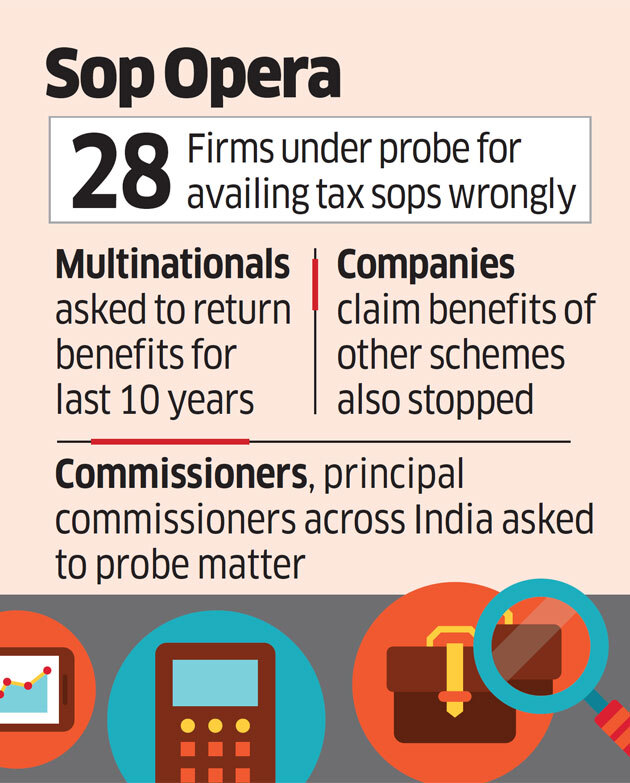
28 companies under lens for wrongly claiming services export sops

By 
Sachin Dave
, ET Bureau|
Updated: Jun 09, 2018, 08.00 AM IST

fraud-agencies


MUMBAI: The Directorate of Revenue Intelligence (DRI) has begun investigations into 28 companies that have wrongly claimed services export benefits, according to the agency, which has issued notices to them. They include a New York Stock Exchange-listed pharma company focussing on livestock and pets that has an R&D centre in India, an IT product company and a few five-star hotels. 

DRI alleges these companies claimed export benefits — mainly tax sops — reserved for Indian firms for Indian firms for promoting domestic brands overseas and they need to return the money. DRI asked officials to initiate the adjudication process in its May 28 notification, of which ET has a copy. 


This means the companies have to either pay up or begin litigation proceedings. The magnitude of the sum involved is unclear. 

The investigations relate to the Service From India Scheme (SFIS) intended to promote a ‘Served from India’ brand for services, like ‘Made in India’ for goods. Under this, exporters were issued ‘duty credit scrips’ equivalent to a certain portion of their forex earnings. They could set off these credits against import duty on capital goods. 
graph
The May 28 notice sent to commissioners across India asks them to investigate whether the companies claimed credit for services that were authorised under the foreign trade policy. 

As per the notice, in some cases, a first set of notices had been issued in December 2017 and April 2018 with a corrigendum in May. 

According to the investigating agency, some MNC subsidiaries were “not promoting an Indian brand, but just extending interests of a foreign brand”, so they weren’t entitled to the benefits. 

There was no response to queries from the firms cited above. 

Duty Credit Scrips were Traded 
In some cases, the government has been denying companies the benefits of a successor scheme — the Service Exports from India Scheme (SEIS), said people with knowledge of the matter. The government replaced SFIS with SEIS in 2015. 

“SFIS and SEIS are two independent export benefit schemes and there is no legal rationale in holding back eligible SEIS benefits to exporters of services for the sole reason that SFIS issues are pending resolution,” said Suresh Nair, partner, EY India. 

Investigators are also checking whether the duty credit scrips were misused, sources said. 

“The problem is not just whether some companies have correctly classified the services which are eligible for the scrips but also what would happen to those companies that have bought these defaulting scrips,” said Abhishek A Rastogi, partner, Khaitan & Co. “In several cases in the past, investigations have revealed that these scrips were often traded and shell companies would buy these only to set off their tax liabilities.” 

According to another person in the know, many Indian companies and brokers were treating these scrips as currency. They would buy them through middlemen and then use them or sell them to other companies. Investigators suspect some of these scrips may have been sold to shell companies that may have taken the benefit of these tax sops when they were not eligible. 


DONALD TRUMP HAS A TRADE PROBLEM WITH INDIA'S VEGETARIAN COW

Say cheese if you want duty-free access, Trump poser to India

By 
Pranab Dhal Samanta
, ET Bureau|
Updated: Jun 09, 2018, 06.23 AM IST

1
The US dairy industry has lobbied hard through a strong representation before the US Trade Representative, asking him to “suspend India’s eligibility for GSP” specifically because it does not provide US dairy products “reasonable and equitable access” to its market. 

India and the US are headed for a major row over Indian religious sentiments attached to the cow, for which US-origin dairy products are banned in the country. The issue is not new, but the Donald Trump Administration is using the ban to review benefits given to Indian products under the US General System of Preferences (GSP) scheme. GSP provides duty-free access to about 3,500 Indian products to US markets.

Trump’s reasons are political. The US dairy industry has lobbied hard through a strong representation before the US Trade Representative (USTR), asking him to “suspend India’s eligibility for GSP” specifically because it does not provide US dairy products “reasonable and equitable access” to its market. The decision to prohibit US dairy products was taken in 2003 by the Vajpayee government.

Initially, India skirted around the main issue by altering labelling standards, pesticide values and other detail but eventually conveyed its true concern, which was religious and cultural. The problem is with animal feed to cows in the US that contains ruminantorigin products and blood, while the cow in India is sacred and strictly vegetarian.

“India continues to require that dairy products be derived from animals which have never consumed any feeds containing internal organs, blood meal, or tissues of ruminant origin. India has explained that its position is based on religious and cultural grounds,” the 2018 US National Trade Estimate Report has said.

To get around the problem, the US proposed a ‘labelling solution’ in 2015, after Prime Minister Narendra Modi assumed office. This entailed labelling a ‘red dot’ sticker to denote ‘non-vegetarian’ for dairy products derived from animal that have consumed feeds with ruminant proteins. India has so far rejected the suggestion on grounds that feeding ruminant proteins, those derived from intestinal organs of animals, to cows deeply hurts and violates Indian religious and cultural sentiments.

After the US got New Delhi to back off at WTO on not allowing US companies to sell frozen chicken in India, the US has decided to challenge it on the ban on dairy products too. On Tuesday, the US Dairy Export Council (USDEC) handed over detailed comments USTR sought on the issue and has even requested to testify at a hearing on India’s nontariff barriers on June 19. 

“India…presents are large and unrealized market opportunity for the US dairy industry. USDEC has estimated that a resolution of this issue could yield additional exports ranging from $30 mn to $100 million…depending on the nature of the resolution and the growth in the Indian market over the next few years,” the council wrote in its June 5 letter to USTR.

The powerful US National Milk Production Federation had joined hands with USDEC to mount a potent lobbying offensive, asking the Trump Administration to stop granting benefits to India until it accepts the labelling solution. In the context of a 14-year ban, the lobby has asked for withdrawal of GSP benefits. “India should not continue to receive unilateral GSP benefits so long as it continues to block US dairy exports,” the letter states.

Washington has through diplomatic channels conveyed to New Delhi that it has been forced to order a review of India’s GSP benefits after repeated representations from the dairy industry. On its part, India has told the US that it would simply have to respect Indian religious and cultural sentiments on the issue. The matters remains unresolved as the USTR has started its review. 

Friday, June 8, 2018

India must take action before it runs dry Failure to manage agricultural and personal water use has led India to the brink of a crisis Last Published: Fri, Jun 08 2018. 04 28 AM IST

Illustration: Jayachandran/MintImage result for PIC OF INDIAN WASTING WATER
Illustration: Jayachandran/Mint
Rudyard Kipling once described Shimla as a “centre of power and pleasure”. The power faded with the Raj. Now, pleasure is at a premium. Shimla is struggling with a water crisis that is an echo of Cape Town’s distress earlier this year. It has run out of municipal drinking water supply during peak tourist season. Citizens are being forced to queue up to collect water from tankers. Schools have been shut down for 10 days. This crisis is a reflection of a wider problem confronting India.
India has adequate freshwater. The problem is inefficient and wasteful use. This has two components. The first is agriculture. According to the Central Water Commission, agriculture consumed about 85.3% of total freshwater in 2000. This is likely to decrease only by a meagre 2% by 2025. Water usage for major crops in India—paddy and maize, for instance—is two to four times that in other large farming nations thanks to wasteful flood irrigation, mostly in northern India. This can be traced to the subsidy regime. The Economic Survey, 2015-16 noted that the present subsidy structure “encourages using more inputs such as fertiliser, water and power, to the detriment of soil quality, health and the environment”. Most states provide electricity either for free or at a flat rate. This inevitably leads to wasteful water extraction.
Both the Economic Survey and a 2015 International Monetary Fund (IMF) study have noted that these subsidies disproportionately benefit rich and large farmers. A number of economists have recommended tapering off electricity and water subsidies. The Aadhaar and financial inclusion drives have laid the foundations for the Centre and states to do just that via targeted direct benefit transfers.
Concurrently, irrigation infrastructure must be upgraded and research and development efforts focused on improving agricultural productivity with lower water usage. There have been some promising developments here. Punjab Agriculture University, for example, has recently come up with a new water-saving variety of rice that matures one to five weeks earlier than other varieties without compromising on the yield. The government is also collaborating with Israel—an established leader in water-management techniques—to promote drip irrigation; Asia’s largest such project took off in Karnataka earlier this year.
The second component is the use of water for personal consumption. About 80% of drinking water needs are sustained by groundwater. Look no further than today’s centre of power to see the problems here. In 2001, India’s groundwater authority banned private water extraction in Delhi due to the looming fear of groundwater depletion. However, the black market persists. Here’s how dire the situation is: According to scientists at the National Geophysical Research Institute, Delhi could dry up in a few years.
It’s worth noting here that water is a state subject and states have kept water-pricing rates stagnant for about three decades now. Pair this with the subsidy burden—the IMF study reckoned that it “amounted to 0.6% of global gross domestic product in 2012”—and authorities are left with little financial means to invest in the water- management practices that would provide sustainable, long-term solutions. These range from the construction of reservoirs to building water treatment and recycling infrastructure.
Putting in place viable water-pricing policies and ending subsidies will be tricky given the political optics. But these are essential changes. Others are needed as well. India has an antiquated legal framework to regulate groundwater. Since it is considered a part of land and gives landowners unrestricted entitlement to it, the government is left with little leeway to act. Legislative change is important.
Policies that nudge public behaviour can also help. The World Bank’s World Development Report 2015: Mind, Behavior And Society (goo.gl/FSPP2i)studied how creative interventions by city officials, such as publishing daily data on Bogota’s water consumption, identifying households that were not cooperating and rewarding those who were in leading newspapers, effectively reduced water consumption. In Hebei, China, authorities started publishing data on temperature, rainfall, soil moisture content and groundwater level. This induced farmers to rely on such irrigation forecasts instead of their own experience in making effective water use decisions. Eateries in Maharashtra, a state struggling with critical water scarcity, have started serving only half a glass of water and replenish it only on request.
Authorities in Cape Town took a gamble last year and announced “Day Zero”—the day when taps would be turned off and people would have to adopt communal water collection. This doomsday notion, despite affecting tourism and creating panic, pushed people to act. Water use per person per day has been reduced to half and “Day Zero” has been averted—for now, at least. Governments at various levels in India must act before more Shimlas make such drastic steps necessary here.
What can be done to promote water conservation in India? Tell us at views@livemint.com

Equity mutual funds qualify for LTCG tax in 1 year, debt funds in 3 years Indexation benefits will apply on debt funds and after indexation, a 20% LTCG tax will apply on the gains Last Published: Thu, Jun 07 2018. 09 16 PM IST

LTCG tax on mutual fund investments differs from one fund type to another—both the definition of the period that qualifies as long term as well as the tax rate that applies. Photo: iStock
I invest in mutual funds every month, but plan to redeem Rs1 lakh every year starting from the fifth year. How will long-term capital gains (LTCG) tax apply?
—Sunil K.P.
LTCG tax differs from one fund type to another—both the definition of the period that qualifies as long term as well as the tax rate that applies. For equity funds, long term is 1 year and for other funds (including debt funds) long term is 3 years. In your case, since you will be withdrawing from the 5th year onwards, assuming the amount you are withdrawing (Rs1 lakh) would materialize from units bought at least 3 years before the date of redemption, all your redemptions will be considered long term. For equity funds, gains accrued until 31 January 2018 will be tax-exempt, and gains after that will be subject to a 10% tax. For debt funds, indexation benefits will apply (the cost of investment will be raised by, roughly, the inflation during the period of holding—this will reduce the gains on which taxes will have to be paid), and after indexation, a 20% tax will apply on the gains.
I am 27 years old and I can invest Rs20,000 a month in mutual funds. My risk appetite is moderately high. My aim is to generate regular returns in 5, 10, 15, 20 and 30 years. Which schemes and fund categories will help me save tax, earn short-term and long-term returns and generate a retirement corpus?
—Chinmay Patil
As a young person with moderately high risk appetite, you have lots of options on the funds you can invest in and your portfolio design. However, given your various time frames, I’d suggest a simple approach. For your time frame of 5 years, which is relatively medium term, you should set aside investments in a separate portfolio, and the remaining amount in another portfolio.
For medium term, you can invest in a pair of equity oriented hybrid funds—HDFC Balanced fund and ICICI Prudential Equity and Debt fund would fit the purpose well.
For your long-term portfolio, you can go with a more aggressive approach of investing in equity funds entirely. Funds such as Mirae Asset India Equity fund, Franklin India Prima Plus fund, and L&T India Value fund will suit this portfolio (these belong to large-cap, diversified, and mid-cap categories, respectively). You can also look at Mint 50 catalogue of funds. How much money you need to place in each of these portfolios should be decided by how much you would need in five years, and what amount of systematic investment plan (SIP) is likely to generate the corpus. For saving tax, invest in equity-linked saving schemes (ELSS) such as Invesco India Tax plan and L&T Tax Advantage fund.
For more queries, go to www.livemint.com/askmintmoney
Srikanth Meenakshi is co-founder and chief operating officer, FundsIndia.com
Queries and views at mintmoney@livemint.com

US celebrity chef Anthony Bourdain dead of suicide at 61 Anthony Bourdain was found dead in a hotel room in France where he had been working on an upcoming episode of his program Parts Unknown, CNN said Last Published: Fri, Jun 08 2018. 05 38 PM IST

The cause of Anthony Bourdain’s death was suicide, CNN said in a statement. Photo: Reuters
Boston: US celebrity chef Anthony Bourdain, host of CNN’s food-and-travel-focused Parts Unknown television series, hanged himself in a French hotel room, CNN said on Friday, in the second high-profile suicide of a US celebrity this week. He was 61.
Bourdain was found dead in a hotel room in Strasbourg, France, where he had been working on an upcoming episode of his program, a CNN representative said in a statement.
Bourdain’s death comes three days after American designer Kate Spade, who built a fashion empire on her signature handbags, was found dead in her New York apartment of suicide on Tuesday.
Suicide rates rose in nearly every US state from 1999 to 2016, according to data from the US Centers for Disease Control and Prevention on Thursday. Nearly 45,000 people committed suicide in 2016, making it one of three leading causes of death in the United States, along with Alzheimer’s disease and drug overdoses.
Bourdain’s profile began to soar in 1999, when the New Yorker magazine published his article Don’t Eat Before Reading This, which he developed into the 2000 book, Kitchen Confidential: Adventures in the Culinary Underbelly.
He went on to host television programs, first on the Food Network and the Travel Channel, before joining CNN in 2013.
“His love of great adventure, new friends, fine food and drink and the remarkable stories of the world made him a unique storyteller,” the network said in a statement on Friday. “His talents never ceased to amaze us and we will miss him very much. Our thoughts and prayers are with his daughter and family at this incredibly difficult time.”

Notice shot off to businesses for less IGST input credit claim PTI|Updated: Jun 08, 2018, 01.44 PM IST

GST.-Thinkstock

Tax authorities have started sending notices to businesses who have claimed less IGST input tax credit while filing sales returns as against the credit claims generated by GST Network (GSTN). 

The effort of this exercise, officials said, is to find out whether the mismatch is on account of genuine errors by the businesses or with a view to evade taxes. 

The notices follow a big data analytics conducted by the revenue department which has prepared a list of dealers and businesses who have claimed less IGST Input tax credit (ITC) in summary returns GSTR-3B than what they have passed on or is reflected in GSTR-2A. 

Such notices have been sent to a number of businesses in Mumbai, Chennai and Bangalore, officials said. 

As per the notice, GST officers have pointed out the discrepancy and has asked taxpayers to claim the input credit or refund in the returns of the subsequent month. 

The analytics was conducted based on data between July to March - the first nine months of GST rollout. 


The GST Council, headed by Union Finance Minister had in March had directed officials to conduct further analysis of the data to zero in on the chain leading to evasions and initiate adequate action thereof. 

EY Partner Abhishek Jain said: "These mismatches could be on account of credits reflecting in GSTR-2A not being eligible (like rent-a-cab, food & beverage, inputs for exempt supplies). However, these e-mails (notices) from the government could also be constructive input for businesses who have inadvertently missed claiming credits (like airline credits, hotel credits)." 


AMRG & Associates Partner Rajat Mohan said lower claim of tax credit could be due to multiple reasons, some of which would be genuine like delay in recording/processing of invoices, incorrect endorsement of GSTIN in GSTR -1 by supplier, among others. 

"Another reason could be non-reporting of procurements which are then supplied in black markets, leading to massive tax evasions.Industries like mobile phones, LCDs, footwear products, expensive bags/apparel/ jewellery may be prone to such modus operandi," Mohan said. 

Importers typically pay integrated goods and services tax or IGST on goods they bring into the country. This tax is supposed to be set off against the actual GST paid by the final consumer, or claimed as refund. 

According to the results of the analysis, importers including bigger companies are paying IGST on imports but not claiming credit for the same. 

This essentially means that the supply of imported goods to domestic channels is being done without a bill, the officials said. 

A similar situation has been witnessed on cess charged on luxury and sin goods with companies paying it at the time of imports but not claiming credit or setting it off from final GST paid by consumers. 

Deloitte India Partner M S Mani said:"There could be several legitimate reasons for the differences noticed, which would have to be evaluated carefully before proceeding further. 

"There can also be inadvertent errors on the supplier side, which are beyond the control of the buyer. All of these should be considered by the tax authorities". 


Thursday, June 7, 2018

What is presumptive taxation scheme Presumptive taxation scheme can be used by businesses having a total turnover of less than Rs2 crore and eligible professionals with gross receipts of less than Rs50 lakh in a financial year Last Published: Thu, Jun 07 2018. 01 35 PM IST

Photo: iStock
Presumptive taxation scheme (PTS) allows you to calculate your tax on an estimated income or profit.
The scheme can be used by businesses having a total turnover of less than Rs2 crore and eligible professionals with gross receipts of less than Rs50 lakh in a financial year. Those who adopt PTS to file their returns are not required to maintain books of accounts.
Under PTS, the eligible businesses can estimate their net income at the rate of 6% of the total turnover, if gross receipts are received through digital mode of payments or at the rate of 8% in case of cash receipts. However, the assessee is allowed to willingly declare income at a higher rate than the minimum of 6-8% of the total turnover.
Professionals who are governed or regulated by an institute or body such as doctors, lawyers, architects, interior designers and others can adopt PTS. For them, 50% of the total receipts during the fiscal will be considered as profit and get taxed accordingly. A professional can voluntarily declare the income at a higher rate than mandatory 50% of the total receipts.

Are you borrowing beyond your repayment capacity? Here's what you should do Reckless and impulsive borrowing can lead people into debt trap which they might find difficult to extricate themselves from.


That expensive watch costs more than the money you have but you don't hesitate to take out your credit card and pay for it. Is that piece of jewellery so tempting that you are considering buying it on credit? Borrowing is easy today. It can be through quick loans from lending institutions or through your credit card. However, reckless and impulsive borrowing can lead people into debt trap which they might find difficult to extricate themselves from.
Personal finance advisors say borrowing should be selective and resorted to in situations which are absolutely necessary. “Reckless borrowing leads to borrower working for the bank/financial institution/lender. They do not work for themselves. Progressively, all income goes into repaying the loan or debt servicing. Unless income grows substantially, they start selling off assets and investments to barely make ends meet. The last stage is virtual bankruptcy when there are no assets to pledge left or to sell,” says Anil Rego, Founder and CEO, Right Horizons.
But how does one check the impulse to borrow recklessly? Adhil Shetty, CEO, Bankbazaar, sets out a four-point checklist to curb the borrowing instinct.
-Budget: The first step to ensure that you do not fall into a debt trap is to make a budget and stick to it. Take stock of how much money you have by calculating the amount left in your account after deduction for EMIs and other utility bills. Since a lot of shopping happens via credit cards, plan your credit card expenditure too based on how much credit card debt you can manage in future. Once you have zeroed in on an amount that you can spare for your expenses, stick to that budget.
--Plan: The next important thing that goes hand in hand with saving is planning. Make an exhaustive list of everything you would like to spend on. Once you are done with the shopping list, start purchasing only the items mentioned in the list and refrain from impulsive buying. If you stick to your shopping list, the chances of overshooting your shopping budget will be smaller. Also, keep your eyes open for all the deals, discounts and offers on items on your shopping list. This will help you get the best deals, and even small savings add up in the long run.
--Restrict: Don’t borrow more than what you can afford to pay back. With credit in the form of personal loans and credit cards being available more easily, it is easy to get carried away and borrow more than your repayment capacity. Loans are not a source of free money. Do not have multiple loans simultaneously or take new loans to close old ones. Make sure your debt is in control by making sure your loan EMI does not exceed 35-40% of your monthly income.
--Track: Remember the due date. Lenders charge a huge interest rate on defaults. So make sure you make your payments before the due dates to avoid penalties. These penalties along with the interest charged are a sure-fire way of hitting a debt trap.
Anil Rego advises putting a definite limit on spending. “One should avoid excessive spending that ultimately leads to over-borrowing. Firstly, limit spending to 50% of income. Second, borrow only 50% of your total assets. Three, avoid people, situation, and places where you have the tendency to over-spend. Four, take the majority opinion of 2-3 family members or childhood friends before you take any loan,” he says.
Nirmal Rewaria, CEO & Co-founder, My Finpeace, suggests resisting peer pressure and keeping one’s own aspirations realistic. “Avoid using plastic money which has been pushed in your wallet. Use only debit cards. Credit cards should only be used only in emergencies. Before buying making it a habit to analyze whether you need the thing or it is a push sell or emotional push,” he said.
First Published on Jun 7, 2018 10:56 am moneycontrol Sarbajeet Sen

Impact of GST on credit card charges, mutual fund exit loads Govt FAQs explain impact of GST on charges levied by mutual funds for early exit and by credit cards for late payment of dues Last Published: Thu, Jun 07 2018. 09 53 AM IST

Graphic: Jayachandran/Mint
If you were stumped to read that you will now be paying goods and services tax (GST) on your mutual fund exit load, you are not alone. The frequently asked questions (FAQs) issued by the Central Board of Indirect Taxes and Customs (CBIC) reveals the impact of GST on some financial services.
The FAQs explain tax implication on various charges, penalty and fees such as “exit loads” charged by mutual fund companies at the time of redemption, additional interest charged for default in payment of loan instalments and charges for late payment of dues on credit card outstanding. Here is how GST will impact your investments and financial transactions.
Impact on mutual fund investors
In case of mutual funds, expenses incurred by asset management companies (AMCs) are factored in the net asset value (NAV) of the scheme on a daily basis. However, exit loads are not included in the total expense ratio (TER) and charged at the time of redemption based on the scheme you have invested in and the tenure of your investment.
Typically, exit loads are nil or charged at a nominal rate in case of debt-oriented mutual fund schemes, if the redemption is made within a short period, say, 7 to 30 days from the date of purchase. However, in case of equity-based schemes, fund houses typically charge exit load of 1% of the NAV if the investor redeems from schemes within 365 days from the date of allotment.
In the recent FAQ, it has been clarified that the exit load will attract GST. However, “the load will not increase for the investor as GST is included in the existing load levy. The scheme on the other hand will lose out as the exit load amount credited back to the scheme will be net of 18% GST,” said a chief operating officer of a medium sized fund house,who is not an official spokesperson for the fund house.
He said the fund houses made a representation to the GST authorities and the service tax authority about this. In that they requested the tax to be withdrawn, and clarified that this is not a service provided to the investor, it is in fact, a levy to deter investors from exiting too soon. Their request hasn’t been accepted and thus fund houses are going to pay GST on exit load, but the tax will be included in the load itself.
All fund houses do not have clarity on this yet. Another fund house that Mint contacted was unclear about this issue and its treatment.
Impact on credit card holders
The FAQs clarified that additional interest charged for default in payment of instalment of a loan and charges for late payment of dues on credit card outstanding be chargeable to GST. “Credit card outstanding may comprise retail spends, EMIs and/or fees and charges pertaining to the use of credit card. However, GST is not applicable to the entire outstanding on credit cards. It is applicable only to fees and charges levied on credit cards. For example, components like interest charges, late payment fee or annual fee attract GST as per regulatory norms. Currently, the GST rate applicable is 18%,” said Pralay Mondal, senior group president – retail and business banking, Yes Bank Ltd.
While the new FAQs have brought clarity with regard to the implication of GST in the financial sector, many people continue to be puzzled how exit loads or fee on a default of loan payment can be considered “services” and attract GST.
Lisa Pallavi Barbora and Shaikh Zoaib Saleem contributed to the story

'Walmart will dump all the kachra (Garbage) in India'

June 07, 2018 09:00 IST

'Walmart will source globally and more from China and will dump these cheap goods in India, making our country a dumping yard.'
'Sadly, since Independence, the retail trade has not been a priority for any government although we have an annual turnover of around Rs 40 lakh crores and we contribute around 45% to the GDP,' says Praveen Khandelwal, secretary general, Confederation of All India Traders. Photograph: Reuters
While young entrepreneurs look upon Walmart buying a 77% stake in Flipkart for $16 billion as inspirational, those working in the retail business in India look at the deal with fear -- the fear of being made extinct by the huge wave that is coming in the form the world's largest retailer.
"All of us know that Walmart is not entering the Indian market to do charity. It is coming to make profits and, looking at the track record of Walmart, it can go to any extent to achieve the goal," Praveen Khandelwal, secretary general, Confederation of All India Traders, tells Rediff.com/Shobha Warrier


Why is the Confederation of All India Traders unhappy with the Walmart-Flipkart deal?
The main reason is the deal seems a little dicey.
The real intent behind the deal is to try to enter India's retail trade through the e-commerce channel, and capture and then monopolise it.
What gives you the impression that Walmart is trying to capture India's retail market through e-commerce?
E-commerce is not the core competence of Walmart. It's an offline retailer company.
So, an offline retailer entering the retail market gives rise to suspicion in the minds as to why it is entering through e-commerce.
How do you think it will enter the offline market through the online business?
Walmart is big enough to source its inventory from across the globe wherever it is available at a cheaper price.
So, what Walmart will do is, it will source globally and dump all the kachra in India at a relatively lower price by indulging in deep discounting and low funding.
The ultimate goal is to wipe out competition.
You mean, in e-commerce?
No. When you sell at a very lower price online, people would prefer to buy online rather than from an offline retailer.
Naturally the impact of online business will be on the offline retailer.
So, competition will be wiped out not only in e-commerce, but even in offline retail as well.
You also said the Walmart-Flipkart deal is dicey. Why do you get the feeling that it is dicey?
Number one, Walmart is not an online retail company.
Secondly, the stake of 77% means it has virtually taken over the company.
Once Walmart takes over the company, it will be dictating its terms.
All of us know that Walmart is not entering the Indian market to do charity. It is coming to make profits and, looking at the track record of Walmart, it can go to any extent to achieve the goal.
And this will have its ramifications on the state of the Indian economy as well.
What kind of impact will it have on the economy?
There will be destabilisation in the retail market and power will be controlled by these MNCs.
I am sure after Walmart, Amazon and Alibaba also will follow the same path.
So, Indian retail will be controlled by them which will go against the fundamentals of the Indian economy.
FDI in retail is not allowed in India...
Absolutely. That is why they want to enter retail through the backdoor. That is the reason we see this deal as dicey and that's why it needs complete interrogation.
The Indian offline market is very fertile and versatile and that's why Walmart has been too eager to enter the offline retail market of the country.
Through e-commerce, it will be able to fulfil its long-pending wish.
In India, only 40% of the population has access to the Internet, and millions still buy offline. But you still feel that the Indian retail market will be affected by the deal.
Yes. You will agree with me that people in India are cost-conscious.
So, when goods are made available at a relatively cheaper price, the offline consumer will become an online consumer.
Or, Walmart will redefine its strategy to take online goods and sell them offline through its associates or affiliates.
Nobody can stop them from selling through such route.
Won't be they purchasing from Indian companies?
Today, Indian goods are not competent in the market. Indian producers cannot compete with, for example, cheap Chinese goods.
You need to understand that funding in the US and Europe ranges from 1.5% to 2.5% interest while in our country, the interest rate for a dealer ranges from 11% to 12% to 20% which is a huge gap of 10% at least.
This itself is enough to kill the competition.
Then, Walmart will source globally and more from China and will dump these cheap goods in India, making our country a dumping yard. And it will adversely affect the small manufacturers of the country.
Can the small traders of India stop this deal between two private parties from materialising?
First of all, the Government of India should frame a policy for e-commerce and the retail trade.
Then, there has to be a retail regulator to monitor and regulate the retail trade.
If these two things happen, Walmart will not be in a position to dictate terms and conditions.
Probably we may have a level playing field.
Today, our retailer is not able to compete with Walmart because of limited resources.
Do you expect the government to do anything?
We want the government to interrogate the deal on all aspects, particularly the questions raised by us. Then, there has to be consultation with small retailers.
Approval should be given only after an e-commerce policy and a retail regulatory in place.
Traders in India are big supporters of the BJP. If something like this happens, will you withdraw support in the 2019 elections?
It is too premature to answer the question. But if things happen the way it is happening, it may have its impact.
What is needed is the government should have consultation with retailers.
It should support retailers in modernising and upgrading the existing retail trade.
All the most important modern tools should be available to our retailers too.
There has to be upgradation in consultation with trade organisations.
Without the support of the government, we cannot bring Indian retailers to a certain level. After that, you open the market for anybody, we are ready to compete with them.
I am hopeful that better sense prevails upon the government. vIf not, we are ready to fight this battle up to the highest court.
Many say the Indian retail market is booming and creating a lot of jobs... 
I am sorry to say I reject this expert opinion. These experts never visit the market. They sit in air-conditioned rooms and make such expert comments.
The ground reality is different and they are far away from reality.
The fact is, the Indian retail market is suffering to a large extent.
You mean, due to demonetisation and GST implementation?
Not due to demonetisation and GST, there are many other factors.
For example, infrastructure. Power is not available in many places.
Internet connectivity is not there in some other places.
There are no roads in several places.
Our markets are in a shabby condition. There are cumulative problems. These problems have to be addressed first by the government.
Sadly, since Independence, the retail trade has not been a priority for any government although we have an annual turnover of around Rs 40 lakh crores and we contribute around 45% to the GDP. Yet no government has given priority to the retail trade.
This is the only sector in the economy which doesn't have a policy or a ministry. That itself shows how badly the retail trade has been treated.
Shobha Warrier / Rediff.com

America may soon face its biggest labor strike in decades by Chris Isidore @CNNMoney June 6, 2018: 8:20 AM ET

The Teamsters and UPS could be heading toward the nation's largest strike in decades.

On Tuesday, the union announced that members voted more than 90% in favor of going on strike, if a deal is not reached before the current labor contract expires on August 1.
UPS employs 260,000 Teamsters, and has added 40,000 union members since its current contract was reached five years ago. The shipments UPS transports equal an estimated 6% of the nation's GDP, which means a labor dispute could disrupt the US economy.
At issue is how the shipping giant will expand to offer deliveries seven days a week.
UPS (UPS) began offering regular Saturday delivery service just a year ago. It hasn't officially announced plans for Sunday service, but the union says the company has made several proposals to expand weekend deliveries.
One proposal on the negotiating table is to create a two-tier wage system that would take part-time workers who earn $15 an hour and make them full-time at the same wage. Existing full-time drivers now earn an average of $36 an hour, or roughly $75,000 a year.
The Teamsters are divided on this proposal, which makes it harder to reach a deal and avoid a strike.
An opposition group within the union, UPS Teamsters United, argues that the delivery company, which posted a $5 billion profit in 2017, should pay new full time workers the same as existing workers.
"Most people understand in the world of Amazon (AMZN) and e-commerce, UPS isn't going to be Monday to Friday or even Monday to Saturday any more, it's going to be a seven-day operation," said David Levin, spokesman for UPS Teamsters United. "But they made record profits. They don't need concessions to do that."
A union spokesperson declined to comment on the negotiations.
Meanwhile, labor and management still have plenty of time to reach a new deal before the existing one runs out.
"The reality is that UPS and the Teamsters have already reached tentative agreements on a wide variety of non-economic issues," said UPS spokesperson Glenn Zaccara.
Strike authorization votes almost always pass. Typically union members remain on the job until a new labor deal is reached. But the split within the union means if there is an agreement reached to allow a lower pay scale, rank-and-file members might reject the proposal, increasing the chance of a strike.
The last time UPS had a strike was a 16-day walkout by the Teamsters in 1997, and there hasn't been a bigger strike since then. This strike could be even larger, since there were only 180,000 Teamsters at UPS at that time.