Pages

Saturday, April 13, 2019

Amritsar: Theresa May describes 1919 massacre as 'shameful scar'


  • ebook
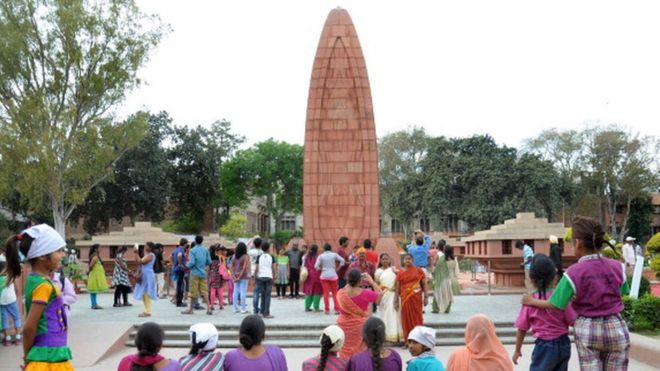
Indian visitors gather near the Jallianwala Bagh Martyrs' Memorial in AmritsarImage copyrightGETTY IMAGES
Image captionHundreds died at Jallianwala Bagh park, which is now home to a memorial
UK Prime Minister Theresa May has described the 1919 Amritsar massacre as a "shameful scar" on Britain's history in India.
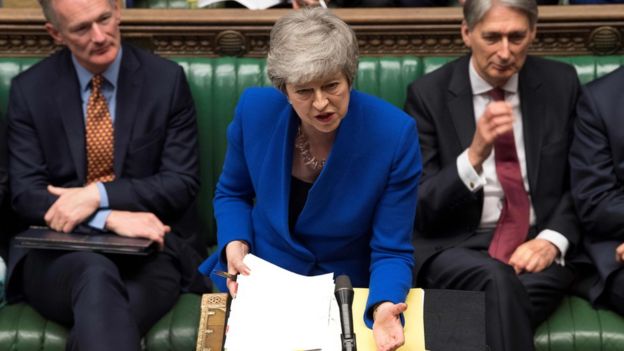
Speaking in Britain's parliament, Mrs May reiterated the "regret" expressed by previous prime ministers.Her statement, however, fell short of a formal apology that some people have called for.
Hundreds of people were shot dead during the massacre - the 100th anniversary is on Saturday."We deeply regret what happened and the suffering caused," Mrs May told MPs."The tragedy of Jallianwala Bagh of 1919 is a shameful scar on British Indian history."
Opposition leader Jeremy Corbyn said "a full, clear and unequivocal apology" was needed.
Britain's Prime Minister Theresa May speaking during the weekly Prime Minister's QuestionsImage copyrightGETTY IMAGES
Image captionPrime Minister May expressed "regret" for the massacre, but fell short of a formal apology
Troops opened fire on thousands of people who had gathered at the Jallianwala Bagh public gardens in Amritsar. Some were Indian nationalists protesting against heavy war taxes and the forced conscription of Indian soldiers.
Others were celebrating the city's Sikh Baisakhi festival and found themselves mixed up with the demonstrators.
British colonial authorities had earlier declared martial law in the city and banned public meetings due to a rise in public demonstrations.
Brigadier General Reginald Dyer was sent to disperse the crowds at Jallianwala Bagh.
Without warning, Gen Dyer blocked the exits and ordered his troops to fire on the crowd. They stopped firing 10 minutes later when their ammunition ran out.
The death toll is disputed - an inquiry set up by the colonial authorities put the figure at 379 but Indian sources put it nearer to 1,000.
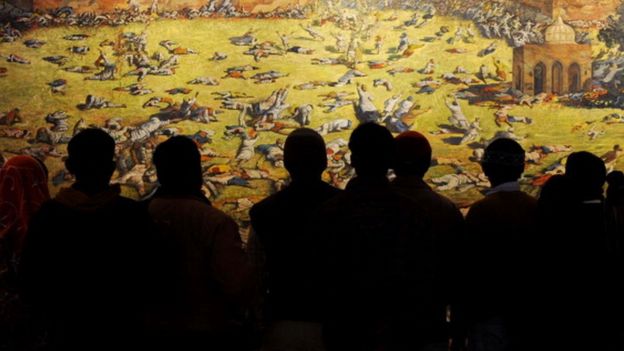
Indian visitors look at a painting depicting the Amritsar Massacre at Jallianwala Bagh in AmritsarImage copyrightGETTY IMAGES
Image captionThe killings are portrayed in a painting at Jallianwala Bagh Martyrs' Memorial
The killings were condemned by the British at the time - War Secretary Winston Churchill described them as "monstrous" in 1920.
In 2013, David Cameron became the first serving UK prime minister to pay his respects at Jallianwala Bagh public gardens.
He later defended his decision not to offer an apology, saying the British government had "rightly condemned" the massacre at the time.
"I don't think the right thing is to reach back into history and to seek out things that we should apologise for. I think the right thing to do is to acknowledge what happened, to recall what happened, to show respect and understanding for what happened," he said.

UK's Labour Party Wants "Unequivocal Apology" For Jallianwala Bagh Jallianwala Bagh Massacre 100th Anniversary: In a statement, marking the 100th anniversary of the Jallianwala Bagh massacre, at the start of her weekly Prime Minister's Questions in the House of Commons, she reiterated the "regret" already expressed by the British Government. All India | Press Trust of India | Updated: April 13, 2019 02:24 IST


UK's Labour Party Wants 'Unequivocal Apology' For Jallianwala Bagh
Labour Party leader Jeremy Corbyn demanded a "full, clear and unequivocal apology for what took place"

LONDON: 
Theresa May on Wednesday described the Jallianwala Bagh massacre in Amritsar as a "shameful scar" on British Indian history but stopped short of a formal apology sought by a cross-section of Parliament in previous debates.
In a statement, marking the 100th anniversary of the massacre, at the start of her weekly Prime Minister's Questions in the House of Commons, she reiterated the "regret" already expressed by the British Government.
The massacre took place in Jallianwala Bagh in Amritsar on Baisakhi in April 1919 when the British Indian Army troops, under the command of Colonel Reginald Dyer, fired machine guns at a crowd of people holding a pro-independence demonstration.
According to the British government records, 379 people, including men, women and children were killed and around 1200 injured in the firing.
"The tragedy of Jallianwala Bagh of 1919 is a shameful scar on British Indian history. As Her Majesty the Queen (Elizabeth II) said before visiting Jallianwala Bagh in 1997, it is a distressing example of our past history with India," she said in her statement.
"We deeply regret what happened and the suffering caused. I am pleased that today the UK-India relationship is one of collaboration, partnership, prosperity and security. Indian diaspora make an enormous contribution to British society and I am sure the whole House wishes to see the UK's relationship with India continue to flourish," she said.
In response, Opposition Labour Party Leader Jeremy Corbyn demanded that those who lost their lives in the massacre deserve a "full, clear and unequivocal apology for what took place".
May's statement comes a day after British lawmakers at Westminster Hall of the Parliament complex debated the issue of a formal apology for the April 13, 1919 massacre to mark its centenary this Saturday.
Foreign Office Minister Mark Field had told lawmakers that he had been "compelled" by the arguments to raise the issue of going further than the "deepest regret" expressed over the killings during the British Raj.
"I feel that we perhaps need to go further... I have now been persuaded - not just by this debate - to take a different approach," the minister said, adding that the government had to also consider the "financial implications" of any apology for events of the past.
"These issues are an important way of trying to draw a line under the past. Therefore, this is work in progress and I cannot make any promises," he said, holding out some hope of a formal apology over the incident.
The debate was tabled by Conservative Party lawmaker Bob Blackman, who opened proceedings with a strong sentiment of "shame" as he called on the British government to apologise.
"General Dyer was vigorously defended by - I say this with shame - the Conservative party, as well as most of the military establishment. He evaded any penalties post inquiry, as his military superiors advised that they could find no fault with his actions, his orders, or his conduct otherwise," Blackman said, in reference to the British general who had ordered the shooting at a Baisakhi gathering in Amritsar 100 years ago.
"As we approach the 100th anniversary of the Jallianwala Bagh massacre in Amritsar on 13 April 1919, it is clear that there needs to be a formal apology from the United Kingdom government that accepts and acknowledges their part in the massacre," said Indian-origin Labour lawmaker Preet Kaur Gill.
"This is the right time for the (British) Prime Minister to publicly apologise," added fellow Labour lawmaker Virendra Sharma.
In wrapping up the outcomes of the debate, Blackman concluded that children in British schools should be taught about the tragedy because people should know what happened in Britain's name and that "saying sorry - apologising for this massacre - is the right thing to do".
The pressure on the Cabinet minister mounted further on Wednesday as he received a letter signed by 80 lawmakers stressing that he must consider their call for an "apology anew".
"Relations between the UK and India today are friendly and constructive. Yet that does not mean an apology would not be good," notes the letter, initiated by Labour lawmaker Pat McFadden.
During a previous debate in the House of Lords earlier in the year, it was confirmed that UK foreign secretary Jeremy Hunt was "reflecting" on demands for a formal apology to mark the centenary of the Jallianwala Bagh massacre this week.

Following Theresa May's latest statement on the issue in the Commons, it remains to be seen if the UK government will follow up with any further statements in the lead up to the 100th anniversary on Saturday.
WE INDIANS AND PAKISTANIS (incluing BANGLADESHI) MUST NOT FORGET APRIL 13 1919 JALLIANWALA BAGH MASSACRE BY BRITISH OFFICERS.

Image result for jallianwala bagh history

Image result for PIC OF REGINALD DYER

The Jallianwala Bagh massacre, also known as the Amritsar massacre, took place on 13 April 1919 when troops of the British Indian Army under the command of Colonel Reginald Dyer fired rifles into a crowd of Indians, who had gathered in Jallianwala BaghAmritsarPunjab. The civilians had assembled for a peaceful protest to condemn the arrest and deportation of two national leaders, Satya Pal and Saifuddin Kitchlew. Raja Ram has argued however, that the Proclamation was ineffective, the crowd formed in deliberate defiance and the event signals a beginning of Indian nationalism.
The Jallianwalla Bagh is a public garden of 6 to 7 acres (2.8 ha), walled on all sides, with five entrances.
On Sunday, 13 April 1919, Dyer was convinced of a major insurrection and he banned all meetings; however this notice was not widely disseminated. That was the day of Baisakhi, the main Sikh festival, and many villagers had gathered in the Bagh. On hearing that a meeting had assembled at Jallianwala Bagh, Dyer went with Sikh, Gurkha, Baluchi, Rajput troops from 2-9th Gurkhas, the 54th Sikhs and the 59th Sind Rifles they entered the garden, blocking the main entrance after them, took up position on a raised bank, and on Dyer's orders fired on the crowd for about ten minutes, directing their bullets largely towards the few open gates through which people were trying to flee, until the ammunition supply was almost exhausted. The following day Dyer stated in a Report to the General Officer Commanding that “I hear that between 200 and 300 of the crowd were killed. My party fired 1,650 rounds.”,a number apparently derived by counting empty cartridge cases picked up by the troops. The Hunter Commission report on the incident, published the following year by the Government of India, criticised both Dyer, and the Government of the Punjab for failing to compile a casualty count, so quoted a figure offered by the Sewa Samati (A Social Services Society) of 379 identified dead,with approximately 1,100 wounded, of which 192 were seriously injured. The casualty number estimated by the Indian National Congress was more than 1,500 injured, with approximately 1,000 dead. This "brutality stunned the entire nation", resulting in a "wrenching loss of faith" of the general public in the intentions of the UK.The ineffective inquiry and the initial accolades for Dyer by the House of Lords fuelled widespread anger, later leading to the Non-cooperation Movement of 1920–22.
Dyer was initially lauded by conservative forces in the empire, but in July 1920 he was censured and forced to retire by the House of Commons. He became a celebrated hero in the UK among most of the people connected to the British Raj, for example, the House of Lords, but unpopular in the House of Commons, which voted against Dyer as a Colonel. He was disciplined by being removed from his appointment, was passed over for promotion and was prohibited from further employment in India. Upon his death, Rudyard Kipling declared that Dyer "did his duty as he saw it".. This incident shocked Rabindranath Tagore (first Asian Nobel laureate) to such extent that he stated whilst refusing his knighthood that "such mass murderers aren't worthy of giving any title to anyone". The massacre some historians have argued caused a re-evaluation of the army's role, in which the new policy became minimum force; however, later British actions during the Mau Mau insurgencies have led Huw Bennett to question this school of thought. The army was retrained and developed less violent tactics for crowd control.Some historians consider the episode a decisive step towards the end of British rule in India.

Friday, April 12, 2019

Russian award for PM Narendra Modi The Order of St Andrew the Apostle is the highest state decoration of Russia, the official said. PTI|Apr 12, 2019, 03.22 PM IST

 PM Modi Conferred Russia’s Highest Award  For Exceptional Work In Promoting Indo-Russian Ties

NEW DELHI: Prime Minister Narendra Modi was on Thursday named for the 'Order of St Andrew the Apostle' award by Russia for exceptional services in promoting bilateral ties between the two countries, a Russian embassy official said. 


The Order of St Andrew the Apostle is the highest state decoration of Russia, the official said. 


Modi has been conferred with the award for exceptional services in promoting special and privileged strategic partnership between Russia and India, the the official said. 


Pentagon defends India's ASAT test, says country is concerned over "threats" in space The test made India the fourth country in the world after the US, Russia, and China to have ASAT capabilities.


WASHINGTON: India is concerned about the "threats" it faces in space, the Pentagon has said, defending the country for acquiring anti-satellite (ASAT) missile test capabilities. 
pentagon-AP

On March 27, India achieved a historic feat by shooting down its own low-orbit satellite with a ground-to-space missile, making the country a space power. 

The test made India the fourth country in the world after the US, Russia and China to have the ASAT capabilities. 

"The first lesson from the Indian ASAT is just the simple question of why did they do that. And the answer should be, I think to all the committee looking at it, is that they did that because they are concerned about threats to their nation from space," US Strategic Command Commander General John E Hyten told members of the powerful Senate Armed Services Committee on Thursday. 


"And therefore, they feel they have to have a capability to defend themselves in space," Hyten told Senate Armed Services Committee while responding to a question from Senators on the need for India to do anti-satellite missile test, and the debris it generated in the space. 

After India's test, NASA termed as a "terrible thing" the country's shooting down of one of its satellites, saying it created about 400 pieces of orbital debris, endangering the the International Space Station (ISS). 


NASA Administrator Jim Bridenstine had said about 60 pieces were tracked and out of which 24 are going above the apogee of the ISS. 

Hyten advocated for the development of some kind of international norms of behaviour in space. 

"And where those norms of behaviour should begin, from my opinion, is with debris, because as the combatant commander responsible for space today, I don't want more debris," said the top Pentagon commander. 

Raising the issue, Senator Tim Kaine said India announced last month that it had successfully conducted a test of an anti-satellite weapon. 

"So, they had something in low earth orbit. They used an anti-satellite weapon to down, and it resulted in - the estimate's right now 400 pieces of debris, 24 which are large enough to potentially pose a threat to the International Space Station," he said. 

"There have been other instances like this. There was a Chinese - a similar effort in 2007 that led to the catalogued 100,000 pieces of debris, many of which are still observing in debris fields that pose danger to other assets in space," he said. 

There was a collision in '09 between a working US satellite and a sort of defunct Soviet era satellite that -kind of a fender bender that produced debris. Then this debris causes challenges, he added. 

"If we think that space is going to be more of a traffic jam, more satellites for all kinds of purposes up there, what should we be thinking about as a Senate in this committee or in Foreign Relations about sort of the rules?" he asked. 

"What should the rules environment be, and what should we be doing to try to promote rules? India is an ally. We're not talking about an adversary doing something. We're talking about them testing some capacity, but then that creates challenges for all kinds of uses of space. How should we be solving problems like that?" Kaine asked. 


Source the Economic Times

Wednesday, April 10, 2019

Congratulations Mr.Benjamin Netanyahu Mazel tov מזל טוב

Image may contain: 1 person, smiling, text

HFCL:-SO FINALLY MR.SHANKAR SHARMA PAYS OFF BALANCE MONEY AND GETS 52,08,333 EQUITY SHARES ALLOTTED

Image result for PIC OF HFCL GROUP
GOOD NEWS FOR THE RETAIL INVESTORS OF THE COMPANY

FINALLY MR.SHANKAR SHARMA PAY OFF BALANCE MONEY AND WAS ALLOTTED  5208333 NUMBERS OF EQUITY SHARES OF HFCL BY CONVERSION OF 1,00,00,000 SHARE WARRANTS VIDE COMPANY BOARD/COMMITTEE MEETING HELD ON APRIL 9 2019.

THANK YOU MR.SHANKAR SHARMA 
Image result for PIC OF MR SHANKAR SHARMA
AND I HOPE YOU HOLDING NOW 0.41 % OF EQUITY IN THE COMPANY AND WITH YOUR RIGHT GUIDANCE TO THE MANAGEMENT COUPLED WITH START OF NEW TELANGANA PLANT FOR MANUFACTURE OF OPTIC FIBRE AND WITH MORE THAN RS.12000 CRORES ORDERS IN HAND THE SHARE PRICE MAY START ITS UPWARD JOURNEY SOON FOR THE BENEFIT OF ALL THE INVESTORS OF THE COMPANY


Tuesday, April 9, 2019

All payments within India allowed from NRO account 1 min read . Updated: 09 Apr 2019, 07:15 AM IST livemint


 (iStock)
I am an 83-year-old widow. Can my son, who became a non-resident Indian (NRI) recently, transfer money from his non resident (ordinary) or NRO account to my resident account? Are there any tax restrictions or implications?
—Bimla Kumari
Under the exchange control law, all payments within India in Indian rupees are allowed from an NRO account. There is no limit on such transfer of funds. Accordingly, your son may transfer funds from his NRO account to your resident account.
There are no tax implications on transfer of funds from your son’s NRO account to your resident account. Gifts received by mother from son are exempt from tax. However, note that any income earned from such funds in your bank account (such as interest income) will be taxable in your hands. Deduction under Section 80TTB may be available on interest income up to50,000.
I am an NRI living in Canada. My niece is getting married. What is the tax implication if I gift something like cash or gold to a relative who is a resident Indian?
—Karan Verma
Tax is levied on any sum of money, moveable or immoveable property (specified property) received in excess of 50,000 by an individual without consideration or for inadequate consideration, except gifts received from a relative or on marriage or by way of inheritance or other specified exclusions.
The term “relative" includes brother or sister, brother or sister of the spouse, brother or sister of either of the parents, any lineal ascendant or descendant, any lineal ascendant or descendant of the spouse, spouse of any of the persons referred above and spouse of the individual. The above definition of “relative" needs to be seen from the perspective of the recipient. Thus, if the niece is receiving any specified property from the brother or sister of either of the parents, there will be no tax implications in India. In any case, there will be no Indian tax implication in the hands of your niece if receipt of gifts (either cash or gold) is on the occasion of marriage. However, document the gift to enable you or your niece to respond to any inquiries from the tax authorities. You may also be required to share your creditworthiness and source of funds for making the gift in case of inquiries.