Pages

Sunday, August 9, 2020

Gurugram: Call centre dupes 30,000 Americans in three weeks by posting malware links :-ET

Synopsis

The Sohna Road call centre underscores the law and order challenge cyber police still face in the national capital region, which has been on the radar of international law enforcement agencies, including America’s FBI, since a large number of crook calls were traced to cities around Delhi, particularly Gurgaon and Noida. Over the past couple of years, several large call centres, primarily targeting American citizens, have been busted.


(This story originally appeared in  on Aug 09, 2020)
GURUGRAM: A call centre that had in just three weeks of existence allegedly cheated more than 30,000 Americans by posting malware links on their PCs and then offering technical support to fix it was found operating from an upscale business centre on Sohna Road on Saturday by the CID’s chief minister’s flying squad.

Ironically, the two who ran the criminal operation are familiar faces for the law. They had been arrested last year running a similar bogus call centre from Udyog Vihar but were out on bail and had got right back to the swindling business.

Vikram Verma, a resident of Delhi, and his partner Rishab, a resident of Gurgaon, have been charged under section 420 (cheating) and 120B (criminal conspiracy) of the IPC and sections of the of IT Act in the FIR filed at Sadar police station.

The Sohna Road call centre underscores the law and order challenge cyber police still face in the national capital region, which has been on the radar of international law enforcement agencies, including America’s FBI, since a large number of crook calls were traced to cities around Delhi, particularly Gurgaon and Noida. Over the past couple of years, several large call centres, primarily targeting American citizens, have been busted.

Sixteen such call centres have been found to operating just in the last 36 months. This January, a call centre operating from Udyog Vihar was busted and around 30 people were detained. It had collected millions by cheating residents of the US and Mexico by pretending to be customer associates of Amazon.

In November 2018, youths sitting in Gurgaon conned hundreds of people by sending pop-ups to people in the US, UK, Canada, Australia to make it appear that their computers were attacked  by virus. They then posed as Microsoft representatives and offered technical support in exchange of payments. The menace had become so huge that Microsoft had asked FBI to help in the investigation.

 In May this year, around seven people were arrested from Noida for cheating US residents using the same modus operandi.The 38-seater call centre, which was operating without a licence since July 13 from JMD Megapolis on Sohna Road, used to send pop-ups warning of a system lockdown and asking users to call on certain toll-free numbers to get their computers protected against a one-time payment. The fraudsters also convinced many users to buy anti-virus of reputable companies and charged them via iTunes cards as well as gift cards. They would charge $250 or more from each user. The gift cards were routed  to bank accounts in India via Europe and China.

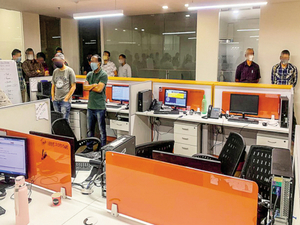
DSP (CID) Inderjeet Yadav said, “A raid was conducted on Saturday and around 26 youths, including seven women, were found working at the call centre named Green Rock Enterprise and owned by Verma,” he said, adding that around 25 employees were also working from home.

Yadav said that the accused had a partner in the US who used to provide them with citizens’ data. All the employees working at the call centre were paid between Rs 15,000 and Rs 25,000 per month. They have not been arrested yet but are being questioned.

Transfer NCB to new car by cancelling old car’s insurance livemnt . Updated: 22 Jul 2014, 07:25 PM IST Abhishek Bondia You can apply for a NCB retention letter within 90 days from the date of sale

iStockPhoto
I have had a car for five years and plan to buy a new car. Can I transfer the NCB to my new car? —Rajeev Singh
You can transfer the NCB to a new car by cancelling the old car insurance. Upon cancellation, you will receive an NCB retention letter from your current insurer. Present the NCB retention letter to the new car’s insurer to avail the bonus.
The insurer will ask for the following documents to issue the NCB retention letter:
- Request letter for policy cancellation
- Original policy copy and certificate of insurance (also called Form 51)
- Form 29 (notice of transfer of ownership of a motor vehicle)
- Form 30 (application for intimation and transfer of ownership of a motor vehicle)
- Photocopy of registration certificate book with name of the new owner
- Proof of delivery of car to the new owner
The last four documents are only required if you are selling your old car. Though technically, it is possible to transfer NCB without selling the old car. Several insurers insist on ownership transfer. I interviewed frontline executives of five insurers and got a different view from each. A transfer to a spouse or family member is considered valid. You can apply for a NCB retention letter within 90 days from the date of sale. The retention letter is valid for three years. So, do the paperwork much in advance before you actually buy your next car.

Friday, August 7, 2020

How A Russian Cargo Ship's Unscheduled Port Visit Led To Beirut Disaster "They were being greedy," said Boris Prokoshev, who was captain of the Rhosus in 2013 when he says the owner told him to make an unscheduled stop in Lebanon to pick up extra cargo.

 How A Russian Cargo Ship's Unscheduled Port Visit Led To Beirut Disaster

Moscow: 

The chemicals that went up in flames in Beirut's deadliest peace-time explosion arrived in the Lebanese capital seven years ago on a leaky Russian-leased cargo ship that, according to its captain, should never have stopped there.

"They were being greedy," said Boris Prokoshev, who was captain of the Rhosus in 2013 when he says the owner told him to make an unscheduled stop in Lebanon to pick up extra cargo.

Prokoshev said the ship was carrying 2,750 tonnes of a highly combustible chemical from Georgia to Mozambique when the order came to divert to Beirut on its way through the Mediterranean.

The crew were asked to load some heavy road equipment and take it to Jordan's Port of Aqaba before resuming their journey onto Africa, where the ammonium nitrate was to be delivered to an explosives manufacturer.

But the ship was never to leave Beirut, having tried and failed to safely load the additional cargo before becoming embroiled in a lengthy legal dispute over port fees.

"It was impossible," Prokoshev, 70, told Reuters of the operation to try and load the extra cargo. "It could have ruined the whole ship and I said no," he said by 'phone from his home in the Russian resort town of Sochi on the Black Sea coast.

The captain and lawyers acting for some creditors accused the ship's owner of abandoning the vessel and succeeded in having it arrested. Months later, for safety reasons, the ammonium nitrate was unloaded and put in a dock warehouse.

On Tuesday, that stockpile caught fire and exploded not far from a built-up residential area of the city. The huge blast killed 145 people, injured 5,000, flattened buildings and made more than a quarter of a million people homeless.

The ship might have succeeded in leaving Beirut, had it managed to load the additional cargo.

The crew had stacked the equipment, including excavators and road-rollers, on top of the doors to the cargo hold which held the ammonium nitrate below, according to the ship's Ukrainian boatswain, Boris Musinchak. But the hold doors buckled.

"The ship was old and the cover of the hold bent," Musinchak said by 'phone. "We decided not to take risks."

The captain and three crew spent 11 months on the ship while the legal dispute dragged on, without wages and with only limited supplies of food. Once they left, the ammonium nitrate was unloaded.

"The cargo was highly explosive. That's why it was kept on board when we were there ... That ammonium nitrate had a very high concentration," Prokoshev said.

BOUND FOR MOZAMBIQUE

Prokoshev identified the ship's owner as Russian businessman Igor Grechushkin. Attempts to contact Grechushkin were unsuccessful.

The ammonium nitrate was sold by Georgian fertiliser maker Rustavi Azot LLC, and was to be delivered to a Mozambique explosives maker, Fabrica de Explosivos.

A senior representative for Fabrica de Explosivos did not immediately respond when sent a request for comment on LinkedIn.

Levan Burdiladze, the Rustavi Azot plant director, told Reuters that his company had only operated the chemical factory for the last three years and so he could not confirm whether the ammonium nitrate was produced there.

He called the decision to store the material in Beirut port a "gross violation of safe storage measures, considering that ammonium nitrate loses its useful properties in six months."

Initial Lebanese investigations into what happened have pointed to inaction and negligence in the handling of the potentially dangerous chemical.

Lebanon's cabinet on Wednesday agreed to place all Beirut port officials who have overseen storage and security since 2014 under house arrest, ministerial sources said.

The head of Beirut port and the head of customs said that several letters were sent to the judiciary asking for the material be removed, but no action was taken.

Reuters could not immediately reach Lebanon's justice minister for comment. The Justice Ministry is closed for three days of national mourning.

According to Prokoshev, the ship had been leaking but was seaworthy when it sailed into Beirut in September 2013. However, he said Lebanese authorities paid little attention to the ammonium nitrate, which had been stacked in the hull in large sacks.

"I feel sorry for the people (killed or injured in the blast). But local authorities, the Lebanese, should be punished. They did not care about the cargo at all," he said.

The abandoned Rhosus sank where she was moored in Beirut harbour, according to a May, 2018 email from a lawyer to Prokoshev, which said it had gone down "recently".

(Except for the headline, this story has not been edited by NDTV staff and is published from a syndicated feed.)

Promoted

Thursday, August 6, 2020

25 learnings for India from China Standoff -Source-Rediff.com -used here for educational purposes only


By SANJEEV NAYYAR
August 06, 2020 10:05 IST

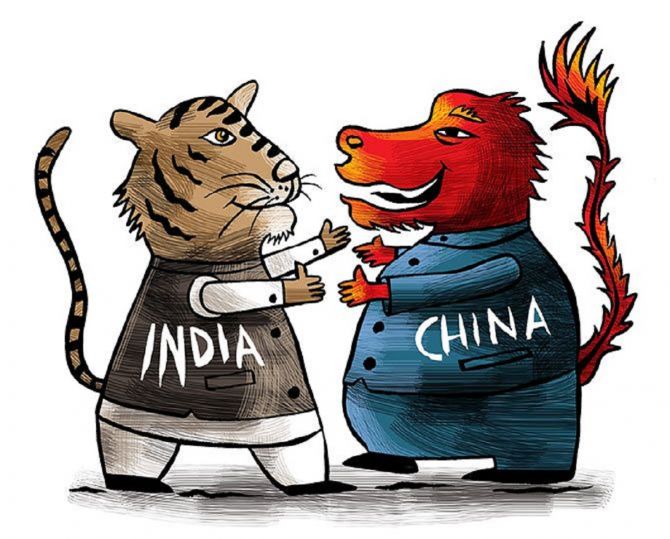
Just like China wants Trump to lose the US presidential poll, it may want Modi to lose the Lok Sabha polls.
So months before the 2024 elections, China may take possession of an important area, say one of the Char Dhams, warns Sanjeev Nayyar.
Illustration: Uttam Ghosh/Rediff.com
Now that the latest India-China stand-off does not seem to be ending, it might be useful to reflect on the learnings for India.
Post Pokhran 2, then defence minister George Fernandes justified India's second nuclear explosion by naming China as 'India's Enemy No 1'.
Twenty-two years later, the current stand-off has resulted in the average Indian too seeing China as enemy number one, thanks to the Galwan Valley clash in which 20 Indian soldiers made the supreme sacrifice.
Here are some key learnings and observations for India on how to handle the dragon to our eastern borders.
1. Never trust the Chinese. ]=;They have mastered the art of deception. As Geostrategist Brahma Chellaney wrote (external link), 'Deception, concealment and surprise have driven China's repeated use of force -- from seizing the Johnson Reef in 1988 and the Mischief Reef in 1995 to occupying the Scarborough Shoal in 2012 and now vantage locations in Ladakh. It has changed the South China Sea's geopolitical map without firing a shot or incurring any international costs.'
2. Never let your guard down. Political leaders might shake hands, but the Indian armed forces should always be on the alert, and plan for the unexpected.
3. The Chinese respect strength, both economic and military power. India should work towards building both.
4. The Chinese hate to lose, so expect them to be back in Ladakh with renewed vigour or they will acquire new areas that makes the current understanding irrelevant.
5. Iran, North Korea and Pakistan are among China's best friends. Their plans will now work more in tandem than ever before and require close observation.
6. The Chinese cherry pick agreements. Former foreign secretary Kanwal Sibal wrote (external link), 'China has repeatedly demonstrated that either it does not respect the agreements it signs or interprets them as it wants. In 1996 it agreed to 'clarifying the alignment of the LAC in those segments where they (the two sides) have different perceptions In 2002, China decided to repudiate this agreement unilaterally.'
7. India need not always play by the rule book or go by signed agreements, but be driven by national interests alone. Remember the story of Ashwatthama in the Mahabharata.
8. Appeasement postpones but magnifies problems. For decades successive Indian governments have been sensitive to Chinese interests.
What India got in return was encroachment of its territory, arming of Pakistan by China and Galwan Valley clash!

9. India must accept that China and Pakistan are made for each other. Former high commissioner to Pakistan G Parthasarathy wrote (external link), 'Nawaz Sharif described his country's relations with China as: 'Sweeter than the sweetest honey'/. Pakistan's ambassador to China gushingly described the Sino-Pakistan relationship as: 'Deeper than the ocean, higher than the mountains and stronger than steel'.
Remember that China protects 'Pakistan-based terrorist groups like the LeT and JeM from international sanctions in the United Nations'.
Therefore, India should expect that China would continue to support Pakistan in every way and prepare for a two-front war, with China and Pakistan, in the next three years or risk losing parts of Arunachal Pradesh and Ladakh.

10. China has a bigger economy and is a stronger military power than India, but Indians are no pushovers either.
We must stop underestimating ourselves, at the same time not underestimate Chinese intent to harm India's rise non-stop.
Former ambassador P Stobdan wrote (external link) in India Today, 'India is not a pushover like the three Central Asian states of Kazakhstan, Kyrgyzstan and Tajikistan, with which China fixed boundary settlements in its favour through a blend of 'incentives with coercion' pressure tactics.'

11. China follows the creeping acquisition route. They take possession of a small area of another country. If the protests are not strong enough they continue.
The Dalai Lama said on Rediff.com, 'The Chinese way... is to do something rather mild at first; then to wait a bit, and if it passes without objection, to say or do something stronger. But if we take objection to the first statement or action, they urge that it has been misinterpreted, and cease, for a time at any rate, from troubling us further.'

12. China is used to presenting countries with a fait accompli, for example, the road through Eastern Ladakh from Sinkiang to Tibet via eastern Ladakh or Aksai Chin.
If China wants such favours there should be a clear strategic status quo.
Strategic affairs analyst Maroof Raza wrote (external link) in The Tribune, 'If China has control over the Galwan valley, the Depsang plains (north of Leh) will greatly shorten the route taken by the Chinese -- to link up with the Shaksgam valley, that China first grabbed and then made Pakistan 'temporarily' gift it to Beijing! This valley, though inhospitable, has the largest collection of glaciers (over 250 to be precise) that China regards as a source of water to further its agenda of world domination.'

13. Talks with China on the boundary question must take place only when China submits its version of the Line of Actual Control. So far China has not given India any such maps.
14. India must remember that China has deliberately kept the border dispute unresolved so as to keep India off balance and 'reduce its maritime military investments'.
15. The Chinese strategy is to win without fighting. They captured the US market with low cost products such that US industry became dependent on it. They are replicating the same strategy with India.
India needs to enhance domestic production and design capabilities so that dependence on China reduces.
Similarly, they take possession of a country's territory, then negotiate a pullback by which they continue to be in possession of the country's territory and simultaneously ensure Indian Army pulls back from its own territory. Brahma Chellaney says it is part of the well-known 'advance ten miles, retreat six miles strategy'.

16. Gautam Chikermane of the Observer Research Foundation, summed up the Chinese approach in his tweet: 'How China negotiates 101: First intrude, then seek "partners". First attack, then talk "peace". First create zero-sum, then push for "win-win". First build suspicions, then ask for "trust". First go backwards, then pursue "forward".
17. Boycott Chinese products. Start with not buying Chinese brands. So if I have to buy a laptop I will buy an American brand, even if it is made in China, instead of a Chinese one. Companies that own brands make profits, not the ones who contract manufacture.
Indian consumers must not buy products of companies who indulge in 'lazy manufacturing', meaning Indian companies who import a finished product from China, stamp their brand name and then sell to consumers.

18. The Government of India must remember that diplomacy works best when it is backed by military power. So India must arms itself adequately, enough to fight a two-front war.
19. Present-day China is 'centred on the rhetoric of national rejuvenation', according to Aswini K Mahapatra (external link).
Deeper intent is to end China's humiliation and restore to its historical position, returning China to its rightful position in the world stage.
'Likewise,' he adds, 'China's assertion of territorial claims, whether in the South China Sea or in the East China Sea over Japan's Senkaku islands or over territory along the India-China border, including Arunachal Pradesh, has much to do with its national rejuvenation logic.'
The Chinese want to retrieve lands they feel were theirs before the Western and Japanese invasions of the 19th century, hence the current aggression.

20. China wants the 21st century to be the Chinese century and not an Asian century.
Even though many Indians are not aware of it, China is aware of India's potential and hence wants to 'thwart India's rise to the global high table'.
How many Indians know that Indian masters helped the Chinese deal with epidemics between the 1st and 8th centuries AD, as Prof Dr Shashi Bala recently wrote (external link) in Bhavan's Journal.

21. Whilst building strategic border roads, India must check whether it occupies the mountain heights, to prevent a Kargil-like situation where Indian convoys were fired from hill tops by Pakistanis, to ensure the enemy does not dominate the road.
22. Indians must note that jingoism works with Pakistan, whilst low key dialogue works better with the Chinese.
23. Water could be another weapon that China would use aggressively against India.
Sonali Mitra wrote (external link), 'The absence of data sharing on the Brahmaputra during and after the Doklam standoff and lack of clarity on the intent behind the 1,000 m⎯long tunnel to transfer water from Yarlung Tsangpo in Tibet to Xinjiang betray China's self⎯declared 'responsible' behaviour involving transboundary waters.'

24. Just like China wants Donald Trump to lose the coming US presidential poll, China may want Modi to lose the Lok Sabha polls.
So months before the 2024 elections, China may take possession of an important area, say one of the Char Dhams.
Options given to Modi would be war or give up all claims on Gilgit/Baltistan if he wants the possessed area or tirth sthan back.

25. India all along has been too sensitive to China's concerns. So India must:
  • Ask what it has achieved by being sensitive to China's concerns.
  • Start exporting arms, for example the Brahmos missiles to countries like Vietnam and Indonesia.
  • Establish diplomatic relations with Taiwan.
  • Establish close economic, defence and tourism ties with countries of South East Asia with whom India has centuries-old civilisational linkages.
  • Award the Dalai Lama the Bharat Ratna.
    Prepare a comprehensive plan to increase domestic production of key items like active pharmaceutical ingredients where India depends on China substantially for supplies.
  • Note that Indian pharma companies can export medicines to the West because of API that comes from China. If China chokes the supplies, the world gets affected.
  • Organise packaged tours to Daulat Beg Oldi, close to the Xinjiang Highway. Tourists are one way of saying the territory is India's.
  • Make one organisation responsible for guarding the Line of Actual Control. Currently, the LAC is guarded by the Indian Army and the Indo-Tibetan Border Police. So let the army control the ITBP, but the responsibility should be made clear.
China will treat India with respect only when India increases the cost for Chinese expansionism and makes the Chinese lose face.

Sanjeev Nayyar is a chartered accountant and founder, www.esamskriti.com.
75 years on, the horror of Hiroshima & Nagasaki bombings :-Source Rediff.com-used here for Educational purposes only


August 06, 2020 08:51 IST

On August 6 and August 9 of 1945, warfare changed forever when the United States dropped two atomic bombs on Japan, devastating the cities of Hiroshima and Nagasaki and killing more than 100,000 people.
The attack on the people of Hiroshima at 8:15 a.m. on August 6, 1945, and the second attack on the city of Nagasaki at 11:02 am on August 9 killed and wounded hundreds of thousands of unsuspecting men, women, and children in a horrible blast of fire and radiation, followed by deadly fallout.
In years that followed, those who survived -- the hibakusha -- suffered from the trauma of the experience and from the long-term effects of their exposure to radiation from the weapons.
Before the blast, they were thriving cities. In a flash, they became desolate wastelands.
Seventy-five years later, take a glimpse at the destruction.
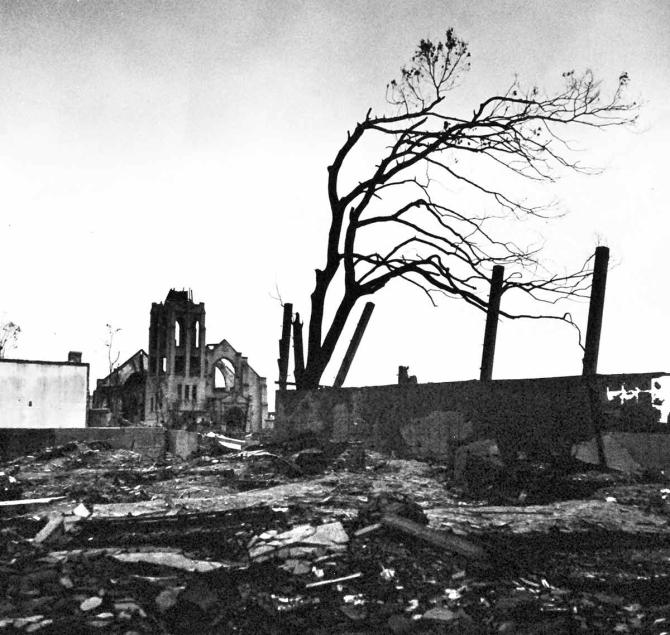
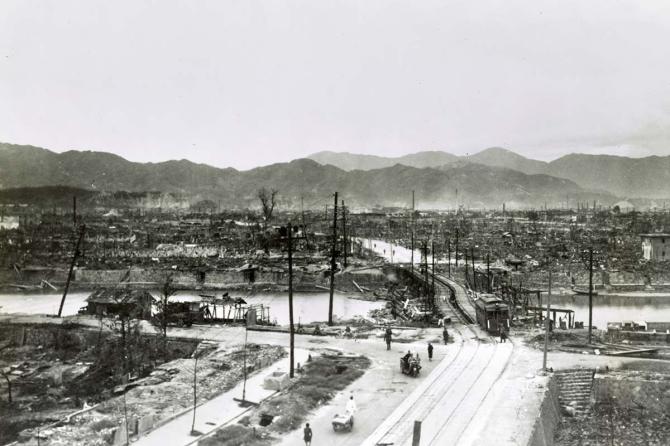
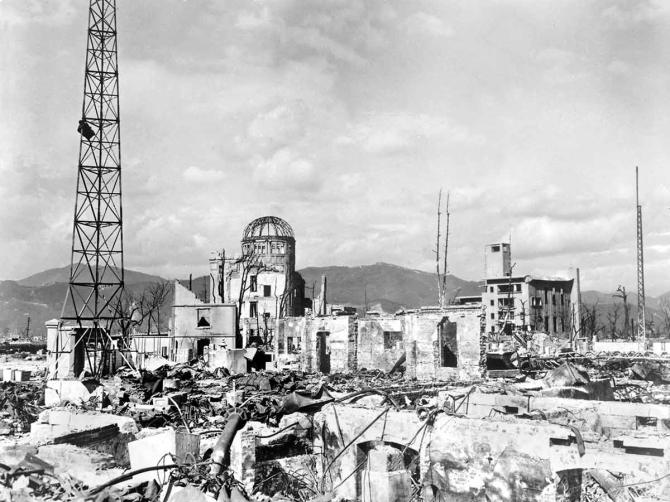
Rubble caused by the atomic bomb blast is seen in Hiroshima, Japan in September 1945. On August 6, 1945, at 8:15 am, the crew of the B-29 bomber Enola Gay dropped the first wartime atomic bomb over Hiroshima, Japan, a bustling regional hub that served as an important military communications center, storage depot and troop gathering area. The bomb, code-named "Little Boy," detonated with an estimated 15,000 tons of TNT, destroying five square miles of the city and directly killing some 70,000 people. Final casualty numbers remain unknown; by the end of 1945, injuries and radiation sickness had raised the death toll to more than 100,000. Photograph: US Navy/Lieutenant Wayne Miller/Reuters
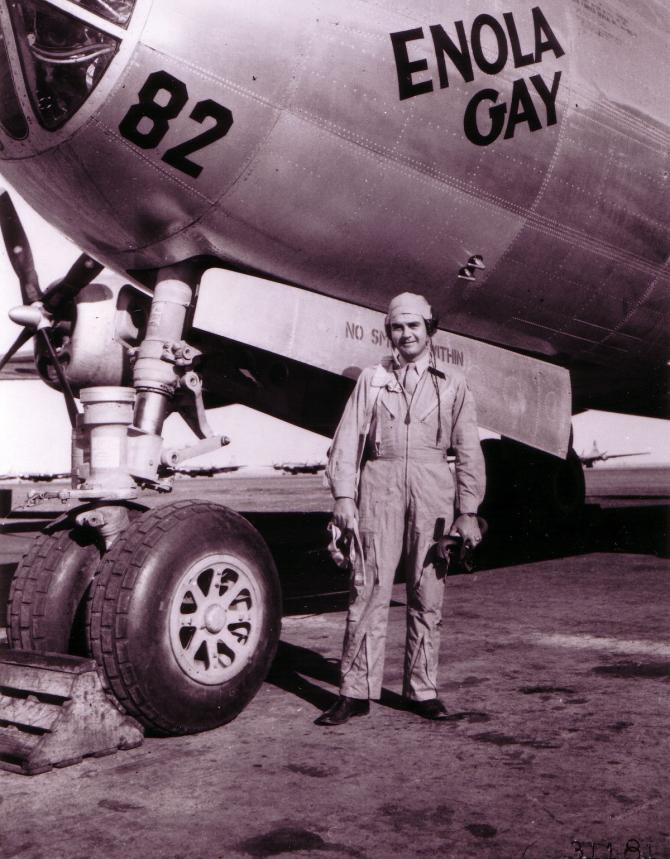
Colonel Paul Tibbetts poses in front of his B-29 Superfortress "The Enola Gay" (named for his mother) in this undated US Air Force handout photo. The Enola Gay is the same plane he piloted when his bombardier dropped the first atom bomb over Hiroshima. Photograph: US Air Force/Reuters
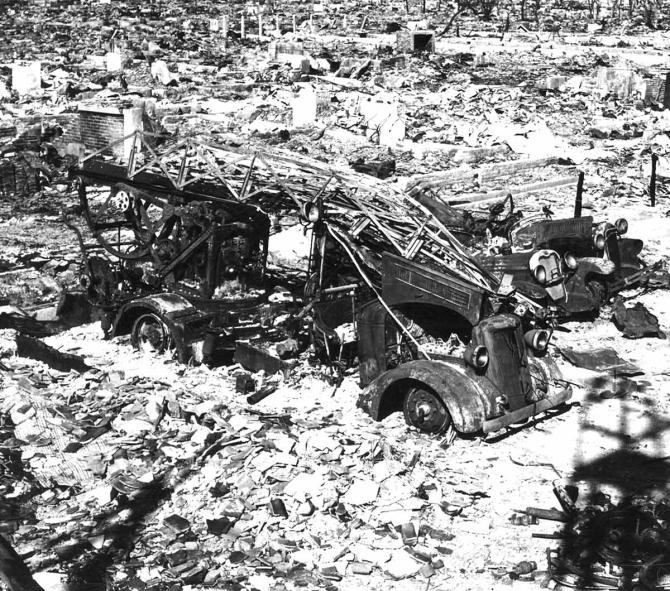
A Japanese soldier walks through the atomic-bomb levelled city of Hiroshima, Japan in September 1945. Archive footage shows pre-bomb Hiroshima as a bustling, thriving city of trilby-topped gentlemen boarding trams, ladies dressed in elegant kimonos, and uniformed schoolchildren walking beneath cherry blossoms overhanging shopping streets. After the blast, rubble and contorted metal stretched almost uninterruptedly to the horizon. Photograph: Lieutenant Wayne Miller/USNR/Naval History and Heritage Command/Reuters
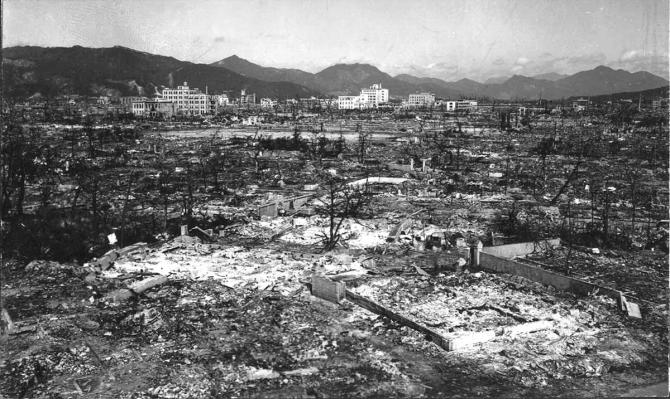
Devastation caused by the atomic bomb seen in Hiroshima, Japan. The radius of total destruction was reportedly 1.6 km. "The impact of the bomb was so terrific that practically all living things -- human and animal -- were literally seared to death by the tremendous heat and pressure set up by the blast," Tokyo radio said in the aftermath of the explosion, according to a report by The Guardian in August 1945. "All the dead and injured were burned beyond recognition. Those outdoors were burned to death, while those indoors were killed by the indescribable pressure and heat." Photograph: War Department/US National Archives/Reuters
A bridge 4,400 feet (1.34 km) east of the detonation center of the atomic bomb blast is seen in Hiroshima, Japan. When the bomb was dropped on Hiroshima, the first thing people noticed was an "intense ball of fire" according to the International Committee of the Red Cross. Temperatures at the epicentre of the blast reached an estimated 7,000 degrees Celsius, which caused fatal burns within a radius of about 3 km. ICRC experts say there were cases of temporary or permanent blindness due to the intense flash of light, and subsequent related damage such as cataracts Photograph: US Army/Library of Congress/Reuters
Hiroshima turned into a wasteland after the bombing. Photograph: War Department/US National Archives/Reuters
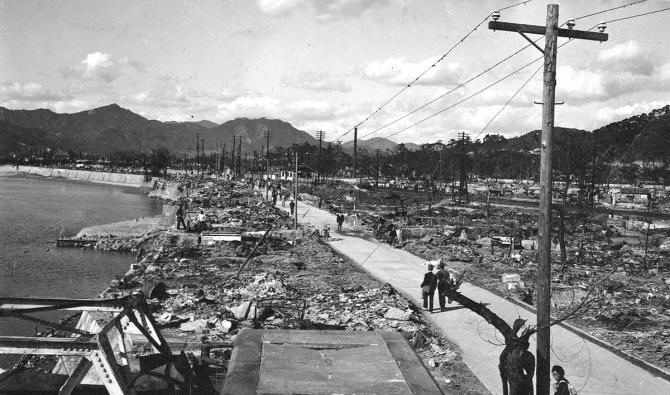
People walk along a road cleared of the debris caused by an atomic bomb in Hiroshima, Japan. The bombing started intense fires that spread rapidly through timber and paper homes, burning everything in a radius of 2 km. Photograph: War Department/US National Archives/Reuters
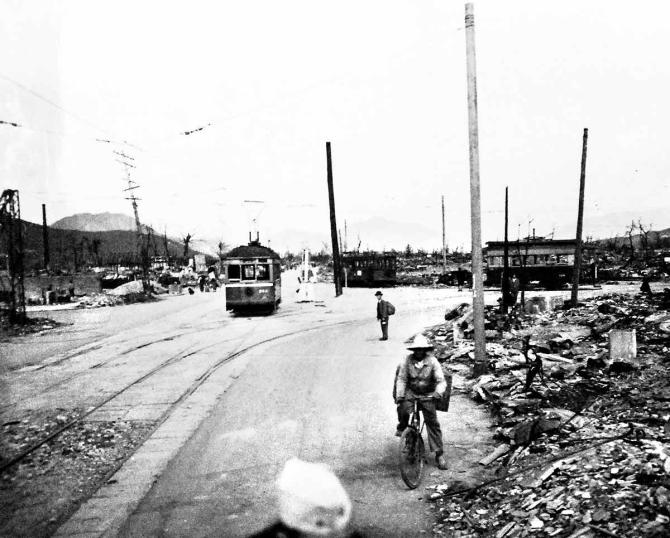
A cyclist rides near a trolley on streets cleared of the debris of the atomic bomb blast in Hiroshima, Japan. It is estimated that as many as 20,000 Japanese military personnel were killed. US surveys estimated that 4.7 square miles of the city were destroyed. Japanese officials determined that 69 per cent of Hiroshima's buildings were destroyed and another 6 to 7 per cent damaged. Photograph: US Navy/PhoM3/C George Almarez/Reuters
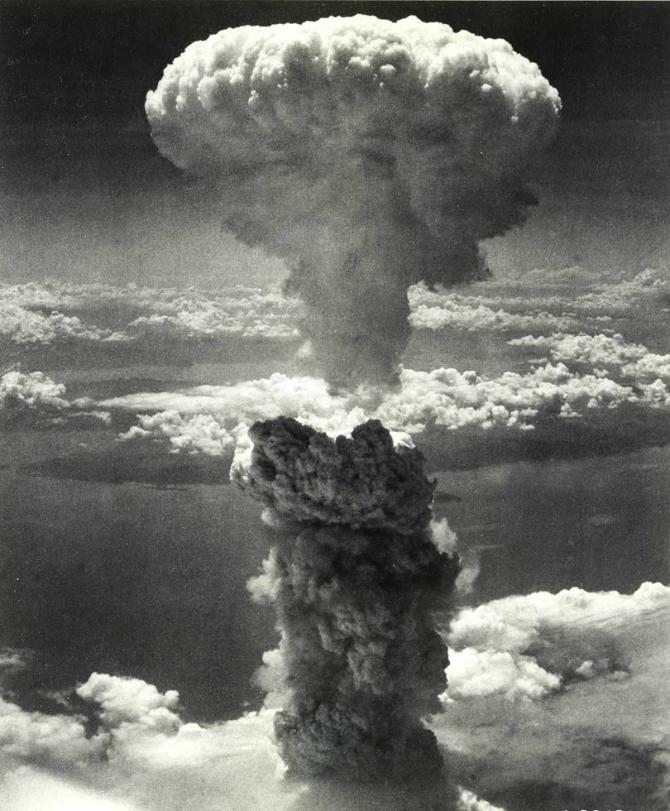
A mushroom cloud rises after an atomic bomb codenamed "Fat Man" exploded after being dropped by a US Army Air Force B-29 bomber over Nagasaki on August 9. Three days after the destruction of Hiroshima, another American bomber dropped its payload over Nagasaki, some 185 miles southwest of Hiroshima, at 11:02 am. Not the original intended blast site, Nagasaki only became the target after the crew found that city, Kokura, obscured by clouds. The Nagasaki explosive, a plutonium bomb weighed nearly 10,000 pounds and was built to produce a 22-kiloton blast. Photograph: US Army Air Forces/Library of Congress/Reuters
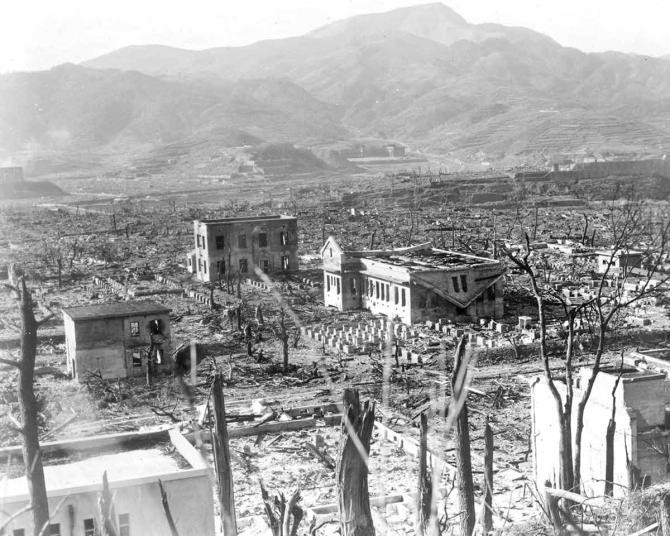
Devastation caused by an atomic bomb is seen in Nagasaki. The bomb's destructive force wiped out about 30 per cent of the city. Some 60,000 to 80,000 people died in Nagasaki, both from direct exposure and long-term side effects of radiation. Photograph: Department of Energy/Lawrence Berkeley National Laboratory/Reuters
Although the bomb was more powerful than the one used on Hiroshima, its effects were confined by hillsides to the narrow Urakami Valley. The radius of total destruction was about 1 mile (1.6 km), followed by fires across the northern portion of the city to 2 mi (3.2 km) south of the bomb. Photograph: Department of Energy/Lawrence Berkeley National Laboratory/Reuters
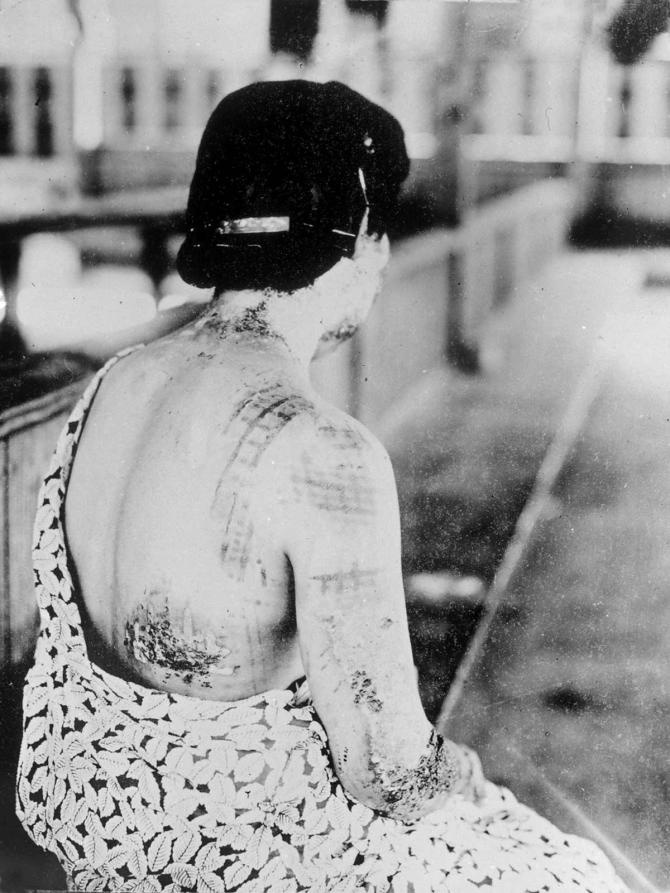
A woman being treated shows her wounds caused by an atomic bomb in Nagasaki. The bomb attacks unleashed radiation that proved deadly both immediately and over the longer term. Radiation sickness was reported in the attack's aftermath by many who survived the initial blast and firestorm. Acute radiation symptoms include vomiting, headaches, nausea, diarrhoea, haemorrhaging and hair loss, with radiation sickness fatal for many within a few weeks or months. Bomb survivors, known as hibakusha, also experienced longer-term effects including elevated risks of thyroid cancer and leukaemia, and both Hiroshima and Nagasaki have seen elevated cancer rates. Of 50,000 radiation victims from both cities studied by the Japanese-US Radiation Effects Research Foundation, about 100 died of leukaemia and 850 suffered from radiation-induced cancers. Photograph: Department of Energy/Lawrence Berkeley National Laboratory/Reuters
US troops arrive the month after an atomic bomb was dropped on Nagasaki, Japan in September 1945. Japan surrendered to the Allies on August 15, six days after the the bombing of Nagasaki. Historians have debated whether the devastating bombings ultimately saved lives by bringing an end to the conflict and averting a ground invasion. But those calculations meant little to survivors, many of whom battled decades of physical and psychological trauma, as well as the stigma that sometimes came with being a hibakusha. In 2019, Pope Francis met with several hibakusha on visits to Hiroshima and Nagasaki, paying tribute to the "unspeakable horror" suffered by victims of the attacks. In 2016, Barack Obama became the first sitting US president to visit Hiroshima. He offered no apology for the attack, but embraced survivors and called for a world free of nuclear weapons. Photograph: Naval History and Heritage Command/Reuters

Wednesday, August 5, 2020

Female soldiers deployed for first time in Kashmir :-Rediff.com

Female soldiers deployed for first time in Kashmir

Source: ANI  -  Edited By: Roshneesh Kmaneck
August 05, 2020 11:57 IST

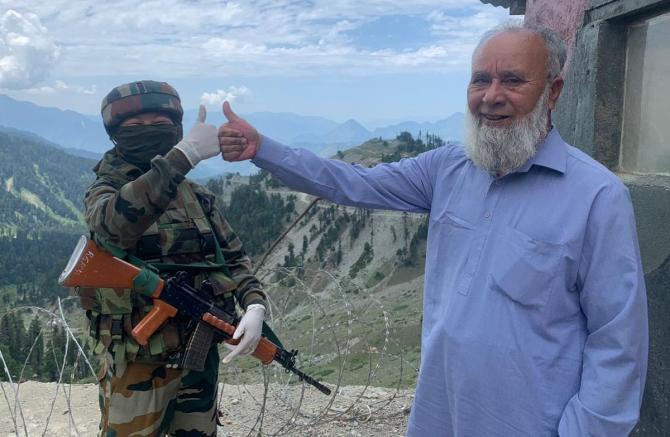
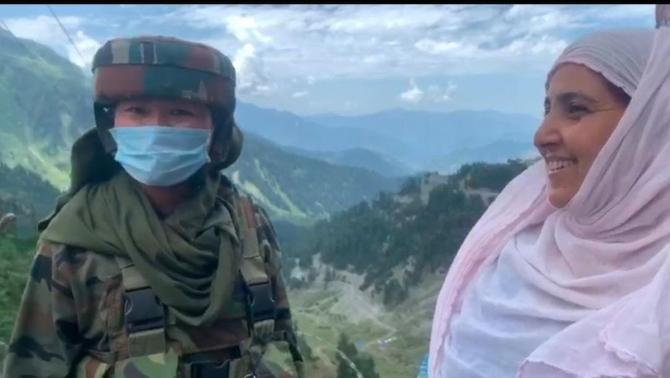
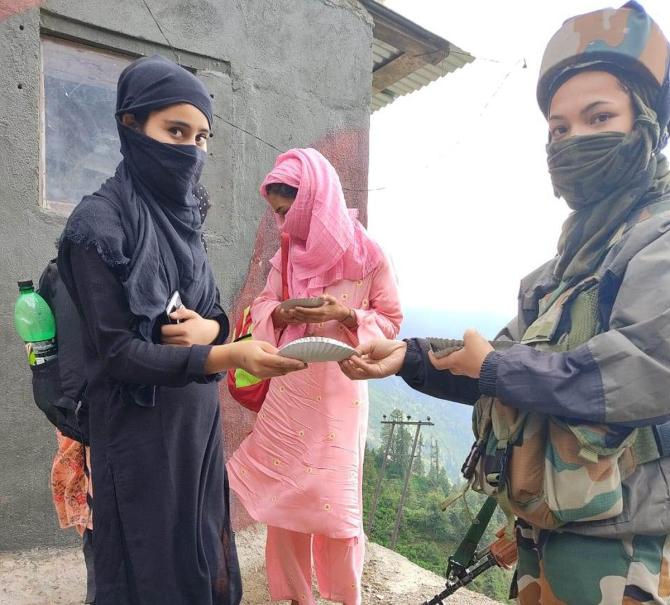
The Assam Rifles said that for the first time in Kashmir, 'Rifle Women' have been deployed on duty.
In a tweet, Assam Rifles said, "Women soldiers of Assam Rifles deployed for the first time in Kashmir make a positive impact on the local populace in a matter of days. Smiling faces of locals is a testimony of professionalism of the Riflewomen of Assam Rifles."The ‘Rifle Women’ is an unit of the Assam Rifles, the oldest paramilitary force of India.
It has been a year since Parliament took the historic decision to abrogate Article 370 in Jammu-Kashmir.
As per the data, after the abrogation, the number of youth joining terror groups dropped by 40 per cent. The year only witnessed 67 youth taking to terror.
All photographs: @official_dgar/Twitter

Monday, August 3, 2020

Government helped Mukesh Ambani out of the way and allowed Reliance to use spectrum of Rel.Comm.Why RIL s beng allowed such cheating and why Nation is being made to suffer due to such Bankrupt Anil Ambani Rel.Comm.Why Mukesh Ambani despite of making full use of Rel Comm Spectrum is not being held liable to pay AGR dues of Rs.21000 Crores like others.ET Telecom news:- AGR liabilities rest with RCom: SSTL to SC Sistema Shyam Teleservices Ltd (SSTL) has told the Supreme Court that Anil Ambani’s insolvent telco Reliance Communications (RCom) is liable to pay its adjusted gross revenue (AGR) dues as the latter had acquired the former’s entire telecom business in October 2017. Himanshi LohchabETTelecomAugust 02, 2020, 22:46 IST

AGR liabilities rest with RCom: SSTL to SCAnil Ambani thanks 'repected brother' Mukesh for last-minute save ...

New Delhi: Sistema Shyam Teleservices Ltd (SSTL) has told the Supreme Court that Anil Ambani’s insolvent telco Reliance Communications (RCom) is liable to pay its adjusted gross revenue (AGR) dues as the latter had acquired the former’s entire telecom business in October 2017.


In an affidavit filed before the top court, SSTL said it has complied with the AGR judgement by paying Rs 72.90 lakh as per its own assessment of deficit AGR dues that were not covered under the merger scheme with RCom in 2017. SSTL said it paid the amount as several letters to the Department of Telecommunications (DoT) seeking clarification after the judgement did not elicit any response.

The DoT has identified the combined AGR liability of Rs 25,194.58 crore for Rcom and SSTL as on March 6, of which Rs 222.1 crore belongs to the Indo-Russian telecom JV, which merged into the Anil Ambani-owned carrier in 2017. In February 2019, RCom filed for insolvency.

Under the proceedings, the DoT has claimed nearly Rs 30,000 crore in dues from RCom, of which over Rs 21,000 crore has been verified by the resolution professional.

“I say that there is no wilful default on the part of SSTL to comply with this… court’s judgment to the extent it is applicable to SSTL,” the company said in an affidavit. ET has seen a copy of the affidavit.

The Supreme Court, in its June 20 hearing of the AGR case, had asked for bankruptcy related details of telcos such as Aircel, RCom, SSTL and Videocon within seven days, to ensure that they were not misusing the insolvency laws to evade AGR liability.

As per the merger scheme approved by the DoT on 31.10.2017, "all licences held by SSTL stood cancelled with immediate effect" and "simultaneously all the liabilities of SSTL in respect of licences in various LSAs stood transferred to the respective licences held by Reliance Communication Ltd.”

SSTL, a joint venture between Russia’s Sistema and India’s Shyam Group, which was providing telecom services under the brand name MTS had sold its entire telecom business including licences and spectrum in nine circles to RCom in October 2017, in exchange for a 10% stake in the Indian telco.

Back then, RCom acquired two million customers and 30MHz of 800/850 MHz band spectrum, ideally suited for 4G LTE services. The merger of SSTL extended the validity of RCom's spectrum portfolio in the 800 and 850 MHz band in eight circles by a period of 12 years — from 2021 to 2033 and enhanced spectrum value by Rs 7300 crore. But it also assumed the liability for SSTL’s spectrum amounting to Rs 390 crore per annum for the next eight years.

Next year, as Rcom’s financial health deteriorated, SSTL sold its 10% stake, marking the complete exit of the Russian telco from India.

Weighed by debt of some Rs 46,000 crore and mounting losses due to intense competition following Reliance Jio’s entry in 2016, RCom filed for bankruptcy protection in February 2019, having failed to sell its assets to repay lenders.


Source ET telecom.