Pages

Tuesday, August 11, 2020

'BSNL employees are traitors': Anantkumar Hegde stirs row BJP MP Anantkumar Hegde has stirred a controversy by saying that BSNL employees are "traitors" who were not willing to work to develop a well-known company. TIMESOFINDIA.COM August 11, 2020, 17:38 IST


Image result for pic of bsnl


NEW DELHI: BJP MP Anantkumar Hegde has stirred a controversy by saying that BSNL employees are "traitors" who were not willing to work to develop a well-known company.

The BJP leader said that 88,000 employees from the company will be fired as government is going to privatise BSNL.

Hedge made these comments while speaking at an event on August 10 in Kumta region of Karnataka.

However, the BJP leader is not new to controversies.

Earlier in February this year, the former Union minister attacked Mahatma Gandhi by calling the freedom struggle led by him a "drama". He also questioned as to how "such people" come to be called 'Mahatma' in India.

Hedge was also in news when his Twitter account was blocked in April and he accused the microbloging site of taking an "anti-India" stand and acting "with very prejudiced intentions'.

The MP from Uttara Kannada had also written to Prime Minister Narendra Modi against the 'digital colonisation' by a a corporate entity.

The government had earlier this year said that it will not go in for selling out or disinvesting state-owned telephone companies BSNL or MTNL and instead has planned for a “revival” of both companies.

With both companies reeling under financial crisis, salaries of employees were delayed, leading to strikes by protesting workers.

Google turns Android phones into earthquake sensors; California to get alerts Alphabet Inc's Google's Android phones on Tuesday started detecting earthquakes around the world to provide data that could eventually give billions of users precious seconds of warning of a tremor nearby, with an alerting feature first rolling out in California. Reuters August 11, 2020, 19:05 IST

Google turns Android phones into earthquake sensors; California to get alerts
By Paresh Dave

OAKLAND, Calif: Alphabet Inc's Google's Android phones on Tuesday started detecting earthquakes around the world to provide data that could eventually give billions of users precious seconds of warning of a tremor nearby, with an alerting feature first rolling out in California.

Japan, Mexico and California already use land-based sensors to generate warnings, aiming to cut injuries and property damage by giving people further away from the epicenter of an earthquake seconds to protect themselves before the shaking starts.

If Google's approaches for detecting and alerting prove effective, warnings would reach more people, including for the first time Indonesia and other developing countries with few traditional sensors.

Seismology experts consulted by Google said turning smartphones into mini-seismographs marked a major advancement, despite the inevitably of erroneous alerts from a work in progress, and the reliance on a private company's algorithms for public safety. More than 2.5 billion devices, including some tablets, run Google's Android operating system.

"We are on a path to delivering earthquake alerts wherever there are smartphones," said Richard Allen, director of University of California Berkeley's seismological lab and visiting faculty at Google over the last year.

Google's program emerged from a week-long session 4-1/2 years ago to test whether the accelerometers in phones could detect car crashes, earthquakes and tornadoes, said principal software engineer Marc Stogaitis.

Accelerometers - sensors that measure direction and force of motion - are mainly used to determine whether a user is holding a phone in landscape or portrait mode.

The company studied historical accelerometer readings during earthquakes and found they could give some users up to a minute of notice.

Android phones can currently separate earthquakes from vibrations caused by thunder or the device dropping only when the device is charging, stationary and has user permission to share data with Google.

If phones detect an earthquake, they send their city-level location to Google, which can triangulate the epicenter and estimate the magnitude with as few as several hundred reports, Stogaitis said.


The system will not work in regions including China where Google's Play Services software is blocked.

Google expects to issue its first alerts based on accelerometer readings next year. It also plans to feed alerts for free to businesses that want to automatically shut off elevators, gas lines and other systems before the shaking starts.

To test its alerting abilities, Google is drawing in California from traditional government seismograph readings to alert Android users about earthquakes, similar to notifications about kidnappings or flooding.

People expected to experience strong shaking would hear a loud dinging and see a full-screen advisement to drop, cover and hold on, Stogaitis said. Those further away would get a smaller notification designed not to stir them from their sleep, while people too close to be warned will get information about post-quake safety, such as checking gas valves.

Alerts will trigger for earthquakes magnitude 4.5 or greater, and no app download is necessary.

MyShake, an app launched by Allen's Berkeley lab last year to provide Californians warnings and let them report damage, has drawn 1 million downloads.

Stogaitis also said Google has not discussed its plans with Apple Inc, whose competitor to Android comprises half the market in countries including the United States.

Apple was not immediately available for comment.

Russia becomes first country to approve a COVID-19 vaccine, says Vladimir Putin The development paves the way for the mass inoculation of the Russian population, even as the final stage of clinical trials to test safety and efficacy continue. Reuters

Representative image

President Vladimir Putin said on Tuesday that Russia had become the first country in the world to grant regulatory approval to a COVID-19 vaccine after less than two months of human testing, a move hailed by Moscow as evidence of its scientific prowess.
The development paves the way for the mass inoculation of the Russian population, even as the final stage of clinical trials to test safety and efficacy continue.
The speed at which Russia is moving to roll out its vaccine highlights its determination to win the global race for an effective product, but has stirred concerns that it may be putting national prestige before sound science and safety.
Speaking at a government meeting on state television, Putin said the vaccine, developed by Moscow's Gamaleya Institute, was safe and that it had even been administered to one of his daughters.
"I know that it works quite effectively, forms strong immunity, and I repeat, it has passed all the needed checks," said Putin.
He said he hoped the country would soon start mass producing the vaccine.
Its approval by the health ministry foreshadows the start of a larger trial involving thousands of participants, commonly known as a Phase III trial.
Such trials, which require a certain rate of participants catching the virus to observe the vaccine's effect, are normally considered essential precursors for a vaccine to receive regulatory approval.
Regulators around the world have insisted that the rush to develop COVID-19 vaccines will not compromise safety. But recent surveys show growing public distrust in governments' efforts to rapidly produce such a vaccine.
Russian health workers treating COVID-19 patients will be offered the chance of volunteering to be vaccinated soon after the vaccine's approval, a source told Reuters last month.
More than 100 possible vaccines are being developed around the world to try to stop the COVID-19 pandemic. At least four are in final Phase III human trials, according to WHO data.

Monday, August 10, 2020

AGR Hearing Highlights | SC adjourns hearing on telcos under insolvency to August 14 The SC had on July 20 reserved its order on permitting telecom companies to make staggered payments over 15 years. Moneycontrol News @moneycontrolcom

Pic for representation

The Supreme Court (SC) on August 10 adjourned the hearing on telecom companies under insolvency to August 14, while observing that the government must come prepared with a plan for recovery of dues from the telcos under insolvency, CNBC-TV18 has reported.
A Supreme Court bench comprising of Justices Arun Mishra, S Abdul Nazeer and MR Shah heard the case. However, there is still no clarity on the question of time period to be given to telcos for repayment of their respective AGR dues. While Bharti Airtel and Vodafone Idea had sought 15 years' time for repayment of dues, the government had suggested a time-frame of 20 years.
As Justice Arun Mishra is set to retire on September 3, an order on the staggered repayment time frame is likely before that.
The SC had on July 20 reserved its order on permitting telecom companies to make staggered payments over 15 years.SC observations:
>> Justice Arun Mishra said "We want to go into cause of initiation of insolvency for telcos under IBC. We want an understanding of their outstanding liabilities, urgency in pushing for insolvency."
>> Justice Mishra: "If RCom had settled the payment dispute with Ericsson, why was the CIRP process allowed to proceed?"
>> Justice Mishra "SC orders binding on all courts, how can IBC proceedings be revived by NCLAT despite payment by RCom to Ericsson?"
>> How can it be decided for the resolution plan proceeds to be paid only to banks, and nothing to DoT for AGR?
>> What is the government's stance? It seems the govt will get nothing from the IBC process. What is the plan to recover Rs 31,000 crore from R.Comm?
>> Government must come prepared with a plan for recovery of dues from telcos under insolvency.
Solicitor General Tushar Mehta to SC:
>> Amount recoverable from Reliance Communications (RComm) is Rs 31,000 crore.
Senior Advocate Shyam  Divan, RCom's resolution professional, to SC:
>> Ericsson's claim was Rs 1,677 crore. Have submitted details as sought by the SC. Insolvency began on account of claims claims made by operational creditor Ericsson, China Development Bank.
>> After banks failed to sell assets of RCom, the telco and lenders agreed for CIRP process to proceed.
>> Resolution plan pending before NCLT, COC has given 100 percent approval. RCom owes Rs 49,054 crore to banks. RCom's primary asset is the spectrum, it can be sold or monetised under the IBC to realise value for banks.
Senior Advocate Ravi Kadan appearing for Aircel to SC:
>> Resolution plan has been approved by Committee of Creditors (CoC) and the NCLT. AGR dues are of Rs 12,389cr. After the takeover by the resolution applicant, assets can be sold to raise money. Spectrum is transferrable, can be sold and bought. No money is going to operational creditors, in compliance with the IBC. Insolvency process was initiated by the company itself in February 2018.
Here's a quick recap of what happened at the previous hearing:
The top court had in October 2019 upheld the expanded definition of AGR set by Department of Telecommunications (DoT).
>> Vodafone Idea has to pay a balance of Rs 50,399 crore, while Bharti Airtel's outstanding amount is Rs 25,976 crore, said Solicitor General Tushar Mehta said on July 20.
>> Both the telecom majors, which owe the maximum amounts, had on July 20 revised their demand from 20 years to 15 years for the staggered payments after Supreme Court's stringent stance on payment period.
>> The SC is expected to stick to its observation that self-assessment of AGR-related dues by telecom companies is not allowed, and will uphold the DoT's estimates.
>> The SC had objected to any re-assessment or re-calculation of the outstanding amounts, and is unlikely to provide any relaxation in this regard on August 10.
>> The SC might also give more clarity on whether spectrum as a security against AGR-related outstanding payments. "The spectrum itself acts as a security for ensuring payment of AGR dues," Solicitor General Tushar Mehta said on July 20.
>> Reliance Communications, Videocon and Aircel were asked to submit all records and details of insolvency within seven days, after the SC had wondered if the IBC is being misused by the companies.

Sunday, August 9, 2020

Actual Footage Of Beirut, Lebanon Blast | Beirut blast:.A reminder to the world of the horror of nuclear blasts done by USA and faced by Japanese who perished in Hiroshima and Nagasaki during WWII on Aug 6 and 9 1945.

MY SALUTE TO AIR INDIA EXPRESS PILOT AND NOW A HERO :-CAPTAIN DEEPAK SATHE:-Decorated Officer, Jovial Gentleman And A Fighter: Tribute To Wing Commander Deepak Sathe Captain Deepak Sathe had survived an air crash in the early nineties while he was with the Indian Air Force. After he sustained multiple skull injuries, no one thought he would fly again. But his amazing mental strength and love for flying saw him back in the cockpit. Arijit Ghosh09 August 2020

Decorated Officer, Jovial Gentleman And A Fighter: Tribute To Wing Commander Deepak Sathe
Captain Deepak Sathe died in the Air India Express plane crash in Kerala

How many times have there been survivors in a major air crash like the one at Kozhikode? Eighteen people died but nearly 10 times that number survived the crash which is nothing short of a miracle and surely a tribute to the skills of the pilots who battled terrible odds.
The Captain of the ill-fated Air India aircraft, Wing Commander Deepak Sathe (Retd), had an experience of more than 10,000 flying hours on Boeing-737s. He had landed on this very runway more than 20 times. He was flying Air India Express flight IX 1344 carrying passengers from Dubai, which skidded off the runway at Kozhikode International Airport on Friday.
He would have made great efforts to ensure that the aircraft did not catch fire, burning up fuel and switching off the engine before coming in for the landing. But for these actions, the death toll in the accident could have been much higher had the fuel tank of the aircraft gone up in flames on landing.
Career in the Indian Air Force
A former Indian Air Force Test Pilot, Commander Sathe had won the President’s Gold Medal, topping his course both at the National Defence Academy (NDA) and also at the Air Force Academy (AFA) where he won the coveted Sword of Honour as the Best Flight Cadet of the 127th Pilot’s Course, or 127 PC as it was called, in June 1981. He served in the IAF for 22 years, initially flying MiG 21s for the Golden Arrows, the 17 Squadron at Ambala which was recently equipped with Rafales. He was to return to AFA later as a qualified Flight Instructor, teaching budding Air Force Pilots to fly Kirans.
He went on to become an IAF Test Pilot at the prestigious Aircraft & Systems Training Establishment (ASTE) at Bengaluru. Needless to say, being a test pilot is a job fraught with risks and the selection process is one of the toughest and most rigorous. Only the very best get through.
He had survived an air crash in the early nineties while he was still with the Indian Air Force. He was hospitalised for 6 months for multiple skull injuries and no one thought he would fly again. But his amazing mental strength and love for flying saw him back in the cockpit, doing what he loved and did best. It was a miracle brought about by sheer courage and will power.
An Officer and Gentleman
Easygoing and jovial, Captain Sathe was a good Squash player and loved to get a game whenever he could. Generous to a fault, he never shied away from helping others, going out of his way to do so. Whether it was his coursemates in their studies at the Training Establishments or young Flight Cadets whom he taught how to fly, or people generally in need of a helping hand, Deepak Sathe was always there for everyone who needed him. When asked about the 'Vande Bharat' Missions that he had been flying, he had typically replied that he was proud of bringing back his countrymen from the Arab countries who had been stranded abroad due to the COVID-19 crisis sweeping across the world.
He leaves behind his wife and two sons, both pass outs of IIT Mumbai. His parents Colonel (Retd) and Mrs Vasant Sathe live in Nagpur. His brother, late Captain Vikas Sathe, an Army officer, had laid down his life fighting terrorists in Jammu and Kashmir some years ago.
Rest in peace, braveheart! You did your best for your countrymen even in your final moments, battling a doomed aircraft, true to the Armed Forces credo of “My own safety and Welfare comes last, each and every time.”
Salute to an Officer and Gentleman!
(The writer, a retired Wing Commander, served in the Indian Air Force for 24 years and played Ranji Trophy for the Services team. Views are personal)
Source:-Outlook

Gurugram: Call centre dupes 30,000 Americans in three weeks by posting malware links :-ET

Synopsis

The Sohna Road call centre underscores the law and order challenge cyber police still face in the national capital region, which has been on the radar of international law enforcement agencies, including America’s FBI, since a large number of crook calls were traced to cities around Delhi, particularly Gurgaon and Noida. Over the past couple of years, several large call centres, primarily targeting American citizens, have been busted.


(This story originally appeared in  on Aug 09, 2020)
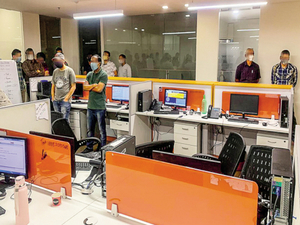
GURUGRAM: A call centre that had in just three weeks of existence allegedly cheated more than 30,000 Americans by posting malware links on their PCs and then offering technical support to fix it was found operating from an upscale business centre on Sohna Road on Saturday by the CID’s chief minister’s flying squad.

Ironically, the two who ran the criminal operation are familiar faces for the law. They had been arrested last year running a similar bogus call centre from Udyog Vihar but were out on bail and had got right back to the swindling business.

Vikram Verma, a resident of Delhi, and his partner Rishab, a resident of Gurgaon, have been charged under section 420 (cheating) and 120B (criminal conspiracy) of the IPC and sections of the of IT Act in the FIR filed at Sadar police station.

The Sohna Road call centre underscores the law and order challenge cyber police still face in the national capital region, which has been on the radar of international law enforcement agencies, including America’s FBI, since a large number of crook calls were traced to cities around Delhi, particularly Gurgaon and Noida. Over the past couple of years, several large call centres, primarily targeting American citizens, have been busted.

Sixteen such call centres have been found to operating just in the last 36 months. This January, a call centre operating from Udyog Vihar was busted and around 30 people were detained. It had collected millions by cheating residents of the US and Mexico by pretending to be customer associates of Amazon.

In November 2018, youths sitting in Gurgaon conned hundreds of people by sending pop-ups to people in the US, UK, Canada, Australia to make it appear that their computers were attacked  by virus. They then posed as Microsoft representatives and offered technical support in exchange of payments. The menace had become so huge that Microsoft had asked FBI to help in the investigation.

 In May this year, around seven people were arrested from Noida for cheating US residents using the same modus operandi.The 38-seater call centre, which was operating without a licence since July 13 from JMD Megapolis on Sohna Road, used to send pop-ups warning of a system lockdown and asking users to call on certain toll-free numbers to get their computers protected against a one-time payment. The fraudsters also convinced many users to buy anti-virus of reputable companies and charged them via iTunes cards as well as gift cards. They would charge $250 or more from each user. The gift cards were routed  to bank accounts in India via Europe and China.

DSP (CID) Inderjeet Yadav said, “A raid was conducted on Saturday and around 26 youths, including seven women, were found working at the call centre named Green Rock Enterprise and owned by Verma,” he said, adding that around 25 employees were also working from home.

Yadav said that the accused had a partner in the US who used to provide them with citizens’ data. All the employees working at the call centre were paid between Rs 15,000 and Rs 25,000 per month. They have not been arrested yet but are being questioned.

Transfer NCB to new car by cancelling old car’s insurance livemnt . Updated: 22 Jul 2014, 07:25 PM IST Abhishek Bondia You can apply for a NCB retention letter within 90 days from the date of sale

iStockPhoto
I have had a car for five years and plan to buy a new car. Can I transfer the NCB to my new car? —Rajeev Singh
You can transfer the NCB to a new car by cancelling the old car insurance. Upon cancellation, you will receive an NCB retention letter from your current insurer. Present the NCB retention letter to the new car’s insurer to avail the bonus.
The insurer will ask for the following documents to issue the NCB retention letter:
- Request letter for policy cancellation
- Original policy copy and certificate of insurance (also called Form 51)
- Form 29 (notice of transfer of ownership of a motor vehicle)
- Form 30 (application for intimation and transfer of ownership of a motor vehicle)
- Photocopy of registration certificate book with name of the new owner
- Proof of delivery of car to the new owner
The last four documents are only required if you are selling your old car. Though technically, it is possible to transfer NCB without selling the old car. Several insurers insist on ownership transfer. I interviewed frontline executives of five insurers and got a different view from each. A transfer to a spouse or family member is considered valid. You can apply for a NCB retention letter within 90 days from the date of sale. The retention letter is valid for three years. So, do the paperwork much in advance before you actually buy your next car.

Friday, August 7, 2020

How A Russian Cargo Ship's Unscheduled Port Visit Led To Beirut Disaster "They were being greedy," said Boris Prokoshev, who was captain of the Rhosus in 2013 when he says the owner told him to make an unscheduled stop in Lebanon to pick up extra cargo.

 How A Russian Cargo Ship's Unscheduled Port Visit Led To Beirut Disaster

Moscow: 

The chemicals that went up in flames in Beirut's deadliest peace-time explosion arrived in the Lebanese capital seven years ago on a leaky Russian-leased cargo ship that, according to its captain, should never have stopped there.

"They were being greedy," said Boris Prokoshev, who was captain of the Rhosus in 2013 when he says the owner told him to make an unscheduled stop in Lebanon to pick up extra cargo.

Prokoshev said the ship was carrying 2,750 tonnes of a highly combustible chemical from Georgia to Mozambique when the order came to divert to Beirut on its way through the Mediterranean.

The crew were asked to load some heavy road equipment and take it to Jordan's Port of Aqaba before resuming their journey onto Africa, where the ammonium nitrate was to be delivered to an explosives manufacturer.

But the ship was never to leave Beirut, having tried and failed to safely load the additional cargo before becoming embroiled in a lengthy legal dispute over port fees.

"It was impossible," Prokoshev, 70, told Reuters of the operation to try and load the extra cargo. "It could have ruined the whole ship and I said no," he said by 'phone from his home in the Russian resort town of Sochi on the Black Sea coast.

The captain and lawyers acting for some creditors accused the ship's owner of abandoning the vessel and succeeded in having it arrested. Months later, for safety reasons, the ammonium nitrate was unloaded and put in a dock warehouse.

On Tuesday, that stockpile caught fire and exploded not far from a built-up residential area of the city. The huge blast killed 145 people, injured 5,000, flattened buildings and made more than a quarter of a million people homeless.

The ship might have succeeded in leaving Beirut, had it managed to load the additional cargo.

The crew had stacked the equipment, including excavators and road-rollers, on top of the doors to the cargo hold which held the ammonium nitrate below, according to the ship's Ukrainian boatswain, Boris Musinchak. But the hold doors buckled.

"The ship was old and the cover of the hold bent," Musinchak said by 'phone. "We decided not to take risks."

The captain and three crew spent 11 months on the ship while the legal dispute dragged on, without wages and with only limited supplies of food. Once they left, the ammonium nitrate was unloaded.

"The cargo was highly explosive. That's why it was kept on board when we were there ... That ammonium nitrate had a very high concentration," Prokoshev said.

BOUND FOR MOZAMBIQUE

Prokoshev identified the ship's owner as Russian businessman Igor Grechushkin. Attempts to contact Grechushkin were unsuccessful.

The ammonium nitrate was sold by Georgian fertiliser maker Rustavi Azot LLC, and was to be delivered to a Mozambique explosives maker, Fabrica de Explosivos.

A senior representative for Fabrica de Explosivos did not immediately respond when sent a request for comment on LinkedIn.

Levan Burdiladze, the Rustavi Azot plant director, told Reuters that his company had only operated the chemical factory for the last three years and so he could not confirm whether the ammonium nitrate was produced there.

He called the decision to store the material in Beirut port a "gross violation of safe storage measures, considering that ammonium nitrate loses its useful properties in six months."

Initial Lebanese investigations into what happened have pointed to inaction and negligence in the handling of the potentially dangerous chemical.

Lebanon's cabinet on Wednesday agreed to place all Beirut port officials who have overseen storage and security since 2014 under house arrest, ministerial sources said.

The head of Beirut port and the head of customs said that several letters were sent to the judiciary asking for the material be removed, but no action was taken.

Reuters could not immediately reach Lebanon's justice minister for comment. The Justice Ministry is closed for three days of national mourning.

According to Prokoshev, the ship had been leaking but was seaworthy when it sailed into Beirut in September 2013. However, he said Lebanese authorities paid little attention to the ammonium nitrate, which had been stacked in the hull in large sacks.

"I feel sorry for the people (killed or injured in the blast). But local authorities, the Lebanese, should be punished. They did not care about the cargo at all," he said.

The abandoned Rhosus sank where she was moored in Beirut harbour, according to a May, 2018 email from a lawyer to Prokoshev, which said it had gone down "recently".

(Except for the headline, this story has not been edited by NDTV staff and is published from a syndicated feed.)

Promoted

Thursday, August 6, 2020

25 learnings for India from China Standoff -Source-Rediff.com -used here for educational purposes only


By SANJEEV NAYYAR
August 06, 2020 10:05 IST

Just like China wants Trump to lose the US presidential poll, it may want Modi to lose the Lok Sabha polls.
So months before the 2024 elections, China may take possession of an important area, say one of the Char Dhams, warns Sanjeev Nayyar.
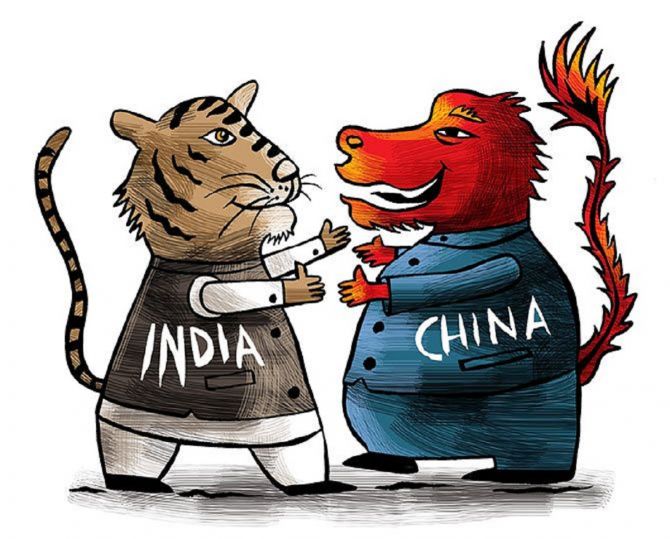
Illustration: Uttam Ghosh/Rediff.com
Now that the latest India-China stand-off does not seem to be ending, it might be useful to reflect on the learnings for India.
Post Pokhran 2, then defence minister George Fernandes justified India's second nuclear explosion by naming China as 'India's Enemy No 1'.
Twenty-two years later, the current stand-off has resulted in the average Indian too seeing China as enemy number one, thanks to the Galwan Valley clash in which 20 Indian soldiers made the supreme sacrifice.
Here are some key learnings and observations for India on how to handle the dragon to our eastern borders.
1. Never trust the Chinese. ]=;They have mastered the art of deception. As Geostrategist Brahma Chellaney wrote (external link), 'Deception, concealment and surprise have driven China's repeated use of force -- from seizing the Johnson Reef in 1988 and the Mischief Reef in 1995 to occupying the Scarborough Shoal in 2012 and now vantage locations in Ladakh. It has changed the South China Sea's geopolitical map without firing a shot or incurring any international costs.'
2. Never let your guard down. Political leaders might shake hands, but the Indian armed forces should always be on the alert, and plan for the unexpected.
3. The Chinese respect strength, both economic and military power. India should work towards building both.
4. The Chinese hate to lose, so expect them to be back in Ladakh with renewed vigour or they will acquire new areas that makes the current understanding irrelevant.
5. Iran, North Korea and Pakistan are among China's best friends. Their plans will now work more in tandem than ever before and require close observation.
6. The Chinese cherry pick agreements. Former foreign secretary Kanwal Sibal wrote (external link), 'China has repeatedly demonstrated that either it does not respect the agreements it signs or interprets them as it wants. In 1996 it agreed to 'clarifying the alignment of the LAC in those segments where they (the two sides) have different perceptions In 2002, China decided to repudiate this agreement unilaterally.'
7. India need not always play by the rule book or go by signed agreements, but be driven by national interests alone. Remember the story of Ashwatthama in the Mahabharata.
8. Appeasement postpones but magnifies problems. For decades successive Indian governments have been sensitive to Chinese interests.
What India got in return was encroachment of its territory, arming of Pakistan by China and Galwan Valley clash!

9. India must accept that China and Pakistan are made for each other. Former high commissioner to Pakistan G Parthasarathy wrote (external link), 'Nawaz Sharif described his country's relations with China as: 'Sweeter than the sweetest honey'/. Pakistan's ambassador to China gushingly described the Sino-Pakistan relationship as: 'Deeper than the ocean, higher than the mountains and stronger than steel'.
Remember that China protects 'Pakistan-based terrorist groups like the LeT and JeM from international sanctions in the United Nations'.
Therefore, India should expect that China would continue to support Pakistan in every way and prepare for a two-front war, with China and Pakistan, in the next three years or risk losing parts of Arunachal Pradesh and Ladakh.

10. China has a bigger economy and is a stronger military power than India, but Indians are no pushovers either.
We must stop underestimating ourselves, at the same time not underestimate Chinese intent to harm India's rise non-stop.
Former ambassador P Stobdan wrote (external link) in India Today, 'India is not a pushover like the three Central Asian states of Kazakhstan, Kyrgyzstan and Tajikistan, with which China fixed boundary settlements in its favour through a blend of 'incentives with coercion' pressure tactics.'

11. China follows the creeping acquisition route. They take possession of a small area of another country. If the protests are not strong enough they continue.
The Dalai Lama said on Rediff.com, 'The Chinese way... is to do something rather mild at first; then to wait a bit, and if it passes without objection, to say or do something stronger. But if we take objection to the first statement or action, they urge that it has been misinterpreted, and cease, for a time at any rate, from troubling us further.'

12. China is used to presenting countries with a fait accompli, for example, the road through Eastern Ladakh from Sinkiang to Tibet via eastern Ladakh or Aksai Chin.
If China wants such favours there should be a clear strategic status quo.
Strategic affairs analyst Maroof Raza wrote (external link) in The Tribune, 'If China has control over the Galwan valley, the Depsang plains (north of Leh) will greatly shorten the route taken by the Chinese -- to link up with the Shaksgam valley, that China first grabbed and then made Pakistan 'temporarily' gift it to Beijing! This valley, though inhospitable, has the largest collection of glaciers (over 250 to be precise) that China regards as a source of water to further its agenda of world domination.'

13. Talks with China on the boundary question must take place only when China submits its version of the Line of Actual Control. So far China has not given India any such maps.
14. India must remember that China has deliberately kept the border dispute unresolved so as to keep India off balance and 'reduce its maritime military investments'.
15. The Chinese strategy is to win without fighting. They captured the US market with low cost products such that US industry became dependent on it. They are replicating the same strategy with India.
India needs to enhance domestic production and design capabilities so that dependence on China reduces.
Similarly, they take possession of a country's territory, then negotiate a pullback by which they continue to be in possession of the country's territory and simultaneously ensure Indian Army pulls back from its own territory. Brahma Chellaney says it is part of the well-known 'advance ten miles, retreat six miles strategy'.

16. Gautam Chikermane of the Observer Research Foundation, summed up the Chinese approach in his tweet: 'How China negotiates 101: First intrude, then seek "partners". First attack, then talk "peace". First create zero-sum, then push for "win-win". First build suspicions, then ask for "trust". First go backwards, then pursue "forward".
17. Boycott Chinese products. Start with not buying Chinese brands. So if I have to buy a laptop I will buy an American brand, even if it is made in China, instead of a Chinese one. Companies that own brands make profits, not the ones who contract manufacture.
Indian consumers must not buy products of companies who indulge in 'lazy manufacturing', meaning Indian companies who import a finished product from China, stamp their brand name and then sell to consumers.

18. The Government of India must remember that diplomacy works best when it is backed by military power. So India must arms itself adequately, enough to fight a two-front war.
19. Present-day China is 'centred on the rhetoric of national rejuvenation', according to Aswini K Mahapatra (external link).
Deeper intent is to end China's humiliation and restore to its historical position, returning China to its rightful position in the world stage.
'Likewise,' he adds, 'China's assertion of territorial claims, whether in the South China Sea or in the East China Sea over Japan's Senkaku islands or over territory along the India-China border, including Arunachal Pradesh, has much to do with its national rejuvenation logic.'
The Chinese want to retrieve lands they feel were theirs before the Western and Japanese invasions of the 19th century, hence the current aggression.

20. China wants the 21st century to be the Chinese century and not an Asian century.
Even though many Indians are not aware of it, China is aware of India's potential and hence wants to 'thwart India's rise to the global high table'.
How many Indians know that Indian masters helped the Chinese deal with epidemics between the 1st and 8th centuries AD, as Prof Dr Shashi Bala recently wrote (external link) in Bhavan's Journal.

21. Whilst building strategic border roads, India must check whether it occupies the mountain heights, to prevent a Kargil-like situation where Indian convoys were fired from hill tops by Pakistanis, to ensure the enemy does not dominate the road.
22. Indians must note that jingoism works with Pakistan, whilst low key dialogue works better with the Chinese.
23. Water could be another weapon that China would use aggressively against India.
Sonali Mitra wrote (external link), 'The absence of data sharing on the Brahmaputra during and after the Doklam standoff and lack of clarity on the intent behind the 1,000 m⎯long tunnel to transfer water from Yarlung Tsangpo in Tibet to Xinjiang betray China's self⎯declared 'responsible' behaviour involving transboundary waters.'

24. Just like China wants Donald Trump to lose the coming US presidential poll, China may want Modi to lose the Lok Sabha polls.
So months before the 2024 elections, China may take possession of an important area, say one of the Char Dhams.
Options given to Modi would be war or give up all claims on Gilgit/Baltistan if he wants the possessed area or tirth sthan back.

25. India all along has been too sensitive to China's concerns. So India must:
  • Ask what it has achieved by being sensitive to China's concerns.
  • Start exporting arms, for example the Brahmos missiles to countries like Vietnam and Indonesia.
  • Establish diplomatic relations with Taiwan.
  • Establish close economic, defence and tourism ties with countries of South East Asia with whom India has centuries-old civilisational linkages.
  • Award the Dalai Lama the Bharat Ratna.
    Prepare a comprehensive plan to increase domestic production of key items like active pharmaceutical ingredients where India depends on China substantially for supplies.
  • Note that Indian pharma companies can export medicines to the West because of API that comes from China. If China chokes the supplies, the world gets affected.
  • Organise packaged tours to Daulat Beg Oldi, close to the Xinjiang Highway. Tourists are one way of saying the territory is India's.
  • Make one organisation responsible for guarding the Line of Actual Control. Currently, the LAC is guarded by the Indian Army and the Indo-Tibetan Border Police. So let the army control the ITBP, but the responsibility should be made clear.
China will treat India with respect only when India increases the cost for Chinese expansionism and makes the Chinese lose face.

Sanjeev Nayyar is a chartered accountant and founder, www.esamskriti.com.