Pages

Tuesday, August 18, 2020

AGR case: Supreme Court asks government if Jio should bear Rcom AGR dues :-ET


Synopsis

The three-judge bench also asked RCom to explain the fall in the value of its assets, even as the government stressed that airwaves of all telcos, including that of bankrupt companies like RCom, belong to the government.


The Supreme Court asked the government to clarify its stand if Reliance Jio should bear the adjusted gross revenue (AGR) liabilities of Reliance Communications  (RCom) for using its spectrum.


The three-judge bench also asked RCom to explain the fall in the value of its assets, even as the government stressed that airwaves of all telcos, including that of bankrupt companies like RCom, belong to the government.

RCom's drop in valuation was one of the moot points on Monday's adjusted gross revenue (AGR) hearing as the apex court wanted to know details of the resolution plan for the bankrupt telco and its units.


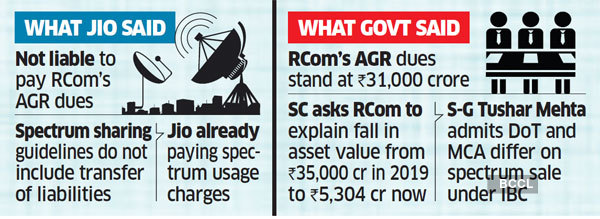
Senior advocate Shyam Divan told the court that Rcom and its units -Reliance Telecom and Reliance Infratel's value eroded from Rs 35,000 crore in 2019 to Rs 5,304 crore as on date of liquidation with a fair value approx. Rs 10000 crore.
Untitled-5

RCom which went bust under a debt Rs 46,000 crore , is awaiting approval from the National company Law Tribunal (NCLT) so that its towers can be sold to Reliance Jio and spectrum, fibre and data centre to asset reconstruction firm UVARCL.

For RCom, its 800 Mhz spectrum in 13 circles is its most valuable asset and it is the dues over spectrum that is now the new battlefront in the AGR crisis. SC's directions on whether spectrum can be traded to resolution applicants will pave way for other insolvent telcos like Aircel, whose assets incidentally are also bought by UVARCL.


"Can spectrum be bought and sold under IBC?', the bench led by Justice Arun Mishra, who was sitting with Justices S. Abdul Nazeer and M.R. Shah.

Solicitor General Tushar Mehta told SC that the Department of Telecommunications’ (DoT) view differs from views of Ministry of Corporate Affairs (MCA) on sale of spectrum under IBC, thereby opening up another line of arguments which will impact in insolvency of both Rcom and Aircel.

However , people aware of the insolvency details of the two bankrupt telcos have said that if spectrum is taken away, then they will head towards liquidation as all resolution plans will fall flat. The court will take up the case on Tuesday.


Monday, August 17, 2020

Guardian of the skies: Five facts about DRDO-developed anti-drone system :livemint. Updated: 15 Aug 2020, 02:10 PM IST

DRDO’s anti-drone system stationed near the Red Fort on Saturday.(ANI Photo)
An anti-drone system developed by the Defence Research and Development Organisation (DRDO) was deployed near the Red Fort on Saturday on the occasion of the 74th Independence Day. Unprecedented security ring was thrown around the Red Fort from where PM Modi delivered his Independence Day speech, listing his government’s past achievements and presenting the roadmap for the future.
Five facts about DRDO developed anti-drone system:
  • The DRDO-developed system can detect and jam micro drones up to 3 kilometres and use laser to bring down a target up to 1-2.5 kilometres depending on the wattage of laser weapon.
  • The DRDO system can detect and identify drone threats at a moment’s instance and terminate them. Unmanned aerial vehicles, mostly of small size, are called drones. They are controlled remotely and can be utilised by miscreants or militants for carrying explosives apart from other threats they pose.
  • It can be an effective counter to increased drone-based activity in the western and northern sectors of the country.
  • The DRDO system successfully neutralised an incoming drone during trials using its kill system. The counter drone system has capabilities to both detect and destroy drones in air.
  • The DRDO counter drone system was first deployed to provide security cover to the Republic Day Parade this year which was attended by Brazilian President Jair Bolsonaro and Prime Minister Narendra Modi, along with other dignitaries.
  • The system was also deployed in Ahmedabad for the Modi-Trump roadshow where they were tasked to thwart any aerial threat from drones.

US investors' rights law firm announces probe against HDFC Bank The investigation is reportedly resulting from allegations that HDFC Bank may have issued materially misleading business information to the investing public. Dinesh Unnikrishnan

Image result for pic of hdfc bank

American Law firm, Rosen Law, has announced an investigation of potential securities claims on behalf of shareholders of HDFC Bank. The firm is also preparing for a class action suit on behalf of bank’s shareholders.
The investigation is reportedly resulting from allegations that HDFC Bank may have issued materially misleading business information to the investing public.
Rosen Law, on its website, asked investors to provide their details if they have purchased HDFC Bank Limited securities and would like to receive information about the investigation concerning the class action to recover the investor losses in HDFC Bank Limited securities.
“A representative of The Rosen Law Firm will contact you at no cost to you and provide you detailed information concerning the proposed class action to recover your losses in HDFC Bank Limited securities,” said the firm.
The charges include bank’s executives forcing the borrowers to buy GPS devices bundled with the auto loans and even insisting that loans will not be sanctioned unless they buy these devices. The devices, manufactured by a Mumbai firm, Trackpoint GPS, cost about Rs 18,000 a piece. Following an internal investigation, the bank had sacked some executives.
The misconduct by the bank officials was acknowledged by Puri himself in the bank’s AGM during which he said that an internal probe was conducted against a few erring employees and appropriate action was taken.
Soon, reports emerged that the bank has sacked six officials in connection with the case and that the RBI has sought details of the probe.
The US security firm’s probe is happening at a time when there are only two months left for current CEO of the bank, Aditya Puri, to retire from service after 26 years in the post. Sashidhar Jagdishan, an insider, has been named as the new CEO of the bank to succeed after Puri's term ends.
Source:-moneycontrol

Japan economy shrinks record 7.8% in April-June livemint. Updated: 17 Aug 2020, 07:27 AM IST

FILE PHOTO - Japan's Prime Minister Shinzo Abe holds a news conference on Japan's response to the coronavirus disease (COVID-19) outbreak, at his official residence in Tokyo, Japan,  (REUTERS)

Japan's economy shrank a record 7.8 percent in the April-June quarter, the worst contraction in the nation's modern history, data showed Monday, as the coronavirus deepens the country's economic woes.
The contraction from the previous quarter was slightly worse than expectations but is still significantly less severe than declines seen in many other industrial economies.
Still, it is the worst economic contraction for Japan since comparable data became available in 1980, eclipsing the brutal impact of the 2008 global financial crisis.
And some analysts labelled it the worst fall since data began to be compiled in 1955, though a change in calculation methods in 1980 makes the comparison complicated.
It was the third straight quarter of negative growth, confirming a deepening recession for Japan, and raising the prospect that the government will consider pumping further stimulus into the economy.
"The fall of the Japanese economy in April and May under the state of emergency went beyond expectations. Record falls are expected in both internal and external demand," Yoshiki Shinke, chief economist at Daiichi Life Research Institute, wrote in a note before the official release of the data.
- Coronavirus deepens recession -
The economy contracted an annualised 27.8 percent, with domestic demand falling 4.8 percent and exports of goods and services plunging 18.5 percent.
But imports fell only 0.5 percent, faring better than the 4.2 percent fall seen in the January-March period.
For the past year to March 2020, Japan's real GDP came to 0.0 percent, compared with a 0.3 percent growth seen in fiscal 2018, the Cabinet Office said.
Japan was already struggling with a stagnating economy and the impact of a consumption tax hike implemented last year before the pandemic hit.
It has seen a smaller coronavirus outbreak compared to some of the worst-hit countries, with infections approaching 55,000 and deaths at slightly under 1,100.
A nationwide state of emergency was imposed as cases spiked in April, but the restrictions were significantly looser than in many countries, with no enforcement mechanism to shutter businesses or keep people at home.
The emergency was lifted in June, and the government has been reluctant to reintroduce measures, even as infections rise again.
Some recovery was seen in Japan after the government lifted the state of emergency, but it was not enough to offset the severe falls felt in April and May, Shinke said.
- Hope for recovery -
The contraction in April-June compared with the market's expectation of a 7.6 percent contraction, the median forecast of major economists surveyed by the Nikkei business daily.
The figure was less severe than quarter-on-quarter falls in some other major economies, including the United States, which logged a 9.5 percent contraction, and Germany with a 10.1 percent decline for the same quarter.
Japan imposed looser restriction against the coronavirus and fared better than its industrial peers, said Naoya Oshikubo, senior economist at SuMi Trust.
"A collapse in personal consumption... will be the largest single factor behind weak domestic demand. Personal consumption was particularly weak in April-May when the national state of emergency was in effect in Japan," he wrote before the data was published.
"Capital investment was also impacted by the COVID-19 pandemic as uncertainty meant companies put their investment plans on hold," Oshikubo said.
Despite the figures, analysts said the economy could now expect a rebound, with Oshikubo projecting 2.6 growth for the July-September quarter.
"The recovery will likely be driven by rising domestic and external demand in addition to normalisation in Western nations as many countries' lockdown measures are lifted," Oshikubo said.
Personal consumption, which fell 8.2 percent in the April-June quarter, should benefit from a government stimulus payment of 100,000 yen ($939) to all residents of Japan, he said.
This story has been published from a wire agency feed without modifications to the text. Only the headline has been changed.

Saturday, August 15, 2020

Court drags Mukesh Ambani into AGR Spectrum :-Supreme Court asks Jio why it shouldn't be paying AGR dues for the RCom spectrum it uses .


Jio has cleared its own AGR dues of Rs 198 crore while Rcom now owes the government Rs 25,194.58 crore in statutory dues, including those of Sistema Shyam Teleservices (Rs 222.1 crore), which was merged with it.
Image result for Pic of Reliance JioReliance Communications likely to oppose Ericsson's insolvency bidHow far behind is Anil Ambani from his brother Mukesh Ambani


New Delhi | Mumbai: The Supreme Court on Friday said Reliance Jio must pay adjusted gross revenue (AGR) dues of Reliance Communications NSE 4.44 % since it has been using the latter’s spectrum since 2016, and asked all bankrupt telcos — who have expressed their inability to pay dues worth ₹57,000 crore — to explain who used their airwaves while the insolvency resolution proceedings were on.

“Reliance Jio must pay ailing RCom’s AGR dues if it has been using RCom’s spectrum since 2016,” a three-judge bench led by justice Arun Mishra observed. The top court was examining whether claims of these companies under the Insolvency & Bankruptcy Code (IBC) were bona fide.

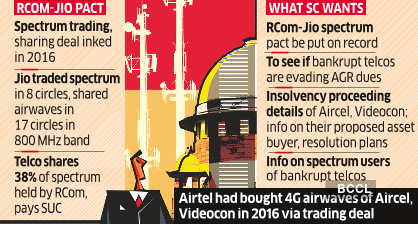
The bench also sought details of who was using the spectrum of Aircel and Videocon, the other two ailing telecom companies. Back in 2016, Airtel had bought Aircel’s 4G airwaves in the 2,300 MHz band and Videcon’s 4G spectrum in the 1,800 MHz band through the spectrum trading route. Earlier this year, the National Company Law Tribunal (NCLT) approved the sale of Aircel’s assets to UV Asset Reconstruction Company (UVARCL).

“Is Reliance Jio using RCom’s spectrum? If so, since when?” the bench asked the RCom’s resolution professional who was represented in the court by senior advocate Shyam Divan.

Divan said that “a part” of the spectrum was “lying idle” and “another part” was being “shared” with “Reliance Jio” under a 2016 deal. That involved use of 800 MHz spectrum. The bench then sought to know why it should not assign the whole of the AGR dues of RCom to Jio to be paid off.

“How can you avoid liability of paying AGR dues? We catch hold of you (Jio) and make you pay. The person using spectrum must pay. Why should we not treat the (2016) deal as effectuated?” asked the bench.

Reliance Jio, through its advocate KV Vishwanathan, argued that spectrum “trading” and “sharing” were two different things and “sharing” would only entail paying spectrum usage charges (SUC). He sought more time to argue these points.

The top court bench also demanded to know who was buying RCom through the insolvency resolution process.

RCom Owes Govt ₹31,000 Crore

Ericsson had settled and China Development Bank had withdrawn from the resolution process, justice Mishra observed. “So why is RCom still in resolution?”

ETD-1-15082020

Justice Mishra, who was sitting with Justices S Abdul Nazeer and MR Shah, sought details of the identity of the owner of UVARCL, the company which has been cleared by RCom’s panel of lenders to buy its spectrum. UVARCL has also bought Aircel’s assets, including airwaves.

Friday’s development comes as an unpleasant surprise for Reliance Jio which appeared to have been the least affected by the top court verdict of October 2019 that had widened the definition of AGR to include non-core items.

Jio had cleared its own AGR dues of ₹195 crore. RCom owes the government ₹31,000 crore in statutory dues, including those of Sistema Shyam Teleservices, which was merged with it, as per the government’s submissions in the last hearing.

RCom and its unit Reliance Telecom (RTL), once owned by Anil Ambani, Mukesh’s younger brother, had entered into an agreement with Jio in 2016 for trading spectrum in eight circles and sharing airwaves in 17 circles.

Jio shares around 38% of total spectrum currently held by RCom, on which SUC is being paid as required under the rules, a person familiar with the matter said.

“The AGR dues of RCom and RTL are in no manner connected with this shared spectrum... AGR has been paid by by both RCom/RTL and RJIL on the revenue generated from the shared spectrum,” the person said.

The SC bench has been trying to find ways to ensure that all telcos pay up their AGR dues. While it has so far managed to get the profitable ones to commit to pay within a deadline which is yet to be fixed, the top court is still grappling with how to recover the dues from those who claim to be bankrupt.

‘Spectrum Owned by Sovereign’

“We need to secure the AGR dues. Spectrum is owned by the sovereign. The government parts with what is a natural resource which is held by the government as a public trustee,” justice Mishra said. “How can the sovereign’s revenue-sharing process (involving spectrum) be overriden by other debtors? How can secure creditors get everything?”

The resolution process ensures that the financial creditors i.e. banks get their dues. But not the government which was only an operational creditor. The telcos have claimed that the spectrum licences that they hold are assets in their hands which could be sold to pay off their dues. The government has contested a finding to this effect by the NCLT and National Company Law Appellate Tribunal in the Aircel case but that is yet to be decided.

The bench stated in no uncertain terms on who would decide the fate of spectrum. “We are the master of the spectrum. We can’t allow NCLT and NCLAT to fritter it away. We will ensure that the government dues are paid.

Source:-Economic Times :-used here for educational purposes for CS students and pictures added for making the topic understanable.


Indian National Anthem | Instrumental

The World's Biggest Indian National Anthem Gathering

Jana Gana Mana (HD)#National Anthem#Lyrics - Best National Anthem Song S...

HAPPY INDEPENDENCE DAY 2020 :-AUGUST 15

Happy Independence Day 2020 wishes| Independence Day 2020: Quotes ...
BEST INDEPENDENCE DAY QUOTES 2020, 15 AUGUST BEST QUOTES 2020 | by ...Independence Day Wishes 2020: Send These Patriotic Messages And ...

Friday, August 14, 2020

Restrictions on cash transactions under Income Tax laws: Here’s all you wanted to know By: Balwant Jain | Updated: Aug 14, 2020 12:53 PM Financial Express

cash transactions, Restrictions on cash transactions, Income Tax Act 1961, Restrictions on cash transactions under Income Tax laws, cash transaction limit, cash transactions above 10000, cash transactions restrictions, cash transactions above 2 lakhs

The income tax laws in India have various restrictions on payment in cash and receipt of money in cash in respect of various transactions. Some restrictions apply to those who are engaged in business or profession and some apply to all the persons.

Let us discuss what are such restrictions:

Restrictions on those carrying on business or profession

If you are carrying on business or profession, the tax laws have prescribed a daily limit of Rs 10,000 beyond which payments in cash cannot be made for any expenditure to a single person. If you fail to do so, the expenses paid in cash will not be eligible for tax deduction. There is one exception to this rule where you can pay up to Rs 35,000 to a transporter in a day without attracting the disallowance.Likewise in case you pay any amount beyond Rs 10,000 for acquiring any asset, such payment is not allowed to be added to the cost of the asset for the purpose of claiming depreciation. So, effectively this expenditure is also disallowed though over the years and not necessarily in the year of payment.

Restrictions applicable to all the persons

# Restrictions on acceptance and repayment of loan: The tax laws have provisions under which you are not allowed to accept or repay any loan beyond the initial limit of Rs 20,000. Though it does not have any impact on your tax liability, but in case of default, the tax officer can levy a penalty equal to the amount of loan accepted or repaid. This threshold is not applicable for each of the transactions of a loan but will apply to every transaction irrespective of the value, once the outstanding amount of loan exceeds Rs 20,000, including the payment being made. Likewise repayment of even a single rupee cannot be made in cash if the balance in the loan account is more than 20,000 at the time of repayment. The acceptance or repayment can be made in cash as long as the balance in the loan account does not exceed the threshold of twenty thousand rupees.
The restrictions in respect of loans are not applicable for transactions with bank, government, Government Company or corporation and other entities if specified by the government. Your home loan will not get covered under these restrictions and you can repay your home loan in cash beyond twenty thousand rupees.
# Restrictions in respect of certain deductions available from your income: In respect of certain payments for which you are eligible to claim deduction from your taxable income, the tax laws have some ceiling for payment in cash. Deduction under Section 80D is not admissible if the premium for health insurance policy is made in cash. However, payment for preventive health check, for which there is a sub limit of Rs 5,000 under Section 80D, can be made in cash. The restrictions of cash payment will also apply in case of deduction under the same section for medical expenses for a senior citizen who does not have health insurance.
Likewise, claims for certain deductions for donations under Section 80G cannot be made if a donation beyond Rs 2,000 is made in cash. The restriction of Rs 2,000 is applicable for each donation and not for all donations in aggregate.
# Blanket restrictions on acceptance of money beyond Rs 2 lakh: The tax laws have one more all pervasive restrictions under Section 269ST whereby a blanket restriction has been placed on receipt of money by any person for an amount of Rs 2 lakh and above. This restriction is applicable to the recipient and not to the payer. The restriction is applicable in respect of receipt of money for each occasion or for each transaction and not necessarily for aggregate of payments in a single day.
This provision has been brought in to curb the use of black money on various occasions like marriage, travel etc. and for which no deduction is claimed by the payer under the tax laws. For example, a caterer cannot accept Rs 2 lakh and more in aggregate for marriage reception form one person whether on a single day or over the period. Likewise, though there are no restrictions on receiving payment for sale of anything like gold jewellery, house or a plot of land etc. in general, but if the value of a single transaction is more than Rs 2 lakh, the seller cannot receive more than two lakh rupees either in full or in part for such transactions.
Likewise you cannot receive any gift beyond Rs 2 lakh in cash even in cases where the gifts are not treated as your income such as gifts received at the time of your marriage or from specified relatives. In case you receive payment in contravention of the above provision, the income tax officer can levy a penalty equal to the amount of money accepted in cash. Please note that there are no penal consequences for the person who is paying such money. The restriction of Rs 10,000 as discussed above is applicable for the person who wishes to claim it as business expenditure.
I am sure the information discussed above will be useful to you in preventing unpermitted cash transactions and, thus, avoid penal consequences.

“Chinese spy” held in 2018 arrested for 1000 crore ‘hawala racket’ in Gurugram (India)

Chinese national Luo Sang, who is alleged to be a Chinese intelligence operative is arrested for money laundering and hawala operation (TOI)
By Tenzin Dharpo
DHARAMSHALA, Aug. 13: A Chinese national earlier held for suspicion of impersonation and forgery has been arrested on Tuesday in the National Capital Region (NCR), for money laundering and hawala racket, after a massive search operation by the Delhi police.
On Tuesday, India’s tax department conducted searches in 21 locations in Delhi, Ghaziabad, and Gurugram after getting “credible information” of the Chinese involvement in money laundering and hawala network. The Central Board of Direct Taxes (CBDT) in a statement said, “Based on the credible information that few Chinese individuals and their Indian associates were involved in money laundering and hawala transactions through series of shell entities, a search action was mounted at various premises of these Chinese entities, their close confederates and couple of bank employees.”
The Chinese national identified to be Luo Sang, who held the fake identity ‘Charlie Peng’ was also arrested in connection with the money laundering and hawala racket. At the time of his arrest, security agencies seized two fake Aadhar cards, two forged Indian passports, a fake PAN card. Lou Sang still operates as Charlie Peng and lives in Gurugram. According to the CBDT, he was using 8-10 bank accounts and represented fake Chinese companies in hawala operations worth Rs 1000 crores.
Sang was earlier arrested in 2018, by a joint team of central intelligence agencies and the Delhi Police special cell for impersonation and forgery. He had married an Indian national to expedite acquiring an Indian passport.  The investigators alleged that he was working for Chinese intelligence agencies and running business of hawala transactions through a currency exchange firm, but he was granted bail by a Delhi court in 2019.
During the interrogations at the time, Sang reportedly admitted to various narratives including being a Tibetan fleeing Chinese persecution, a criminal who was forced into spying by the Chinese government as well as being a PLA soldier.  “He was a hard nut to crack. A trained spy, he confused his interrogators. He repeatedly changed his Chinese background story several times to hoodwink us,” recalled an official who questioned him in 2018, cited by Indian daily Times Now News.
The Indian news agency also revealed that Sang who admitted to interrogators of being a spy said that his two prime tasks were to somehow try to enter the inner circle of Dalai Lama for which he made several trips to Himachal Pradesh where the Tibetan leader resides and also to Majnu-ka-tilla Tibetan colony in Delhi. And to assist Chinese embassy officials help transfer money and arrange logistics for them like providing cars and arranging their travel.
In 2013, a Tibetan-origin man and suspected Chinese espionage operative Pema Tsering was arrested in McLeod Ganj, Dharamshala, where the exiled Tibetan leader His Holiness the Dalai Lama resides. Police at the time said that during interrogation, Tsering admitted to being an ex-member of the People’s Liberation Army (PLA) of China and also having served in the People’s Armed Police Force (PAPF).

Most of covid-related medical supplies are now produced in India :-livemint . Updated: 14 Aug 2020, 07:12 AM IST

A worker sorts through N95 masks. (REUTERS)
NEW DELHI : Most of the medical supplies needed for tackling the covid-19 pandemic are now being domestically manufactured, the Centre said on Thursday, indicating a boost to Atmanirbhar Bharat and Make in India campaigns.
Most products supplied by the government were not being manufactured in the country in the beginning. Additionally, rising global demand due to the pandemic led to them to become scarce in foreign markets, the government said.
The Centre has also been providing free medical supplies to states and Union territories to supplement their efforts to contain the spread of the disease.
Since 11 March, the government distributed over 30.4 million N95 masks and more than 12.8 million personal protection equipment kits to states, UTs and central institutions for free. Over 1.08 billion hydroxychloroquine tablets have also been distributed.
Besides, 22,533 Make in India ventilators were delivered to states, UTs and central institutions. The Centre is also ensuring their installation and commissioning, it added.
The ministries of health and family welfare, textiles, and pharmaceuticals, the department for promotion of industry and internal trade, and Defence Research and Development Organization encouraged and facilitated domestic manufactures to supply essential medical equipment.

What is faceless income tax assessment scheme? Key things to know livemint. Updated: 13 Aug 2020, 03:39 PM IST


PM Modi said that the launch will happen at 11 AM on Thursday. (MINT_PRINT)

Prime Minister Narendra Modi in his video conference on 'Transparent Taxation - Honoring the Honest' announced to launch Faceless Assessment, Faceless Appeal and Taxpayers Charter. While Faceless Assessment and Taxpayers Charter will come in force from today, Faceless Appeal will be available from September 25.
Under the Faceless Appeals system introduced by the government, appeals will be randomly allotted to any officer across the country and the identity of the officer deciding the appeal will remain unknown. Further, decisions will be team-based.
"Till now, all tax-related matters in a city are dealt by Income Tax department of that city, IT officers of that city play main role. Now on, using technology, scrutiny will be done by a randomly chosen IT officer anywhere in the country," said PM.
Here are the features of Faceless Appeals System:
  • Appeals to be randomly allotted to any officer in the country.
  • The identification of the officers deciding appeal will remain unknown.
  • The tax payer will not be required to visit the income tax office or the officer.
  • The appellate decision will be team-bSaed and reviewed.
Exceptions to Faceless Appeal
The exceptions to the Faceless Appeal includes, serious frauds, major tax evasion, sensitive and search matters. The system also excludes international taxation and Black Money Act & Benami Property.
Narendra Modi during his video conference said the goal is to make the system of filling ITR, seamless, painless and faceless.
PM also urged the citizens to be responsible and pay their taxes.
"Amidst all these efforts, the number of people filing income tax returns has increased by about two and a half crores in the last 6-7 years. But it is also true that in a country of 130 crores it is still very less," said the Prime Minister.
"Out of all the tax returns in the year 2012-13, there was scrutiny of 0.94%. In the year 2018-19, this figure has come down to 0.26%. This indicates that the scrutiny of the case has reduced by almost 4 times," PM added.