Pages

Tuesday, April 9, 2019

Government's inaction leads to salaries delay at BSNL partner firms Vihaan Networks Ltd and Himachal Futuristic Communications Ltd. employ nearly 3,000 individuals directly, in addition to an indirect workforce of close to 5,000.

By Muntazir Abbas
BSNL-agenciesImage result for HFCL GROUP PIC

NEW DELHI: Employee salaries of equipment vendors of state-run Bharat Sanchar Nigam Ltd. (BSNL) have got delayed with the stalling of the government project to connect uncovered villages, originally envisaged way back in September 2014. 

Domestic firms Vihaan Networks Ltd. (VNL) and Himachal Futuristic Communications Ltd. (HFCL), which had won gear supply contracts from BSNL for the ambitious telecom connectivity project, employ nearly 3,000 individuals directly, in addition to an indirect workforce of close to 5,000. 


“For the last several months, we are getting our salaries delayed by almost two-to-three weeks with the company sitting idle on one of our important telecom connectivity programs, it had won more than a year ago from BSNL,” a company's source said, adding that wages for field manpower are being continually delayed. 

HFCL founder Mahendra Nahata, however, in a statement, said that there has not been any delay in the payment of employee salaries. 

BSNL had been nominated for the Universal Service Obligation Fund (USOF)-driven contract for connecting the uncovered villages located at critical areas along the China border in Arunachal Pradesh as well as Assam. 

Queries to the USOF administrator, BSNL and Vihaan did not elicit any response. BSNL itself had delayed the February salaries to a majority of its staff by almost three weeks. 

Sources in the vendor-companies say they had taken bank credit, furnished bank guarantees (BG) as well as moved locally-made equipment to some sites, but there is no work at the project and hence no payments, adding to their financial burden. 

In addition, these vendors had employed workforce to maintain already-deployed sites identified by the Ministry of Home Affairs (MHA) under the Left Wing Extremism (LWE) initiative. 

The Northeast-I connectivity program to deploy 2,817 towers in 4,119 villages in Arunachal Pradesh and two districts of Assam— Karbi Anglong and Dima Hasao - had a deadline of December 2018. The initiative, a part of the Comprehensive Telecom Development Plan (CTDP), approved by Prime Minister Narendra Modi hasn't moved despite a recent reshuffling of government officials, including removal of then USOF administrator Sanjay Singh. Meanwhile, an official said that public interest litigation (PIL) was filed in the Delhi high court which is now in appeal before the Supreme Court. 

In the absence of any court direction, the mobile connectivity initiative in the areas of Arunachal Pradesh and Assam continues to hang in the balance. 

In January 2018, the USOF has inked a pact with BSNL to “immediately start” the mobile tower deployment under the Northeast-I initiative, but it did not release any advance as per the agreement that stated it to be paid within the two weeks. 

Payments to BSNL were stopped. The projects which should ideally go to BSNL were stationary and put to legal tangles so that they could not be completed,” Telecom Equipment Manufacturers Association (TEMA) chairman NK Goyal told ETT. 

The Northeast-I initiative was expected to boost BSNL’s revenue considerably, with the total project cost coming to Rs 2,200 crore, and despite telco’s reminders, the department’s fund allocation wing now headed by Ansuli Arya, is yet to give a nod. 

On Saturday, the All India Trade Union Congress (AITUC) said that a “deliberate attempt” is being made to shut down BSNL. 


Monday, April 8, 2019

GST portal updates: 11 new features on GSTN that you need to be aware of Tax filers who file their returns quarterly now do not have to wait for the quarterly filing of refund applications too. The portal has enabled the monthly filing option of the same. ET CONTRIBUTORS|Apr 08, 2019, 10.22 AM IST

GettyImages-954155950
By Archit Gupta


There have been several new updates on the GST portal over the last six months. The GST portal keeps rolling out new updates to help taxpayers file their returns more smoothly and effectively. Taxpayers need to stay up-to-date to avoid missing out on vital compliances, which in turn would prevent notices being issued to them. 


Here are some of the major updates that we have come across:
Comparison of liability declared and input tax credit claimed 

A new functionality released by the portal now helps tax filers in comparing their GSTR-3B tax liabilities with the GSTR-1s that have been filed. Likewise, users can also compare their input tax credit claimed in the GSTR-3B with the credit available in GSTR-2A. There are also 4 different tabs under which data validation and comparison can be carried out- 
  • Liability other than export/reverse charge
  • Liability due to reverse charge
  • Liability due to export and SEZ 
  • supplies
  • ITC credit claimed and due

  • This is a very useful functionality that will help in reconciling the GST returns filed, as well as in the preparation of the annual return. The data is available for both financial years, 2017-18 and 2018-19. 

GSTR-9 and GSTR-9A enabled for filing annual returns 
GSTR-9, the annual return form for normal taxpayers, and GSTR-9A, the annual return form for composition taxpayers have been recently enabled on the portal. Even though the due date has been extended till June 31, 2019 for filing the same, taxpayers are encouraged not to wait till the last moment, but file their returns as soon as possible. A guide for filing these returns is also available, which users can refer in the case of possible doubts.
Filing of Appeals can be done online
A taxpayer can now file an appeal online in the case of 
  • an order passed by an appellate authority
  • an advanced ruling by an appellate authority OR
  • an application to the appellate authority in the case of rectification of a mistake in an order.
A system generated acknowledgement will be issued if the appellate authority fails to issue a final acknowledgement within the stipulated time. The system generated acknowledgement will bear the remark “subject to validation of certified copies”. 

A taxpayer’s GSTIN can be entered while filing a refund application 
Due to the inverted duty structure under GST, a refund application can be filed by a registered taxpayer for accumulated input tax credit. The portal has enabled the entry of a taxpayer’s own GSTIN in the inward supply detail statement, while filing the same on the GST portal. This option wasn’t previously previously available. 

Quarterly-filers can file refund applications monthly 
Tax filers who file their returns quarterly now do not have to wait for the quarterly filing of refund applications too. The portal has enabled the monthly filing option of the same. However, in order to file the refund application, a user has to ensure that the GSTR-1 for the quarter has been filed. Businesses, especially SMEs, can mobilize their cash flows as they do not need to wait the end of the quarter to apply for a refund. 

New window enabled for claiming TDS/TCS credits 
The GST portal has enabled a new window for claiming TDS/TCS credits while filing GST returns. A taxpayer can accept or reject these credits, after which they get moved to the cash ledger. These credits can then be used for making GST payments. This function helps the taxpayers in identifying the credits available, and taking the required action. 

Responding to show-cause notices for compulsory withdrawal 
There is an easy way for Composition taxpayers to reply to show-cause notices that have been issued for compulsory withdrawal from the composition scheme. If a show-cause notice has been issued and if proceedings have been initiated, there is now the option to reply to the same on the portal. This saves time and has simplified responses for composition taxpayers. 

Bank account details can be given any time after registration 
For Normal, OIDAR and NRTP taxpayers, it is now optional to declare bank account details at the time of registration, and the same can be submitted later. Earlier, it was mandatory to submit these details at the time of registration, however, the same can now be given when logging in for the first time. Hence, for new business, this is particularly useful as a GST registration number can be obtained without the hassle of needing to open a bank first. 
Input tax credit can be claimed, and amendment of B2B invoices of FY 2017-18 can be done up till March 2019 

Taxpayers can claim any input tax credit that was omitted to be claimed as of September 2018, as the portal has reopened the option. Even B2B invoices of the FY 2017-18 can be amended. Both facilities are available up till March 31, 2019. This would greatly help taxpayers who had made errors in reporting invoices or missed out on claiming input tax credit due to mistakes. 

6 preferred banks are now available while making payments 
While making GST payments, six preferred banks will now be available to a taxpayer to choose from. With this function on the portal, a user does not need to enter his bank details every time and can select the same from a drop-down menu. If a payment is made through a seventh bank account, then that bank account gets added, and the least used account gets removed. 

Import E-way bill data to file GSTR-1 
The GST Portal has been integrated with the E-way bill (EWB) portal, allowing taxpayers the seamless importing of data. Users can now import the B2B and B2C (large) invoices sections, as well as the HSN-wise-summary of outward supplies section automatically. Taxpayers can verify the data and then proceed, thus saving time and unnecessary data-entry. 

The writer is Founder & CEO ClearTax. 

BJP manifesto highlights: The 75 promises for India, Here's a look at the 75 resolutions that define BJP's vision for India. ET Online|Updated: Apr 08, 2019, 01.58 PM IST

Untitled-1

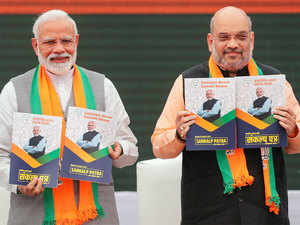
NEW DELHI: PM Narendra Modi, BJP President Amit Shah, and other senior party leaders today launched 'sankalp patra', BJP's manifesto for the upcoming Lok Sabha elections. Apart from making India the third largest economy of the world by 2030, Ram Mandir, doubling farmers' income, abrogation of Article 35A, also found mention in the ruling party's poll manifesto. Here's a look at the 75 resolutions that define BJP's vision for India. 


AGRICULTURE 
  • Achieve the target of doubling farmers’ income by 2022.
  • Enable the creation of 10,000 new Farmer Producer Organizations.
  • Ensure adequate market avenues for the realisation of MSP through e-NAM, GrAMs and Pradhan Mantri AASHA Yojana. Work towards ensuring that maximum farmers get income suppo.. under the Pradhan Mantri Kisan Samman Nidhi Yojana.
  • Launch a pension scheme for small and marginal farmers to ensure social 
  • after 60 years of age.
  • Work towards completing all irrigation projects under the Pradhan Mantri Krishi Sinchayi Yojana.
  • Provide short-term new agriculture loans up to Rs 1 lakh at 0% interest rate for 1-5 years on the condition of prompt repayment of the principal amount.
  • Increase the cropped area under irrigation.
  • Strive to ensure all-weather connectivity for every village.
  • Work towards assisting the maximum number of fishermen by ensuring 
  • the availability of storage and other infrastructure under a new ‘Matsya Sampada Yojana’.
  • Ensure 100% disposal of liquid waste and reuse of waste water.
  • Work towards digitising land records.

  • YOUTH AND EDUCATION 
    • Aim to cover all the secondary schools under Operation Digital Board.
    • Enable investment of . 1 lakh crore in higher education through Revitalising of Infrastructure and Systems in Education (RISE).
    • Work towards increasing the number of seats in premier management institutes.
    • Work towards increasing the number of seats in premier engineering institutes.
    • Work towards increasing the number of seats in premier law institutes.
    • Establish at least one Atal Tinkering Lab in every block.
    • Under a new 'Entrepreneurial Northeast' scheme, provide financial support to MSMEs and for employment generation in northeastern states.

    • INFRASTRUCTURE 
      • Ensure a pucca house to every family.
      • Ensure the LPG gas cylinder connection to all poor rural households.
      • Ensure 100% electrification of all households.
      • Ensure every citizen has access to a bank account.
      • Ensure a toilet in every household.
      • Ensure access to safe and potable drinking water for all households.
      • Complete Phase-1 of Bharatmala Project expeditiously.
      • Double the length 
      • national highways.
      • Ensure 100% waste collection under Swachh Bharat Mission to achieve ODF+ and ODF++ in cities and villages.
      • Ensure ODF status for all villages and cities.
      • Achieve 175 GW of renewable energy capacity.
      • Strive to achieve 10% blending of ethanol in petrol.
      • Connect every Gram Panchayat with high speed optical fibre network.
      • Ensure the supply of piped cooking gas in major Tier 1 and 2 cities.
      • Form a new 
      • Ministry of Water unifying the water management functions. This will help approach the issue of water management holistically and ensure better co-ordination of efforts.
      • Aim to increase the number of operational airpo..s to 150 for better air connectivity
      • Increase port capacity to 2,500 MTPA.

      • RAILWAYS 
        • Ensure conversion of all viable rail tracks to broad gauge by 2022.
        • Make all efforts to ensure electrification of all railway tracks by 2022.
        • Start developing smart railway stations across India.
        • Work towards equipping all main railway stations with Wi-Fi facility.
        • Complete the dedicated freight corridor project by 2022.

        HEALTH 
        • Establish 1.5 lakh health and wellness 
        • centres under Ayushman Bharat.
        • Start setting up 75 new medical colleges/postgraduate medical colleges.
        • Target provisioning of telemedicine and diagnostic laboratory facilities at all health and wellness centres to ensure quality primary medical care to the poor at their doorstep.
        • Work towards increasing the number of childcare facilities threefold.
        • Ensure a drastic reduction in cases of tuberculosis.
        • Increase the doctor-population ratio to !:4000
        • Under the POSHAN Abhiyaan, aim to reduce the malnutrition level as well as accelerate the rate of reduction of malnourishment.

        • ECONOMY 
          • Further improve India’s rank in ‘Ease of Doing Business’ ranking.
          • Work towards improving GDP share from manufacturing sector.
          • Work towards doubling the total exports.
          • Establish National Traders’ Welfare Board and create a National Policy for Retail Trade for the growth of retail business.
          • Work towards creating a single-window compliance and dispute resolution mechanism for MSMEs.
          • Strive to ensure reduced 
          • reduced tax rates, higher tax collection and greater compliance. Work towards ensuring a stable taxation regime.
          • In order to incentivise compliance of law and ease of doing business.
          • Amend the Companies Act to impose civil liability for technical and procedural defaults of a minor nature, thus unclogging the majority of cases from courts.

          • GOOD GOVERNANCE 
            • Ensure the availability of banking services within 5 kms of every 
            • every individual.
            • Achieve complete digitisation and modernisation of courts.
            • Promote and increase digital transactions.
            • Ensure end-to-end digitisation of government processes.
            • Enable digital delivery of government services.
            • Work towards substantially reducing the current levels of air pollution.
            • Work towards completely eliminating crop residue burning to reduce air pollution.
            • Put an Indian in space in an Indian 
            • Indian spacecraft as part of ‘Gaganyaan’ mission.

            • INCLUSIVE DEVELOPMENT 
              • Ensure full immunisation coverage of children.
              • Strive to make all government buildings accessible.
              • Ensure the completion of six Tribal Freedom Fighters Museums.
              • Work towards completing the development of ‘Panchteerth’ circuit.
              • Expand the Pradhan Mantri Shram Yogi Maandhan scheme to cover all small shopkeepers.
              • Ensure 
              • comprehensive social security coverage for all unorganised labourers including insurance, pension etc.

              • WOMEN 
                • Work towards increasing female workforce participation rate.
                • Ensure justice for Muslim women by enacting the law against triple talaq.

                CULTURAL HERITAGE 

Indian Army to test AK-203 in carbine role also against terrorists The assault rife would be provided to troops for carrying out anti-terrorist operations. A separate tender is being floated to buy 93,000 carbines under fast track procedure. ANI|Apr 08, 2019, 10.54 AM IST


NEW DELHI: The Indian Army is planning to use a modified version of the AK-203 assault rifle in carbine role for its troops deployed during counter-insurgency operations in Jammu and Kashmir. 
Image result for pic of ak203 rifle

The AK-203 assault rifle would be manufactured at Uttar Pradesh's Amethi facility in a joint venture between the Ordnance Factory Board and Russia. 

The assault rife would be provided to troops for carrying out anti-terrorist operations. A separate tender is being floated to buy 93,000 carbines under fast track procedure. 


"We want to try out the AK-203 in the carbine role. We can remove the rifle's butt completely to reduce its size and then it can be hidden easily under clothes to be used in close quarter combat operations against terrorists," top Army sources told ANI. 

"If needed, more modifications can be done in the AK-203 to suit the carbine role requirement," they said. 

"The carbines are also useful in close quarter combat and can be highly during operations like room interventions." "Efforts are under process to acquire 93,000 carbines and the Defence Ministry has formed an oversight committee to look into the case." 

A senior Lieutenant General-rank officer has been appointed as the member of the committee including other members from the Defence Ministry and the DRDO. 

The Defence Ministry is expected to take a call once the oversight committee submits its report. 

The Central government has already finalised contracts for buying two types of modern assault rifles for the Army. 

The government is also thinking to meet the requirement of carbines through foreign vendors initially and then through 'Make in India' programme under which more than three lakh carbines would be manufactured at an Indian facility.