Pages

Thursday, August 6, 2020

75 years on, the horror of Hiroshima & Nagasaki bombings :-Source Rediff.com-used here for Educational purposes only


August 06, 2020 08:51 IST

On August 6 and August 9 of 1945, warfare changed forever when the United States dropped two atomic bombs on Japan, devastating the cities of Hiroshima and Nagasaki and killing more than 100,000 people.
The attack on the people of Hiroshima at 8:15 a.m. on August 6, 1945, and the second attack on the city of Nagasaki at 11:02 am on August 9 killed and wounded hundreds of thousands of unsuspecting men, women, and children in a horrible blast of fire and radiation, followed by deadly fallout.
In years that followed, those who survived -- the hibakusha -- suffered from the trauma of the experience and from the long-term effects of their exposure to radiation from the weapons.
Before the blast, they were thriving cities. In a flash, they became desolate wastelands.
Seventy-five years later, take a glimpse at the destruction.
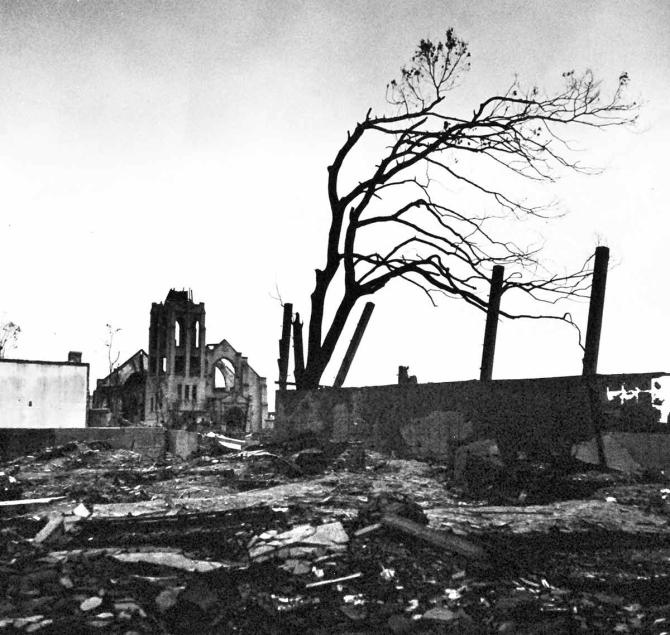
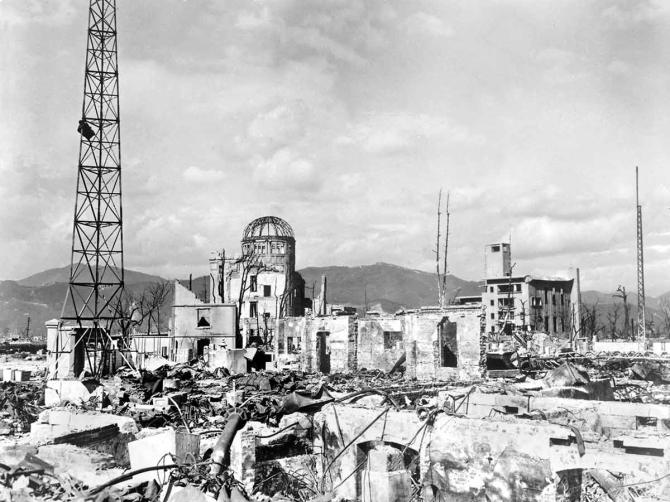
Rubble caused by the atomic bomb blast is seen in Hiroshima, Japan in September 1945. On August 6, 1945, at 8:15 am, the crew of the B-29 bomber Enola Gay dropped the first wartime atomic bomb over Hiroshima, Japan, a bustling regional hub that served as an important military communications center, storage depot and troop gathering area. The bomb, code-named "Little Boy," detonated with an estimated 15,000 tons of TNT, destroying five square miles of the city and directly killing some 70,000 people. Final casualty numbers remain unknown; by the end of 1945, injuries and radiation sickness had raised the death toll to more than 100,000. Photograph: US Navy/Lieutenant Wayne Miller/Reuters
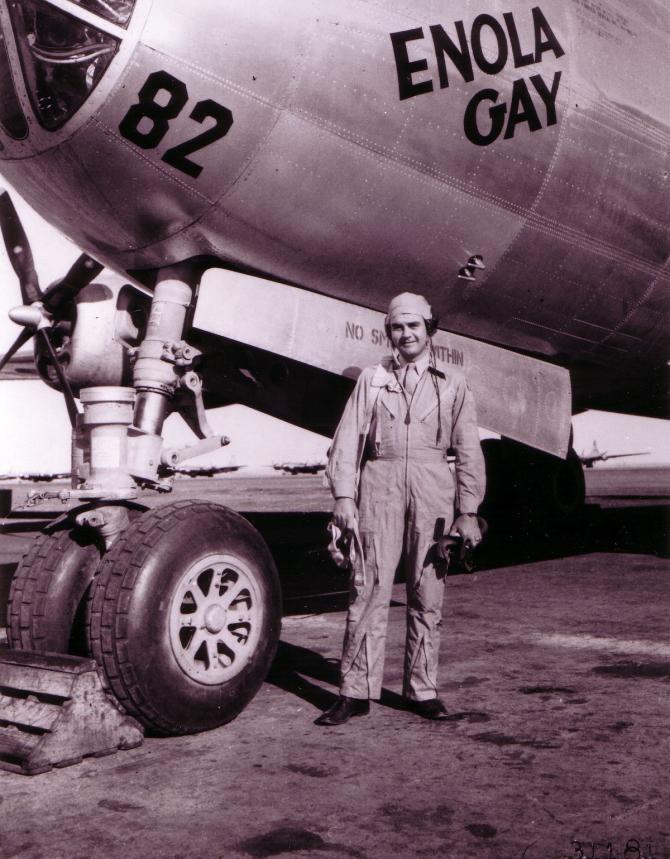
Colonel Paul Tibbetts poses in front of his B-29 Superfortress "The Enola Gay" (named for his mother) in this undated US Air Force handout photo. The Enola Gay is the same plane he piloted when his bombardier dropped the first atom bomb over Hiroshima. Photograph: US Air Force/Reuters
A Japanese soldier walks through the atomic-bomb levelled city of Hiroshima, Japan in September 1945. Archive footage shows pre-bomb Hiroshima as a bustling, thriving city of trilby-topped gentlemen boarding trams, ladies dressed in elegant kimonos, and uniformed schoolchildren walking beneath cherry blossoms overhanging shopping streets. After the blast, rubble and contorted metal stretched almost uninterruptedly to the horizon. Photograph: Lieutenant Wayne Miller/USNR/Naval History and Heritage Command/Reuters
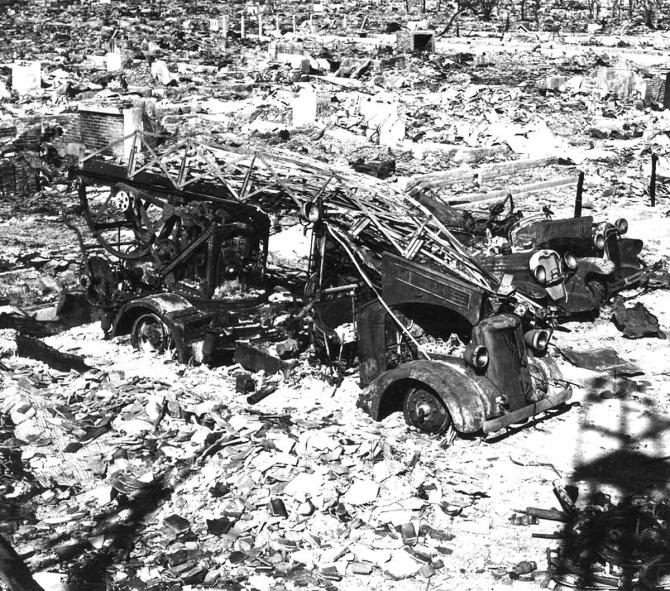
Devastation caused by the atomic bomb seen in Hiroshima, Japan. The radius of total destruction was reportedly 1.6 km. "The impact of the bomb was so terrific that practically all living things -- human and animal -- were literally seared to death by the tremendous heat and pressure set up by the blast," Tokyo radio said in the aftermath of the explosion, according to a report by The Guardian in August 1945. "All the dead and injured were burned beyond recognition. Those outdoors were burned to death, while those indoors were killed by the indescribable pressure and heat." Photograph: War Department/US National Archives/Reuters
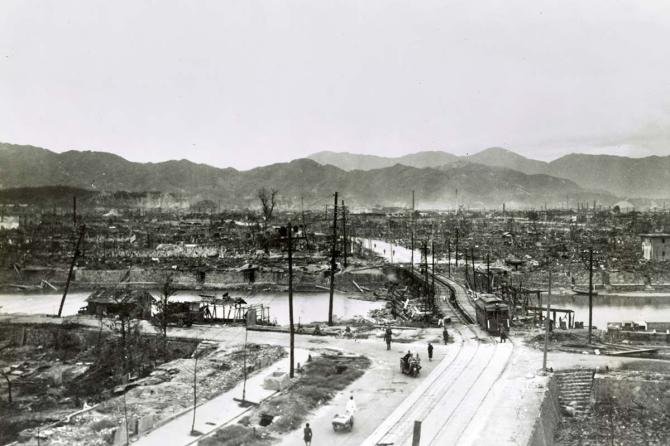
A bridge 4,400 feet (1.34 km) east of the detonation center of the atomic bomb blast is seen in Hiroshima, Japan. When the bomb was dropped on Hiroshima, the first thing people noticed was an "intense ball of fire" according to the International Committee of the Red Cross. Temperatures at the epicentre of the blast reached an estimated 7,000 degrees Celsius, which caused fatal burns within a radius of about 3 km. ICRC experts say there were cases of temporary or permanent blindness due to the intense flash of light, and subsequent related damage such as cataracts Photograph: US Army/Library of Congress/Reuters
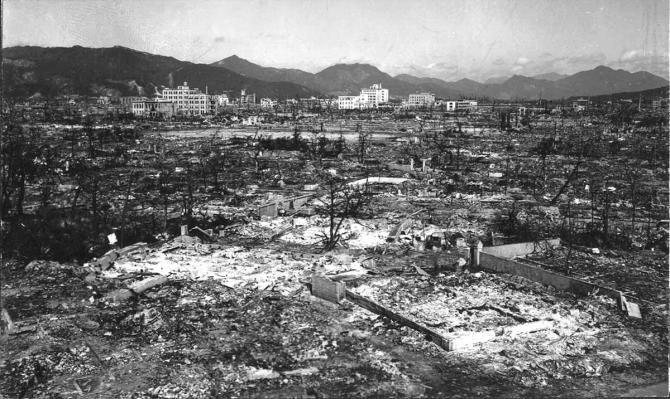
Hiroshima turned into a wasteland after the bombing. Photograph: War Department/US National Archives/Reuters
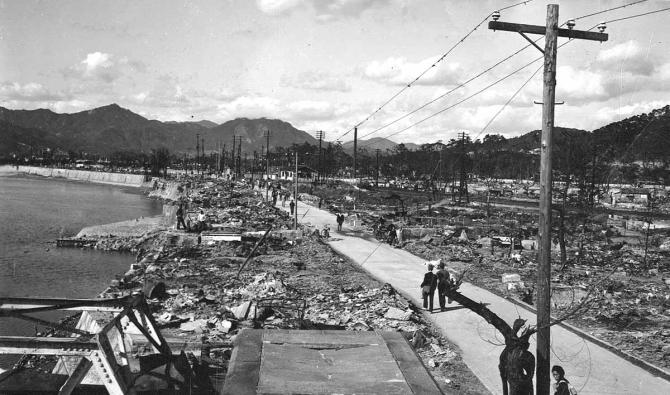
People walk along a road cleared of the debris caused by an atomic bomb in Hiroshima, Japan. The bombing started intense fires that spread rapidly through timber and paper homes, burning everything in a radius of 2 km. Photograph: War Department/US National Archives/Reuters
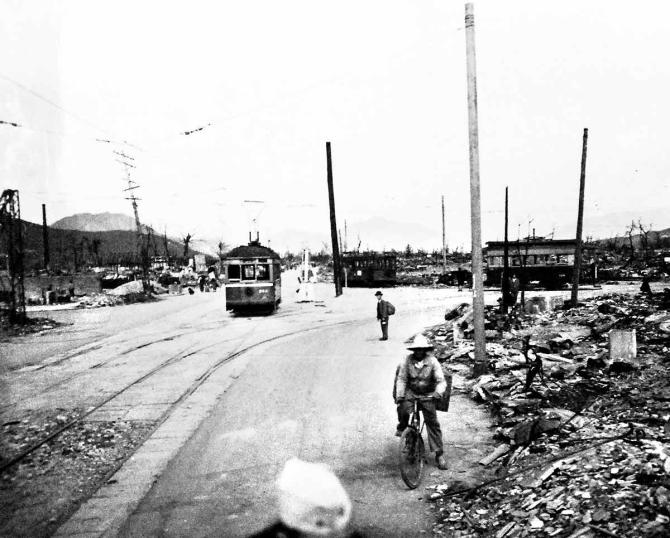
A cyclist rides near a trolley on streets cleared of the debris of the atomic bomb blast in Hiroshima, Japan. It is estimated that as many as 20,000 Japanese military personnel were killed. US surveys estimated that 4.7 square miles of the city were destroyed. Japanese officials determined that 69 per cent of Hiroshima's buildings were destroyed and another 6 to 7 per cent damaged. Photograph: US Navy/PhoM3/C George Almarez/Reuters
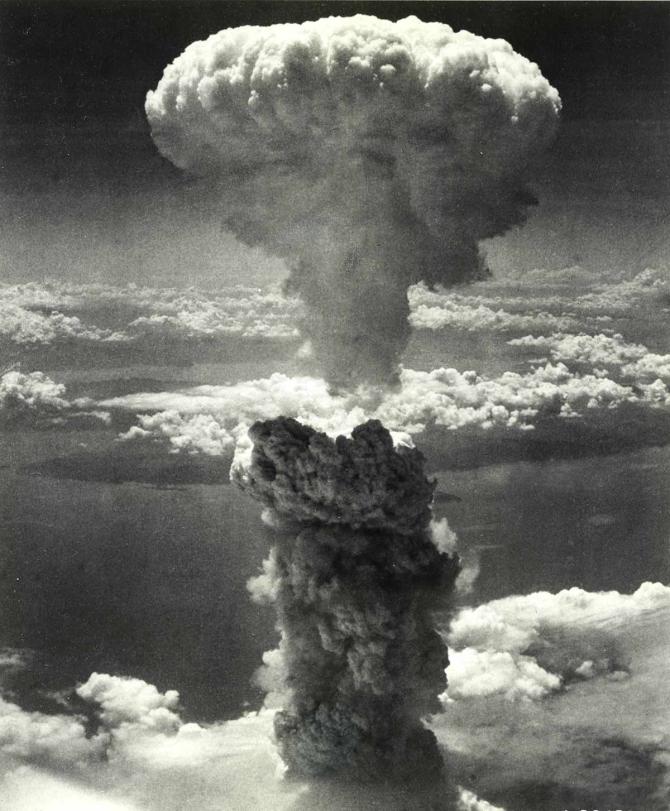
A mushroom cloud rises after an atomic bomb codenamed "Fat Man" exploded after being dropped by a US Army Air Force B-29 bomber over Nagasaki on August 9. Three days after the destruction of Hiroshima, another American bomber dropped its payload over Nagasaki, some 185 miles southwest of Hiroshima, at 11:02 am. Not the original intended blast site, Nagasaki only became the target after the crew found that city, Kokura, obscured by clouds. The Nagasaki explosive, a plutonium bomb weighed nearly 10,000 pounds and was built to produce a 22-kiloton blast. Photograph: US Army Air Forces/Library of Congress/Reuters
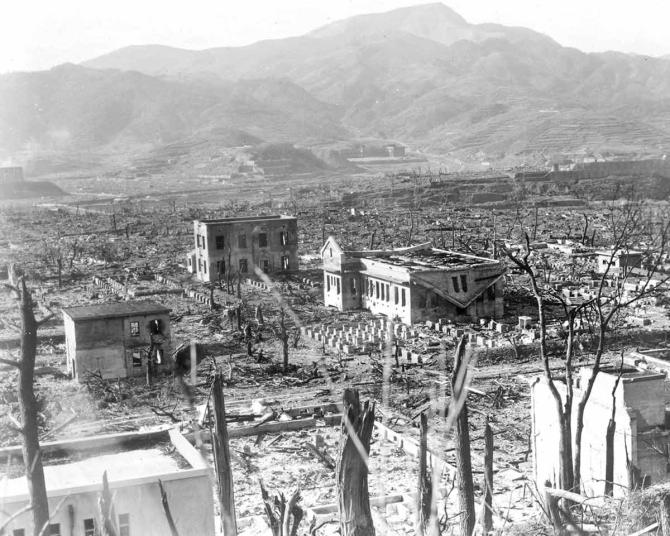
Devastation caused by an atomic bomb is seen in Nagasaki. The bomb's destructive force wiped out about 30 per cent of the city. Some 60,000 to 80,000 people died in Nagasaki, both from direct exposure and long-term side effects of radiation. Photograph: Department of Energy/Lawrence Berkeley National Laboratory/Reuters
Although the bomb was more powerful than the one used on Hiroshima, its effects were confined by hillsides to the narrow Urakami Valley. The radius of total destruction was about 1 mile (1.6 km), followed by fires across the northern portion of the city to 2 mi (3.2 km) south of the bomb. Photograph: Department of Energy/Lawrence Berkeley National Laboratory/Reuters
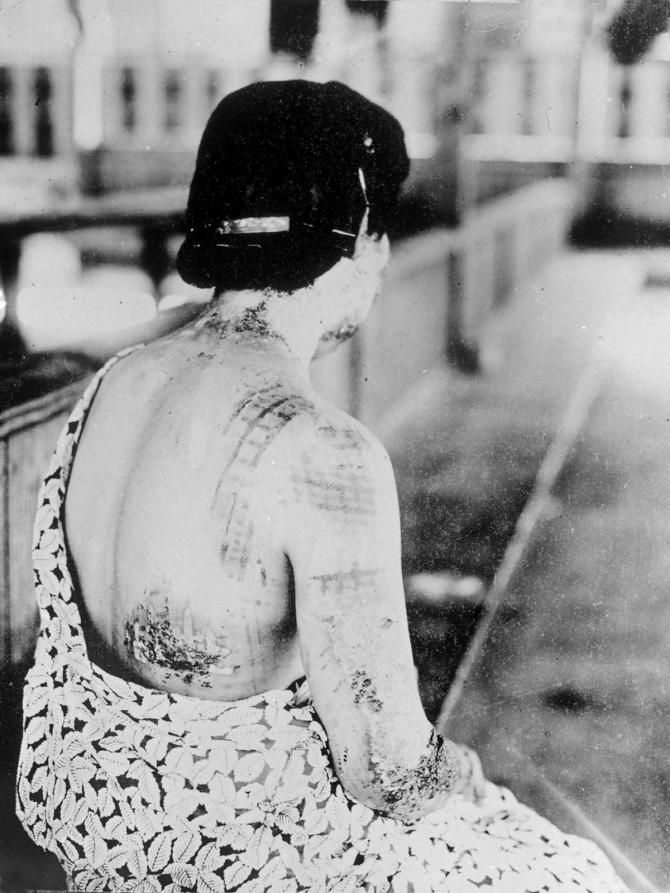
A woman being treated shows her wounds caused by an atomic bomb in Nagasaki. The bomb attacks unleashed radiation that proved deadly both immediately and over the longer term. Radiation sickness was reported in the attack's aftermath by many who survived the initial blast and firestorm. Acute radiation symptoms include vomiting, headaches, nausea, diarrhoea, haemorrhaging and hair loss, with radiation sickness fatal for many within a few weeks or months. Bomb survivors, known as hibakusha, also experienced longer-term effects including elevated risks of thyroid cancer and leukaemia, and both Hiroshima and Nagasaki have seen elevated cancer rates. Of 50,000 radiation victims from both cities studied by the Japanese-US Radiation Effects Research Foundation, about 100 died of leukaemia and 850 suffered from radiation-induced cancers. Photograph: Department of Energy/Lawrence Berkeley National Laboratory/Reuters
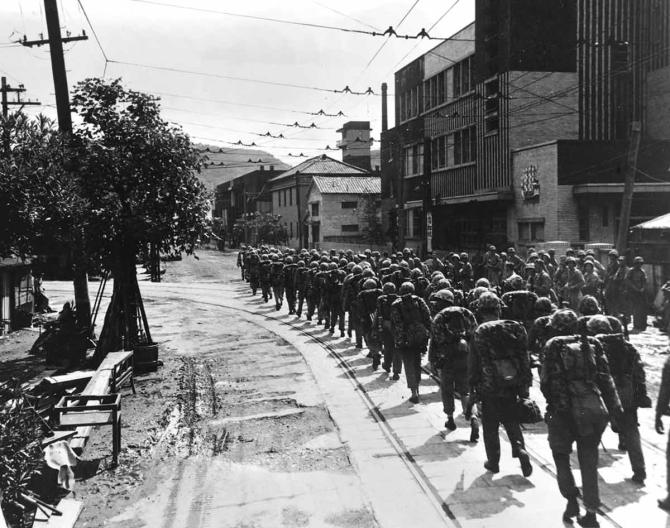
US troops arrive the month after an atomic bomb was dropped on Nagasaki, Japan in September 1945. Japan surrendered to the Allies on August 15, six days after the the bombing of Nagasaki. Historians have debated whether the devastating bombings ultimately saved lives by bringing an end to the conflict and averting a ground invasion. But those calculations meant little to survivors, many of whom battled decades of physical and psychological trauma, as well as the stigma that sometimes came with being a hibakusha. In 2019, Pope Francis met with several hibakusha on visits to Hiroshima and Nagasaki, paying tribute to the "unspeakable horror" suffered by victims of the attacks. In 2016, Barack Obama became the first sitting US president to visit Hiroshima. He offered no apology for the attack, but embraced survivors and called for a world free of nuclear weapons. Photograph: Naval History and Heritage Command/Reuters

Wednesday, August 5, 2020

Female soldiers deployed for first time in Kashmir :-Rediff.com

Female soldiers deployed for first time in Kashmir

Source: ANI  -  Edited By: Roshneesh Kmaneck
August 05, 2020 11:57 IST

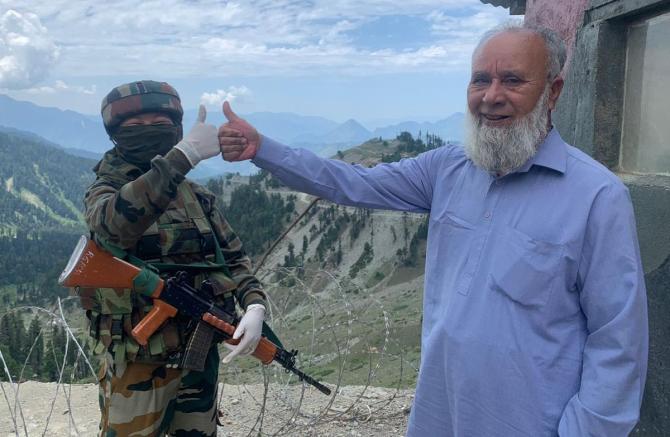
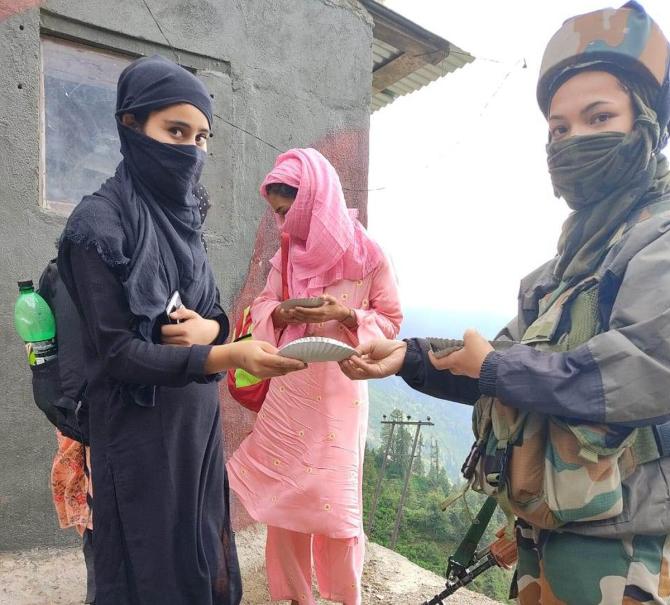
The Assam Rifles said that for the first time in Kashmir, 'Rifle Women' have been deployed on duty.
In a tweet, Assam Rifles said, "Women soldiers of Assam Rifles deployed for the first time in Kashmir make a positive impact on the local populace in a matter of days. Smiling faces of locals is a testimony of professionalism of the Riflewomen of Assam Rifles."The ‘Rifle Women’ is an unit of the Assam Rifles, the oldest paramilitary force of India.
It has been a year since Parliament took the historic decision to abrogate Article 370 in Jammu-Kashmir.
As per the data, after the abrogation, the number of youth joining terror groups dropped by 40 per cent. The year only witnessed 67 youth taking to terror.
All photographs: @official_dgar/Twitter

Monday, August 3, 2020

Government helped Mukesh Ambani out of the way and allowed Reliance to use spectrum of Rel.Comm.Why RIL s beng allowed such cheating and why Nation is being made to suffer due to such Bankrupt Anil Ambani Rel.Comm.Why Mukesh Ambani despite of making full use of Rel Comm Spectrum is not being held liable to pay AGR dues of Rs.21000 Crores like others.ET Telecom news:- AGR liabilities rest with RCom: SSTL to SC Sistema Shyam Teleservices Ltd (SSTL) has told the Supreme Court that Anil Ambani’s insolvent telco Reliance Communications (RCom) is liable to pay its adjusted gross revenue (AGR) dues as the latter had acquired the former’s entire telecom business in October 2017. Himanshi LohchabETTelecomAugust 02, 2020, 22:46 IST

AGR liabilities rest with RCom: SSTL to SCAnil Ambani thanks 'repected brother' Mukesh for last-minute save ...

New Delhi: Sistema Shyam Teleservices Ltd (SSTL) has told the Supreme Court that Anil Ambani’s insolvent telco Reliance Communications (RCom) is liable to pay its adjusted gross revenue (AGR) dues as the latter had acquired the former’s entire telecom business in October 2017.


In an affidavit filed before the top court, SSTL said it has complied with the AGR judgement by paying Rs 72.90 lakh as per its own assessment of deficit AGR dues that were not covered under the merger scheme with RCom in 2017. SSTL said it paid the amount as several letters to the Department of Telecommunications (DoT) seeking clarification after the judgement did not elicit any response.

The DoT has identified the combined AGR liability of Rs 25,194.58 crore for Rcom and SSTL as on March 6, of which Rs 222.1 crore belongs to the Indo-Russian telecom JV, which merged into the Anil Ambani-owned carrier in 2017. In February 2019, RCom filed for insolvency.

Under the proceedings, the DoT has claimed nearly Rs 30,000 crore in dues from RCom, of which over Rs 21,000 crore has been verified by the resolution professional.

“I say that there is no wilful default on the part of SSTL to comply with this… court’s judgment to the extent it is applicable to SSTL,” the company said in an affidavit. ET has seen a copy of the affidavit.

The Supreme Court, in its June 20 hearing of the AGR case, had asked for bankruptcy related details of telcos such as Aircel, RCom, SSTL and Videocon within seven days, to ensure that they were not misusing the insolvency laws to evade AGR liability.

As per the merger scheme approved by the DoT on 31.10.2017, "all licences held by SSTL stood cancelled with immediate effect" and "simultaneously all the liabilities of SSTL in respect of licences in various LSAs stood transferred to the respective licences held by Reliance Communication Ltd.”

SSTL, a joint venture between Russia’s Sistema and India’s Shyam Group, which was providing telecom services under the brand name MTS had sold its entire telecom business including licences and spectrum in nine circles to RCom in October 2017, in exchange for a 10% stake in the Indian telco.

Back then, RCom acquired two million customers and 30MHz of 800/850 MHz band spectrum, ideally suited for 4G LTE services. The merger of SSTL extended the validity of RCom's spectrum portfolio in the 800 and 850 MHz band in eight circles by a period of 12 years — from 2021 to 2033 and enhanced spectrum value by Rs 7300 crore. But it also assumed the liability for SSTL’s spectrum amounting to Rs 390 crore per annum for the next eight years.

Next year, as Rcom’s financial health deteriorated, SSTL sold its 10% stake, marking the complete exit of the Russian telco from India.

Weighed by debt of some Rs 46,000 crore and mounting losses due to intense competition following Reliance Jio’s entry in 2016, RCom filed for bankruptcy protection in February 2019, having failed to sell its assets to repay lenders.


Source ET telecom.


Thursday, July 30, 2020

Zuckerberg, Bezos, Sundar Pichai and Tim Cook getting heat from US Cong on competition


WASHINGTON: Four Big Tech CEOs, Facebook's Mark Zuckerberg, Amazon's Jeff Bezos, Sundar Pichai of Google and Tim Cook of Apple, are set to answer for their companies' practices before Congress as a House panel caps its yearlong investigation of market dominance in the industry.

The powerful executives are set to defend their companies as buttressing competition and offering essential services to consumers. The four CEOs are testifying remotely for a hearing Wednesday by the House Judiciary subcommittee on antitrust.


President Donald Trump, meanwhile, continued to denounce the big tech companies, which he has accused, without evidence, of bias against him and conservatives in general. In a tweet, he challenged Congress to crack down on the companies.``If Congress doesn't bring fairness to Big Tech, which they should have done years ago, I will do it myself with Executive Orders,`` Trump tweeted before the start of the hearing. ``In Washington, it has been ALL TALK and NO ACTION for years, and the people of our Country are sick and tired of it!``

Trump's Justice Department has urged Congress to roll back long-held legal protections for online platforms such as Facebook, Google and Twitter. The proposed changes would strip some of the bedrock protections that have generally shielded the companies from legal responsibility for what people post on their platforms.

The four tech CEOs command corporations with gold-plated brands, millions or even billions of customers, and a combined value greater than the entire German economy. One of them, Bezos, is the world's richest individual; Zuckerberg is the fourth-ranked billionaire.

Critics question whether the companies stifle competition and innovation, raise prices for consumers and pose a danger to society.

In its bipartisan investigation, the Judiciary subcommittee collected testimony from mid-level executives of the four firms, competitors and legal experts, and pored over more than a million internal documents from the companies. A key question: whether existing competition policies and century-old antitrust laws are adequate for overseeing the tech giants, or if new legislation and enforcement funding is needed.

Subcommittee chairman Rep. David Cicilline, a Rhode Island Democrat, has called the four companies monopolies, although he says breaking them up should be a last resort. While forced breakups may appear unlikely, the wide scrutiny of Big Tech points toward possible new restrictions on its power.

``Simply put, they have too much power,'' Cicilline said in opening remarks Wednesday, as he laid out data pointing up the power of the four tech companies as essential cogs of commerce and communications.

He also said that in the wake of the coronavirus pandemic, ``these giants stand to profit'' and become even more powerful as millions shift more of their work and commerce online.

The companies face legal and political offensives on multiplying fronts, from Congress, the Trump administration, federal and state regulators and European watchdogs. The Justice Department and the Federal Trade Commission have been investigating the four companies' practices.

Each company has a distinct profile and each tech titan has his own approach and story to tell.

For Bezos, who presides over an e-commerce empire and ventures in cloud computing, personal ``smart'' tech and beyond, it will be his first-ever appearance before Congress.

Bezos is introducing himself, in a way, in his hearing testimony, unusual for the occasion. He lays out his challenging life story growing up in New Mexico as the son of a single mother in high school, and later with an adoptive father who emigrated from Cuba at 16. Previewing his written testimony in a blog post Tuesday, Bezos traces his origins as a ``garage inventor'' who came up with the concept of an online bookstore in 1994.

He addresses the issue of Amazon's power in what he describes as a huge and competitive global retail market. The company accounts for less than 4% of retail in the U.S., Bezos maintains. ..


Wednesday, July 29, 2020

Anil Ambani loses ADAG Mumbai office to YES Bank after Rs 2,892 crore default Anil Ambani-led Reliance group is one of the biggest borrowers of YES Bank with exposure of over 12,000 crore twitter-logoBusinessToday.In | July 29, 2020 | Updated 19:26 IST

Anil Ambani loses ADAG Mumbai office to YES Bank after Rs 2,892 crore default
YES Bank has reportedly taken possession of Reliance Centre in Mumbai, the headquarter of Anil Dhirubhai Ambani Group (ADAG), after the company failed to repay dues worth Rs 2,892 crore. The Anil Ambani-led group is one of the biggest borrowers of YES Bank with exposure of over 12,000 crore.
The bank has taken over 21,000 square feet building of ADAG in Santacruz and also two floors in Nagin Mahal in South Mumbai, which was its previous headquarters, as per an advertisement published in Financial Express on Wednesday. The bank acquired the building on July 22 under the Securitisation and Reconstruction of Financial Assets and Enforcement of Security Interest (SARFESI) Act.
In March, Anil Ambani was questioned by the Enforcement Directorate (ED) with regard to ADAG's position with respect to its exposure to YES Bank. As per Reliance Group spokesperson, Ambani had told the ED officials that all transactions between ADAG and YES Bank were in compliance with the law and financial regulations. He had said that the group is committed to honour the repayment obligations of all its borrowings from YES Bank through asset monetisation programmes.
In connection with YES Bank founder Rana Kapoor and others, Ambani had said that the Reliance Group has no direct or indirect exposure to Kapoor, his wife or daughters, or any entity controlled by them.
In May, the ED filed a charge sheet against Rana Kapoor, his daughters Roshni Kapoor, Radha Kapoor and Rakhee Kapoor, along with Morgan Credits, Yes Capital and Rab Enterprises in connection with the YES Bank fraud case. Kapoor, who has been accused of receiving kickbacks in lieu of sanctioning loans to certain firms, was arrested by the ED on March 8 under the Prevention of Money Laundering Act.

Source Business Today July 29 2020

Wednesday, July 22, 2020

Relief for Vodafone Idea! SC directs for tax refunds of ₹833 crore livemint. Updated: 22 Jul 2020, 05:34 PM IST

Earlier SC directed the Income Tax department to issue refund of  ₹733 crore to Vodafone Idea for assessment year 2014-15
In a relief to Vodafone Idea, the Supreme Court on Wednesday directed the Income-Tax department to refund the telecom company ₹833 crore, pending for the assessment year (AY) 2014-15.
On April 29, the apex court directed the Income Tax department to issue refund of ₹733 crore to Vodafone Idea for assessment year 2014-15.
The telecom service provider has been facing a financial crisis after the apex court ordered it to pay adjusted gross revenue (AGR) dues and penalties worth ₹53,000 crore.
The telco had earlier sought over ₹5,000 crore refund for the assessment years 2014-15 to 2017-18. For AY 2014-15, the Indian entity of Vodafone Idea filed income-tax returns, for ₹1,532 crore. In November 2015, Vodafone filed returns for AY 2015-16, claiming a refund of ₹1,355.51 crore. A year later, the company claimed a refund of ₹1,128.47 crore for AY 2016-17. For AY 2017-18, Vodafone claimed a refund of ₹743 crore.
The I-T department withheld the refund claiming that massive outstanding dues are pending and are yet to be settled with the telco. The apex court mentioned that the I-T department cannot withhold refunds against undetermined future demands.

Tax on gifts: Documents that you should have :-ET


Gifting is often used to transfer property or money within the family or to relatives by way of will or inheritance. However, gift has also been used as a medium to evade taxes due to which the government had introduced the Gift Tax Act, 1958 (GTA) to curb tax evasion activities. GTA was later repealed and the incidence of tax was comprehensively incorporated in the Income-tax Act, 1961 (ITA) to ensure that bogus transactions are not carried out with the sole objective of tax avoidance.

As per the ITA, amount of money exceeding Rs 50,000 received without consideration is subject to tax as income from other sources in the hands of the recipient. Similarly, if an immovable property having stamp duty value in excess of Rs 50,000 or a movable property such as shares of a company or jewellery or work of art etc. having fair market value in excess of Rs 50,000 is received without consideration, the same is subject to tax in the hands of the recipient. Such income is taxable at applicable tax rates in the year of receipt. However, the ITA also specifies certain categories of transactions which are not covered under the ambit of taxation and it is very important for a recipient of the gift to ensure whether or not the gift received by him is subject to tax.

While a certain transaction may be genuine and free from tax incidence, given the value which may be involved, there is every chance that the tax authorities may question the validity of the transaction and ask for proof to substantiate that the same is not subject to tax.

For example, say you have received Rs 3 lakh in cash on your wedding by way of gift in aggregate from 300 guests and you decide to deposit the same into your bank account. As per the reporting norms, the bank may be required to report this cash deposit with the tax authorities. The tax authorities may question the source of cash receipt to ensure that this is not an undisclosed income which could have fetched tax revenue for the authorities.

Though the ITA specifically provides that any sum of money received on the occasion of marriage of an individual is not to be treated as his/her income, the question arises as to how will you justify that such cash was indeed received on the occasion of marriage. In such a case, it would be useful to maintain a digital or manual register of guests and note down the sum of money gifted by each. This can be used as a proof to justify to the tax authorities the genuineness of the cash deposit made by you in the bank.

Another such example is receipt of money from your relatives which is specifically excluded from the ambit of taxation. If your relative transfers a sum of Rs 10 lakh to your bank account, you may have to justify the source of the money to the tax authorities. It would be prudent to execute a gift deed which acts as documentary evidence for the receipt of gift by the recipient. When an immovable property is transferred as a gift, it is mandatory to execute a a gift deed which acts as documentary evidence for the receipt of gift by the recipient. When an immovable property is transferred as a gift, it is mandatory to execute a gift deed. The same mechanism can be adopted to substantiate receipt of money from the relative in the current example. Other documents such as your bank statement or copy of cheque received etc. may also be maintained.

Property or money received under a will or by way of inheritance is not subject to tax in the hands the recipient. If an immovable property is received under a will, the recipient should try to obtain original buyer's agreement of the property, details and back-up of sums paid to acquire the property by the original buyer (giver of gift) and a copy of the will which will act as proof in case any queries are raised by the tax authorities.

Given the increased scrutiny by the tax authorities, the giver and recipient of the gift should exercise due caution to safeguard themselves from any enquiry. While the documents to be maintained for each gift received would differ as per the nature of transaction, it is prudent to maintain appropriate records to justify the genuineness of the transaction.

(The writer is Tax Partner, People Advisory Services, EY India)
(Views expressed are personal)

Saturday, July 18, 2020

IT LOOKS THAT TRAI (TELECOM REGULATORY AUTHORITY OF INDIA ) JUST WORK FOR RELIANCE JIO ONLY WHO IS BENT UPON DESTROYING COMPETITION IN TELECOM SECTOR.

Image result for TRAI

TDSAT sets aside Trai order blocking Vodafone-Idea premium tariff plan

The appellate tribunal stayed the telecom regulator's July 11 order blocking Vodafone Idea Ltd's RedX premium tariff plan, granting interim relief to the struggling telecom carrier. VIL shares surged 15% in intraday trade.

Monday, July 6, 2020

Did you notice that the alphabet *"C"* has shot to prominence in this Covid-19 era?


See the Sea of Change that the alphabet *C* has brought!
No one expected that the alphabet "C" would play a Completely overwhelming role compared with any of the other alphabets...
Cough (C)
Cold (C)
Corona virus (C)
Covid-19 (C)
Case (C)
Confirmed (C)
Confinement (C)
Contamination (C)
Containment (C)
Curfew (C)
Two most serious "C"s are,
Cemetery (C)
Cremation (C)
The possible remedial drug is, Chloroquine (C)
The beauty is, it started from China (C)....
But at the same time,
GOD smiled, and said...
Cleanliness (is the remedy...)
Courage (is the need of the hour...)
Compliance to the expert advice...
Contention to overcome the crisis...
Clarity of thought...
Cooperation with the fellow beings...
Caring for the needy..
and finally....
"Clearance" is awaited and in a Short while..
"Cure" is definitely going to "Come"......
Till then take vitamin C.....
😁
Stay Safe & Healthy

Thursday, July 2, 2020

Why did the government order to vacate Lodhi Road Bangla to Priyanka Gandhi in which she is residing since the last 23 years?

Replied thru Quora by Amit Sabharwal


Tell me following things;
  • is she a public servant?
  • is she a specialised dignitary?
  • member of any cabinet committee?
  • member of any house?
    • then why she is being treated more than any common man?
    • if she is getting so many perks why can't I?
    • why I am left without security, servant and golden house with best servants?
  • she is not even a common lady. she did the following to us.
    • land grabbers, like china. both husband-wife snatched land from farmers.
    • remember PMC bank scam where she scammed more than 5000 crores and everybody had to suffer?
    • supporting and talking like china. they never helped our jawans and people but did politics over them.
    • remember how she tried to create political crises. she said, “I arranged the buses for migrants”. what did they find? three-wheelers.
    • she thinks she is Indira Gandhi. though, Indira Gandhi was much worse. anyways, she tried to win breaily. what happened? lost with lacs of votes.
    • they are living in bungalows on our tax and doing all anti-national things. Gandhi doesn't care about us.
    • they sit in AC and ask government proof of surgical strikes.
    • the whole family is buddu. lying to the people of India and looting us on the name of welfare with other communist propagandists.
MY OPINION
not only Priyanka. the whole family should be thrown out of the country. let them feel what India mean to us. they looted us badly. they have the thrust for the seat and nothing else. no thrust fir welfare. let them go and let live in Italy. we have to support this move by the government and hope the same for the whole family.