Pages

Wednesday, November 25, 2020

Understanding OpenRAN:-Source Manevir


OpenRAN IS AN ALTERNATIVE WAY OF BUILDING NETWORKS THAT PROMISES GREATER INTEROPERABILITY AND MORE COMPETITION

OpenRAN promises an alternative to the legacy in the radio access network (RAN), one of the costliest parts of the infrastructure. In a traditional RAN, hardware components and software code are tightly coupled, and interfaces do not support interoperability between different vendors. That means nearly all the equipment comes from only one, closed supplier. With the virtualization that OpenRAN brings, operators can run software-based network functions on standard (COTS) servers. Open interfaces allows a new freedom – the use of one supplier’s radios with another’s processors.

OpenRAN is an alternative way of building networks that promises greater interoperability and more competition. The real reason for the incumbents’ apathy is that OpenRAN would introduce competition and threaten their existing business.
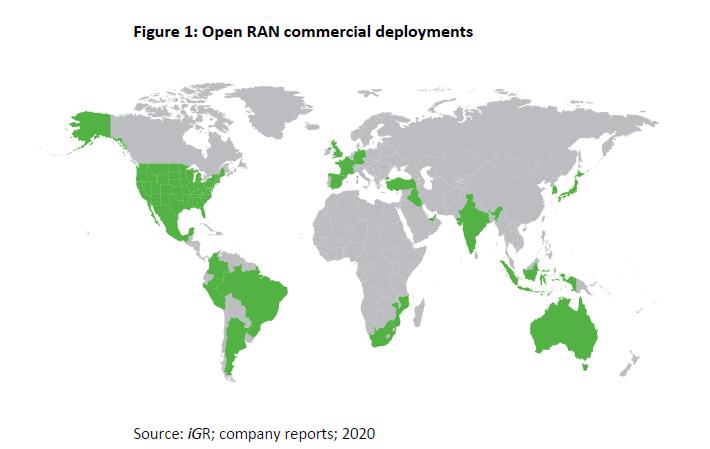
 

Open RAN Commercial Deployments

THE BENEFITS OF OpenRAN vRAN

COST SAVINGS. You can build a virtualized network, containerize it and each of the elements can be completely broken down. This modern network can support either tens of subscribers to millions of subscribers. It just depends on how many instances and substantiations of the VNFs can you run on a single platform.

MULTIPLE OPERATORS & NETWORK SHARING. OpenRAN vRAN can run multiple operators using multiple VNFs sitting side-by-side on the same platform to have segregated networks. The other benefit is network sharing in the future through software.

ELIMINATE VENDOR LOCK-IN. OpenRAN breaks open the interface between the remote radio head and the DU. With current legacy vendors, it’s a walled garden and proprietary. Through O-RAN, a fully open interface on Split 7.2 has been defined including all the OEM.

3rd PARTY TESTING BENEFITS. Radios with 3GPP specs on one side and O-RAN specs on the other will work with different vendors’ baseband and because there is a defined specification with 3GPP interfaces, the elements can be tested independently. It takes pressure off operators to test in their own labs. Radios can be purchased from any vendor and tested by independently by a 3rd party and be assured that it works. Soon radios will be produced at low cost on the basis that any operator can buy them and not get locked into a specific system integrator.
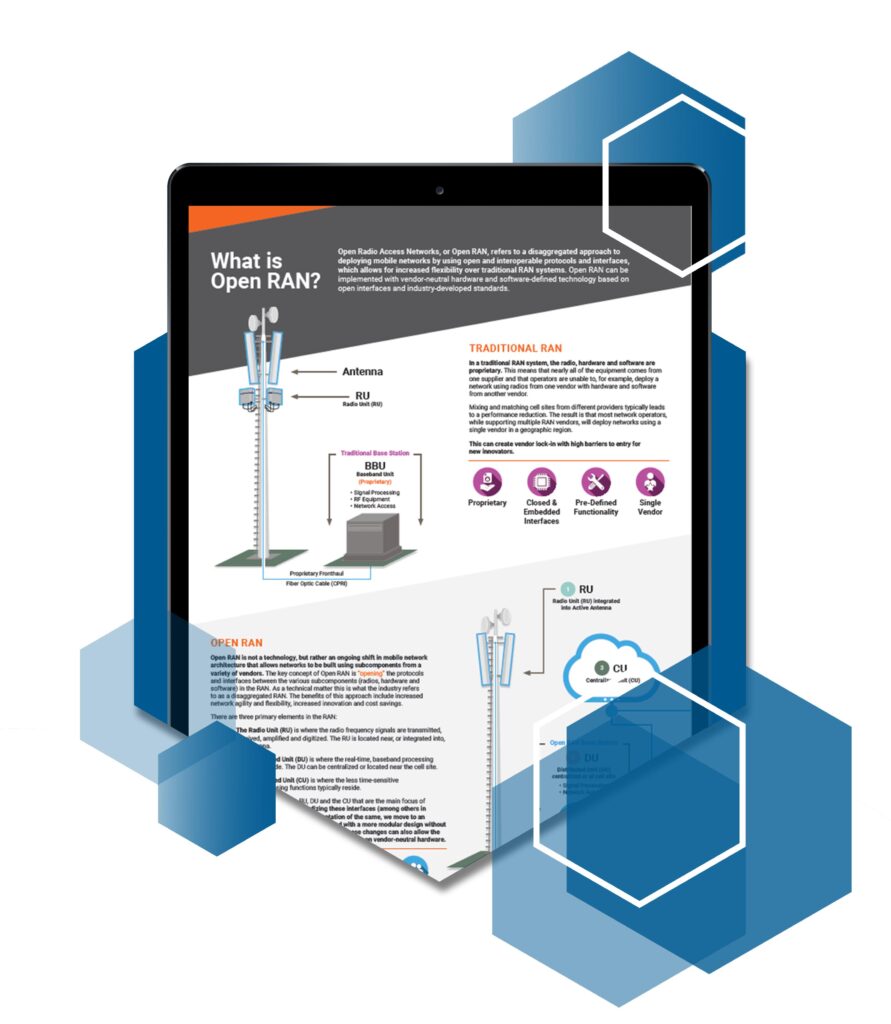
Download the OpenRAN Infographic

RESOURCES


WHITE PAPER

OPEN RAN INTEGRATION: RUN WITH IT

Open RAN is real. Open RAN can be, and is being, deployed in commercial networks today. Download the white paper to learn more.


WEBINAR

OPENRAN – THE WAY FORWARD

Watch the webinar recording that directly addresses the ‘fake news’ of OpenRAN, the opening of the interfaces that fosters an innovative ecosystem and new economics for operators.


WHAT IS THE DIFFERENCE BETWEEN OpenRAN, O-RAN and vRAN?

OpenRAN

Disaggregated RAN functionality built using open interface specifications between elements. Can be implemented in vendor-neutral hardware and software-defined technology based on open interfaces and community-developed standards.

O-RAN

Refers to the O-RAN Alliance or designated specification. O-RAN Alliance is a specification group defining next generation RAN infrastructures, empowered by principles of intelligence and openness.

 

ORANlogo

vRAN

An implementation of the RAN in a more open and flexible architecture which virtualizes network functions in software platforms based on general purpose processors.

For more info, visit Mavenir vRAN and check out our OpenRAN Partner Ecosystem

Tuesday, November 24, 2020

Govt bans 43 more apps in India; check full list here MEITY issues orders for blocking apps under Section 69A of the Information Technology Act. Moneycontrol News


The Ministry of Electronics and Information Technology (MEITY) November 24 issued an order blocking access to 43 mobile apps in India.

The order was issued under Section 69A of the Information Technology Act.

"This action was taken based on the inputs regarding these apps for engaging in activities which are prejudicial to sovereignty and integrity of India, defence of India, the security of the state and public order," MEITY said in a release.

The decision to ban these apps was based on the comprehensive reports received from Indian Cyber Crime Coordination Center, Ministry of Home Affairs.

Here's a list of the apps that have been banned

1. AliSuppliers Mobile App
2. Alibaba Workbench
3. AliExpress - Smarter Shopping, Better Living
4. Alipay Cashier
5. Lalamove India - Delivery App
6. Drive with Lalamove India
7. Snack Video
8. CamCard - Business Card Reader
9. CamCard - BCR (Western)
10. Soul- Follow the soul to find you
11. Chinese Social - Free Online Dating Video App & Chat
12. Date in Asia - Dating & Chat For Asian Singles
13. We Date-Dating App
14. Free dating app- Singol, start your date!
15. Adore App
16. TrulyChinese - Chinese Dating App
17. TrulyAsian - Asian Dating App
18. ChinaLove: dating app for Chinese singles
19. DateMyAge: Chat, Meet, Date Mature Singles Online
20. AsianDate: find Asian singles
21. FlirtWish: chat with singles
22. Guys Only Dating: Gay Chat
23. Tubit: Live Streams
24. We Work China
25. First Love Live- super hot live beauties live online
26. Rela - Lesbian Social Network
27. Cashier Wallet
28. MangoTV
29. MGTV- HunanTV official TV APP
30. WeTV - TV version
31. WeTV - Cdrama, Kdrama&More
32. WeTV Lite
33. Lucky Live- Live Video Streaming App
34. Taobao Live
35. DingTalk
36. Identity V
37. Isoland 2: Ashes of Time
38. BoxStar (Early Access)
39. Heroes Evolved
40. Happy Fish
41. Jellipop Match- Decorate your dream island!
42. Munchkin Match: magic home building

43. Conquista Online II

The government had blocked access to 59 mobile apps on June 29 and another 118 apps on September 2 this year. “Earlier on 29th June, 2020 the Government of India had blocked access to 59 mobile apps and on 2nd September, 2020 118 more apps were banned under section 69A of the Information Technology Act. Government is committed to protect the interests of citizens and sovereignty and integrity of India on all fronts and it shall take all possible steps to ensure that,” Center's press release stated.

The list of apps that were blocked included popular Chinese apps like TikTok, Shareit, Helo, Shein, Likee, PUBG MOBILE LITE, WeChat Work, UC Browser among others.
First Published on Nov 24, 2020 05:14 pm

Monday, November 23, 2020

New rules to sign up for GST:-livemint . Updated: 23 Nov 2020, 06:54 AM IST Gireesh Chandra Prasad


An overhaul of the goods and services tax (GST) registration process and suspension of the registration of businesses identified as risky are among the proposals of a panel of officials attached to the GST Council.

The proposals by the law committee of the GST Council, comprising central and state officials who advise its ministerial members, aim to tighten compliance measures and target restrictions on firms identified as risky, without affecting the ease of doing business in general, said a finance ministry official.

The recommendations include the use of Aadhaar or Aadhaar-like biometric identification for new registrations, steps to identify businesses that pose a risk of revenue loss to the exchequer, use of income tax returns to verify the credentials of entrepreneurs seeking GST registration, and restriction on using tax credits from the purchase of raw materials to meet the final tax liability.

Not filing GST returns for six months could cost a business its registration. At the moment, there are 600,000 dormant GST-registered firms among the 12 million entities with registration.

Entities seeking GST registration would be profiled on the basis of their credentials and classified into trustworthy and others.

Trustworthy entrepreneurs are those who have a credible income tax payment history and have their identity authenticated by Aadhaar and have no history of having their GST registration cancelled.

These entrepreneurs will get GST registration within a week. The others will be given the registration within two months of physical verification of business premises, said the ministry official cited above.

Those that are not trustworthy may also be asked to pay a part of their tax liability in cash instead of adjusting it fully against the tax credit available to them.

The proposals put together by the law panel at a meeting held last week will be further discussed before they are placed before the council, the official said, requesting anonymity.

The move signals a major tightening of the three-year-old indirect tax system leveraging GST’s ability to track the entire supply chain using the system of input tax credits. Discrepancies will get flagged, as the system for filing GST returns becomes more automated with the use of e-invoices and auto-filled tax returns.

GST authorities have been on a nationwide compliance enforcement drive this month, which led to the busting of an invoice racket and the arrest of 48 people and three chartered accountants. As many as 648 cases have been registered so far this month.

The government is better armed to enforce greater compliance with deep digital capabilities for automatically detecting evasion, leakages, defaults and delays, according to Rishi Agrawal, co-founder and chief executive officer of Avantis Regtech Pvt. Ltd, a regulatory technology firm. “Sooner rather than later, India Inc. will need to focus on accurate and timely compliance. Ignorance of the law will not be an excuse for non-compliance," said Agrawal.


41 arrested in fake invoice case; three CAs face disciplinary action livemint . Updated: 20 Nov 2020, 09:19 PM IST Gireesh Chandra Prasad


DGGI will inform accounting rule maker and professional regulator The Institute of Chartered Accountants of India (ICAI) to take action against the three CAs for professional misconduct. Mint (MINT_PRINT)

New Delhi: Forty one people have been arrested in the last eight days in a fake invoice cartel busted by the Directorate General of GST Intelligence (DGGI) and three of them who are chartered accountants are facing disciplinary action, said a government official.

DGGI will inform accounting rule maker and professional regulator The Institute of Chartered Accountants of India (ICAI) to take action against the three CAs for professional misconduct, said the official, who spoke on condition of anonymity. Two of the CAs are from Hyderabad and one from Ludhiana. They are accused of having a role in arranging for fake invoices of fictitious firms and in wrongfully availing tax credits.

In the nationwide crackdown on people abusing the GST system using fake invoices, DGGI has booked 577 cases against 2,221 entities in the last eight days, said the official quoted above.

On Friday, GST authorities held searches and surveys in 20 cities including Chennai, Ahmedabad, Pune, Nagpur, Hyderabad, Jaipur, Delhi, Bengaluru, Mumbai and Kolkata.

Fake invoices are used to evade Goods and Services Tax (GST) and income tax and to divert funds from companies. These are also used for showing non-existent transactions to jack up figures on books to obtain loans from banks. These are also used to wrongfully claim GST refunds meant for exporters.

Direct and indirect authorities have been scaling up use of technology and data analysis to identify businesses with poor compliance track record. With the sharp reduction in tax revenues this year, the trend is expected to gain further momentum. On Friday, the Income Tax Department searched 16 premises of a cattle feed producer including in Kanpur, Gorakhpur, Noida, Delhi and Ludhiana, the department said in a statement.

GST authorities are now trying to tighten the procedure for new GST registration. As per the plan before the GST Council, businesses whose owners or promoters do not have commensurate income tax payment records will require physical and financial verification before their companies can be given GST registration, Mint had reported last Sunday.


WhatsApp OTP scam: Things you should know livemint . Updated: 23 Nov 2020, 10:58 AM IST Staff Writer A new form WhatsApp OTP scam is being reported where the hacker hacks into your friend's account and sends you personalised messages to access your account.


WhatsApp is currently one of the world's most popular multiplatform messaging app, and being famous it also is prone to various forms of manipulations with an aim to target various users of the app.

A new form of scam is surfacing where the hacker hacks into your friend's account and sends you personalised messages to access your account.

How this scam works?

In the WhatsApp OTP scam, the hacker sends you a message claiming to be your friend. To grab your immediate attention, the fraudster describes some kind of emergency.

After providing assurance of being your friend, the hacker will ask for an OTP, who the scamster describes as an accidental forward. The scammers will send multiple messages to lure you to forward the OTP.

The hacker wants to access your WhatsApp account through OTP validation. The moment you will share the OTP with the fraudster, you will be locked out of your WhatsApp account and the hacker will have the full access to your messages, contacts and groups.

The hacker may also request monetary help from your dear ones. The chain of event gets multiplied once the scammer hacks into your account.

Two-factor authentication on WhatsApp comes in handy for users who would want to prevent falling prey to these type of scams. The rule of thumb to prevent these type of frauds is to never share your OTP or personal information with anyone.


Source :-livemint Used here for educational purposes only and this blog is not commercial.


Pros and cons of banking licences for big businesses livemnt . Updated: 22 Nov 2020, 11:15 PM IST Vivek Kaul


An internal working group of the Reserve Bank of India has suggested that large corporates and industrial houses may be allowed to promote banks. Does this leap of faith make sense, given our central bank’s extremely cautious and conservative approach? Mint takes a look.

Why should large cos be allowed in banking?

RBI’s working group feels that allowing corporates to promote banks can be an important source of capital. In a capital-starved economy like India, this makes sense. Further, these corporates can bring “management expertise, experience, and strategic direction to banking". The group also noted that internationally, “there are very few jurisdictions which explicitly disallow large corporate houses". All these reasons make sense, but there are major drivers behind RBI not allowing corporate intrusion in the banking sector over the last five decades. At the heart of this is the conflict of interest it would create.

Why have corporates been kept away so far?

The RBI panel spoke to experts on the issue: “All the experts except one [said] that large industrial houses should not be allowed to promote a bank." The corporate governance in Indian companies isn’t up to international standards and “it will be difficult to ring-fence the non-financial activities of the promoters," the experts said. There will also be a risk of promoters giving loans to selves. Before the bank nationalization happened in 1969, some of the private banks were owned by large corporates. Prof. Amol Agrawal of Ahmedabad University points out that back then, big industrialists used to give loans to themselves.

Key defaulter
View Full Image
Key defaulter

What does the history of banking system reveal?

V.A. Pai Panandiker, an advisor in finance ministry, wrote in August 1967: “Internal procedures… vest large discretionary powers in the boards of directors who have often acted as sources of patronage in deciding credit matters." A survey also showed that 188 individuals served as directors on boards of 20 leading banks and held 1,452 directorships of other firms.

What did corp’s huge power lead to in 1966?

An October 1967 report commissioned by politician Chandrashekhar, the then secretary of the Congress Party found that of the total bank loans amounting to 2,432 crore in 1966, 292 crore was given to bank directors and their companies.

In fact, if indirect loans and advances were included, the actual amount owed by directors was 600-700 crore. With corporates in the scene, there is a danger of something similar happening much more now, given the weak corporate governance structures.

What does this mean in current scenario?

In March 2018, the domestic bad loans of Indian banks peaked at 9.62 trillion. Of this, around 73.2% or 7.04 trillion, were defaults made by the industry. Corporates have thus been responsible for a bulk of the mess in the Indian banking sector. In such a precarious circumstance, it’s apparent that the banking regulator will have to tread with a great deal of caution and oversight to execute this plan.

Vivek Kaul is the author of Bad Money.

Source Livemint:- used here for Educational purposes only and this blog is not commercial.


Tuesday, November 17, 2020

Vodafone Idea adds highest broadband users in August ET had reported that cash-strapped Vodafone Idea is planning to fundraise Rs 25,000 crore in the next 2-3 months. ETTelecom November 17, 2020, 13:07 IST


NEW DELHI: Struggling telco Vodafone Idea added 4.6 million broadband subscribers in August, the highest among all telcos. However, analysts believe this may not be enough to sustain the telco's long-term financial requirements, as per a Mint report.

As the economy reopened, 4G subscribers who did not recharge during the lockdown needed data for consumption. As per an Axis Capital report, the mobile broadband (MBB) market share was up by 42 bps on-month at 17.2% as the conversion of 2G subscribers to 4G picked up the pace.

Telecom analyst Mahesh Uppal told Mint that higher ARPU customers can help Vodafone Idea in improving its revenues vastly. He said that the telco may find it difficult to sustain in the medium-term and requires financial support from either the government or its investors.

ET had reported that the cash-strapped telco is planning to fundraise Rs 25,000 crore in the next 2-3 months.

“We are in discussions with several interested parties to raise funds through the debt and equity routes. The interest levels have been very good and the ongoing discussions are progressing well… we hope to conclude the fund-raise in two to three months at most… we are very optimistic on this score,” managing director Ravinder Takkar had said on a post-earnings call with analysts.

ET had reported that Vodafone Ideaa has reached out to credit funds such as Oak Hill Advisors, Marathon Asset Management, Spectrum Asset Management, Anchorage Capital and Providence Investment Management as well as private equity firms such as Blackstone and asset reconstruction companies for raising the funds that will be used to expand networks and pay adjusted gross revenue dues.