Pages

Tuesday, May 25, 2021

EYE OPENER ARTICLE PUBLISHED IN SEP 2019 (THE CARAVAN) PUT HERE AS EYE OPENER FOR INDIAN PUBLIC

 Indiabulls and corporate groups like Reliance, DLF collaborated to turn hundreds of crores of public money into private wealth: PIL in Delhi HC

06 September 2019
Sameer Gehlaut, the founder and chairman of the Indiabulls group, at his office in Mumbai. A PIL filed today in the Delhi high court has accused Indiabulls of financial irregularities running into thousands of crores, including public money. 
UMESH GOSWAMY/THE INDIA TODAY GROUP/GETTY IMAGES UMESH

Indiabulls Housing Finance Limited, the flagship company of the Indiabulls group, collaborated with large conglomerates including the Reliance Anil Dhirubhai Ambani Group and the DLF Group to divvy up vast amounts of public money by rerouting it through shell companies, according to a public-interest litigation submitted today in the Delhi high court. The PIL stated that IBHFL borrowed large sums from various private and public banks, and used a complex maze of shell companies to extend loans to the tune of thousands of crores to firms owned by these large business groups. In turn, the petition said, the groups invested money in entities owned by the promoters of Indiabulls, including its founder and chairman, Sameer Gehlaut. “The intent of all these methods is to create private wealth out of public money,” the PIL noted. It termed these transactions “round tripping” and a “scam” of those carried out by the ICICI Bank and Dewan Housing Finance, in which a “huge amount of public money involving lakhs of crores is being looted.” The PIL stated: “The clout of the promoters of these companies is such that the regulators have closed their eyes to these frauds happening right under their noses.”

The companies named in the PIL include Anil Ambani’s Reliance ADAG; the DLF Group, promoted by Kushalpal Singh; the Americorp Group, promoted by Harish Fabiani, a Spain-based non-resident Indian; the Vatika Group and the Chordia Group, both real-estate companies. According to the petition, IBHFL loaned close to Rs 9,248 crore to these five companies. It stated that Reliance ADAG received Rs 1,580 crore in loans and invested Rs 570 crore back in Indiabulls, while DLF received Rs 1,705.54 crore as loans and invested at least Rs 66 crore in a company owned by Gehlaut. IBHFL lent a whopping Rs 4,601.01 crore to 51 companies of the Vatika Group, owned by Gautam Bhalla, the petition said. It further stated that many Indiabulls shell companies have been indulging in various other malpractices, involving several thousand crores of rupees.

The PIL was filed by the Citizen Whistle Blowers Forum, a civil-society group that aims to provide a platform to whistleblowers and to litigate on their behalf. The “round tripping” of funds by IBHFL and its promoters is in violation of statutes relating to income-tax evasion, Reserve Bank of India regulations and the rules of the Securities and Exchange Board of India and National Housing Bank, the petition stated. It demanded a special investigation team look into Indiabulls’ finances and the “illegalities, violations and siphoning” committed by the IBHFL’s promoters.

IBHFL is the second-largest home-finance company in India, with 220 branches in 110 cities and towns. According to the PIL, it contributes roughly eighty percent of the group’s turnover. The PIL described IBHFL’s financial status based on documents in the public domain: in the financial year 2017–18, IBHFL disbursed loans worth Rs 1,22,578 crore, a growth of 34.3 percent from the previous year. Its revenue grew by 25.1 percent from the previous year, to Rs 14,640 crore, while its profit after tax was Rs 3,847 crore. However, the PIL noted, the company’s outstanding debt was Rs 96,204.58 crore. As of March 2019, its liabilities stood at Rs 1,13,463.50 crore—about thirteen crores higher than the previous year. Its net worth is Rs 17,258.92 crore. The PIL emphasised that IBHFL had borrowed from a number of public-sector undertakings. This means that “public money is at stake, along with the money invested in IBHFL by its shareholders and investors,” the PIL said.

CURRENT ISSUE
MAY 2021

The petition presented an analysis of the loans IBHFL extended to five companies—although more exist—and the shell companies through which these transactions were carried out. It noted that many of the companies that IBHFL loaned money to have “a small-paid up capital”—the amount that a company receives from its shareholders by selling shares on the primary market—“do not have any fixed assets and are not even engaged in any business activities.” Several companies had a paid-up capital of a few lakhs, but had received loans worth tens of crores. The directors and the office addresses of many of these companies are also common, the petition noted. A majority of these borrower companies have also failed to file charges with the ministry of corporate affairs, the petition said. (A charge is a type of security created on some property of the company to secure a loan and every company has to register the charges created by it on its assets with the registrar of companies.) The petition noted that hundreds of companies are registered at the same address as that of Indiabulls, “thereby showing a staggering number of dummy companies having been created by Indiabulls.”

The petition noted that five Reliance ADAG companies received loans worth Rs 1,580 crore from IBHFL: Reliance Inceptum received a loan of Rs 106 crore; Reliance Big Entertainment received Rs 210 crore, Reliance Communications Enterprises received Rs 200 crore; Reliance Interactive Advisers received Rs 908 crore; and Zapak Digital Entertainment received Rs 156 crore. The former four are all registered to the same address, in Santacruz, Mumbai. The petition also stated that Reliance ADAG companies invested Rs 570 crore back into nine companies owned or promoted directly by Gehlaut, or through group subsidiaries. It noted that the money was invested using a financial instrument called optionally convertible debentures, at a nominal interest rate of 0.01 percent. These debentures are debt instruments where the lender has the option of converting the loan amount to equity.

According to the PIL, Reliance Capital, under Reliance ADAG, invested money in six subsidiaries of Indiabulls: Iphito Properties received Rs 10 crore in loans; Iphito Real Estate received Rs 20 crore; Myrina Real Estate received Rs 10 crore; Myrina Builders received Rs 10 crore; Orthia Real Estate received Rs 35 crore; and EMU Constructions received Rs 50 crore. Further, Reliance Corporate Advisory, also under Reliance ADAG, lent to three subsidiaries of Indiabulls, the petition said: Galax Minerals received Rs 50 crore; Meru Minerals received Rs 185 crore; and Paidia Conconnection received Rs 200 crore. The petition noted that Galax Minerals is owned wholly by Sameer Gehlaut, and that its balance sheets do not show the security necessary for securing such a loan.

Galax received Rs. 726.50 crore in all, the petition said—Rs 50 crore from Reliance Corporate Advisory; Rs 589 crore from Myrina Real Estate and Rs 87.50 crore from Iphito Real Estate. The loan from Reliance Corporate Advisory is in the form of debentures carrying 0.01 percent interest per annum, the petition said. “However, Galax Minerals’ books of accounts show there are no current assets or insignificant current assets available except for investment which is not charged. Thus, the security is an eye wash leading one to conclude that the transaction is round tripping.

According to the petition, IBHFL loaned more than Rs 1,705.54 crore to 48 companies of the DLF Group. It noted that many of these firms have “negative worth” and all are “pass-through companies which have been used to garner huge sums of loans and use them for purposes other than intended ones.” For instance, the petition said, “Despite a negative worth, IBHFL gave the company a loan of Rs. 173.40 crore to Atherol Builders & Developers Pvt. Ltd, subsidiary of Felicite Builder & Constructions … The loan money was used to buy land and give loans to group companies.” It added that EMU Realcon, another company owned by Gehlaut, received an infusion of Rs 66 crore from three companies under the DLF group as “preference shares”—where the holder is entitled to a fixed payout and where the holder’s payment takes priority over ordinary shareholders.

The petition said that IBHFL lent Rs 4,601.01 crore to 51 companies of the Vatika Group, owned by Gautam Bhalla. Forty of these companies are registered to the same address, it stated, while many have a paid-up capital of only Rs 1 lakh. These companies were given loans ranging from Rs 16 crore in the case of Garin Developers to Rs 184.50 crore in the case of Timor Developers. “Most shocking is the case of Shivsagar Builders,” the petition noted. “Though the company has a paid-up capital of Rs. 25 lakh only, IBHFL found it worthy of granting a loan of Rs. 1575 crore.” It is clear that IBHFL “did not do any due diligence and went about giving huge loans for reasons known only to the promoters,” the petition said.

Harish Fabiani, a non-resident Indian based in Madrid, is the promoter of the Americorp Group, four of whose subsidiaries received loans worth Rs 151.9 crore from IBHFL. According to the petition, the money was ploughed back into Indiabulls Group companies through equity investment, which the petition calls a case of “round-tripping.” Two Americorp subsidiaries—Jasol Investment & Trading Company and Joindre Finance—invested Rs 254.87 crore in five Indiabulls subsidiaries. Indiabulls Ventures received Rs 39.58 crore; Indiabulls Housing Finance received Rs 22.88 crore; Myrina Builders recieved Rs 31 crore; Iphito Real Estate received Rs 44 crore; and Indiabulls Real Estate received Rs 117.41 crore.

Three subsidiaries of the Chordia Group, which operates in real estate, received Rs 1,209 crore from IBHFL. “This loan was squared up through money diverted from Mahalunge Land Developers (group Company of Chordia) from the amount borrowed from IBHFL,” the petition notes. “In addition Rs. 50 crores was paid as professional fee to Indiabulls Real Estate Limited.”

In all, these five corporate groups received loans worth Rs 9,248 crore. “In other words, borrowing companies bestow huge benefits to the key shareholders and Chairman of IBHFL for the favour they get in the form of loans from IBHFL,” the petition said.

In April 2016, Gehlaut’s name appeared in the Panama Papers, a leaked database of the documents of the Panamanian law firm Mossack Fonseca that includes attorney-client information of millions of offshore entities. “Sameer Gehlaut had bought three top London properties through a web of intermediary companies all leading to SG Family Trust owned by the parents of Divya Gehlaut, wife of Sameer Gehlaut,” the petition noted, citing an Indian Express report.

The petition detailed some other malpractices by Gehlaut-promoted companies. One of the main irregularities it cited was the issuance of compulsory convertible debentures, or CCDs—debt instruments that should be compulsorily convertible to equity. However, these had been left optional and have been used to “route public money into private equity,” the petition said. It named 18 companies promoted by Indiabulls or Gehlaut, including EMU Realcon and Galax Minerals, as well as Myrina Real Estate and Myrina Builders.

The petition noted that EMU Realcon, which is owned by Sameer Gehlaut and received Rs 66 crore from three DLF companies, made investments using CCDs at almost a nil rate of interest. “The terms of using this vehicle is contrary to and in violation of standard practices. Although these debentures are compulsory in principle, the holder of these CCDs has the liberty to exercise the option of redeeming them. The money is being moved from one company to another without any encumbrances, such as payment of interest and taxes chargeable thereupon,” the petition said.

According to the petition, the financial practices of IBHFL and its promoters are fraudulent, and violated various sections of the Companies Act of 2013, Sections 403, 406 and 420 of the Indian Penal Code—misappropriation of property, breach of trust and cheating, respectively—as well as various guidelines of the Reserve Bank of India and National Housing Bank, the regulatory authority that oversees housing-finance institutions. It named the NHB as a respondent, alongside other regulatory bodies such as the Serious Fraud Investigation Office and the Security and Exchanges Board of India, as well as the ministry of corporate affairs. The petition condemned these institutions for “complete inaction” against IBHFL, and demanded an immediate order for a thorough investigation.

“The instant scam follows close to the heels of scams such as those perpetrated by ICICI Bank, IL&FS and Dewan Housing Finance Limited,” the petition said. “It illustrates how promoters and persons in charge of large NBFCs”—non-banking finance corporations—have looted public monies invested in them and diverted them to their own companies using shell companies.” Any inaction, the petition stated, could “result in jeopardizing and undermining of public interest, rule of the law and the regulatory structure besides probable loss to the public exchequer.”

Update: After this article was published, a representative from the Vatika Group sent The Caravan a press statement from the group’s managing director, Gautam Bhalla. He wrote: “Vatika Limited and our group companies do not have any association with any company associated with Mr. Sameer Gehlaut. Further, Vatika Limited and any of the group companies have not made any investment in any of the companies associated with Mr.Gehlaut.”

TUSHAR DHARA is a reporting fellow with The Caravan. He has previously worked with Bloomberg News, Indian Express and Firstpost and as a mazdoor with the Mazdoor Kisan Shakti Sangathan in Rajasthan.


USED HERE FOR EDUCATIONAL PURPOSES ONLY


All INDIANS MUST READ THIS ARTICLE OF DEC 2020 TO FIND OUT WHO IS ENEMY WITHIN :-Three Anil Ambani companies have reportedly been accused of fraud by banks⁠ — the amount at stake is nearly ten times more than what Mallya owed PRABHJOTE GILL DEC 31, 2020, 12:14 IST Business Insider India


                                                                  Anil AmbaniBCCL
  • The accounts of three Anil Ambani-led Reliance Group entities have reportedly been flagged as fraudulent by three banks, including India’s largest lender, the State Bank of India (SBI).
  • Reliance Communications, Reliance Infratel, and Reliance Telecom owe lenders ₹86,188 crore.
  • This is ten times more than the debt garnered by former billionaires Vijay Mallya and Nirav Modi.

India’s infamous fallen billionaire, Anil Ambani, may have claimed that his ‘net worth is zero’ but Indian banks aren’t buying it.

In the midst of Reliance Communications’ bankruptcy resolution process, three Indian banks — the State Bank of India (SBI), Union Bank of India (UBI) and the Indian Overseas Bank (IOB) — are classifying the company’s accounts and the accounts of its units as fraudulent.

Sources told the Economic Times that the three banks, which includes India’s largest lender, are looking to launch a deeper probe into the transactions from the account of three Anil Ambani-led Reliance Group entities — Reliance Communications, Reliance Infratel and Reliance Telecom.

However, the Delhi High Court has directed Union Bank of India and Indian Overseas Bank to maintain the status quo in a matter pertaining to the classification of accounts as fraudulent until the next hearing on January 13.

SBI and the Reliance Anil Dhirubhai Ambani Group declined to comment on the issue at the time of writing this article.

"It is being falsely and mischievously stated in a section of social media that RCOM Group of companies owe Rs. 86,188 crore to Indian banks and financial institutions. have put out this statement," Reliance Communications told IANS two days later on December 30.
The company asserts that as per figures certified by the Resolution Professional appointed by the lenders, the Reliance Communications' group owed ₹26,000 crore to Indian banks and financial institutions as on the date of filing before the NCLT. The Resolution Plans unanimously agreed by the lenders are at various stages of approval before the NCLT, and upon implementation thereof, the lenders are likely to recover at least 70% of their dues, with potential subsequent upside.

Three Anil Ambani companies have reportedly been accused of fraud by banks⁠ — the amount at stake is nearly ten times more than what Mallya owed
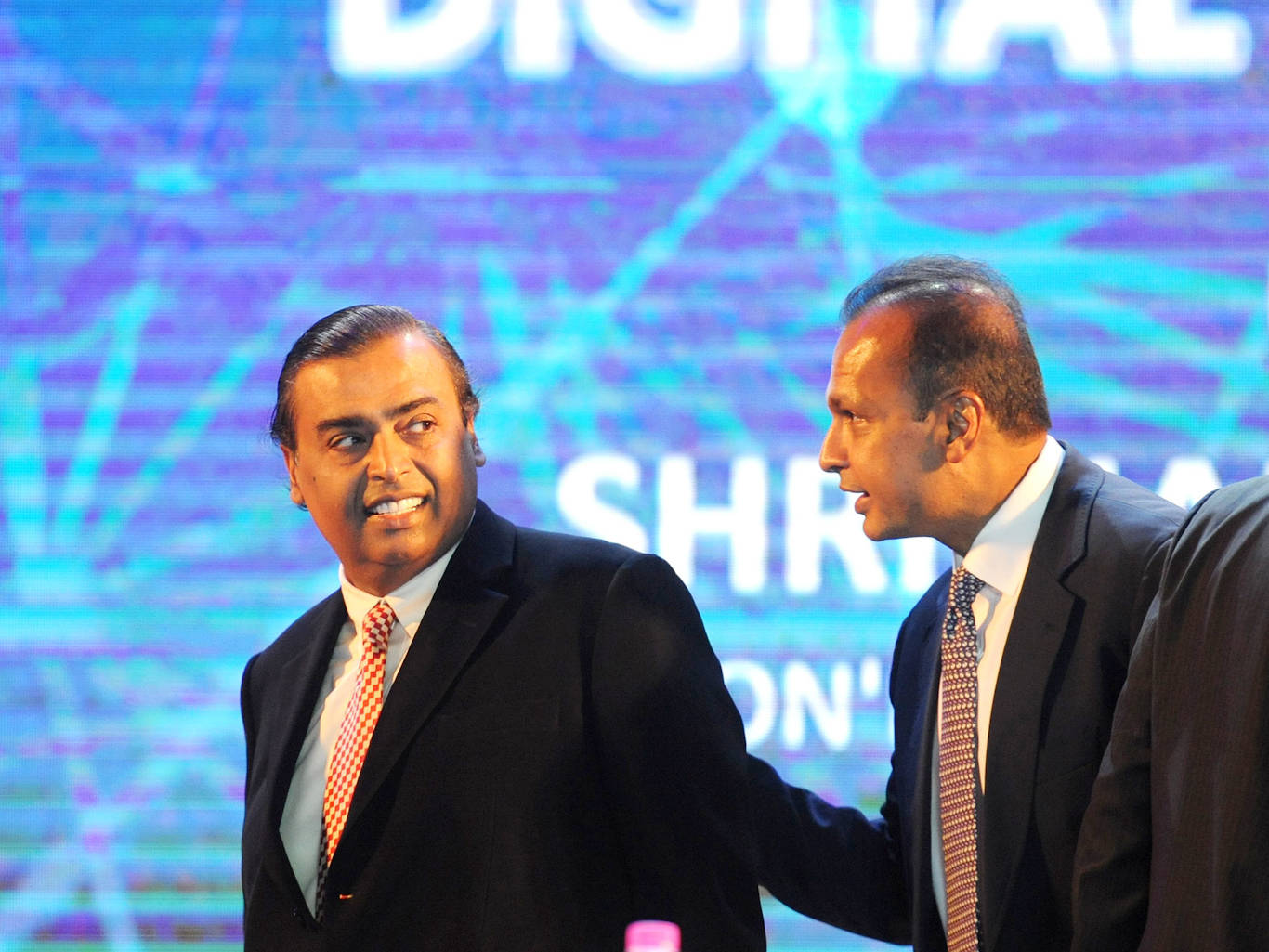
Anil Ambani (R) with brother Mukesh Ambani (L)BCCL

Reliance Communications’ owes nearly ten times more money than Vijay Mallya and Nirav Modi
The accusation of fraud puts Reliance Communications’ resolution plan at risk. According to the company’s official website, it owes ₹49,193 crore in dues.
In addition to that, Reliance Telecom owes ₹24,306.27 crore and Reliance Infratel owes ₹12,687.65 crore.

Cumulatively, this adds up to ₹86,188 crore — while still excluding the ₹28,837 that’s owed in spectrum dues.

CompanyDebt
Reliance Communications₹ 49,193 crore
Reliance Telecom₹ 24,306.27 crore
Reliance Infratel₹ 12,687.65 crore
TOTAL₹ 86,188 crore

This is ten times more than what another fallen billionaire, Vijay Mallya, owed Indian banks, with debt amounting to ₹9,000 crore. Compared to Nirav Modi, who owes at ₹7,409.07 crore, Reliance Communications’ debt is even more than a ten-fold hike.

Three Anil Ambani companies have reportedly been accused of fraud by banks⁠ — the amount at stake is nearly ten times more than what Mallya owed
Vijay MallyaBCCL

Bankruptcy resolution hangs in the balance
These allegations come nearly a year after a forensic audit unearthed questionable transactions worth ₹5,500 crore in the three Anil Ambani-led Reliance Group entities.

At the time, the probe found three suspicious large entries buried between hundreds of thousands of other transactions between May 2017 and March 2018, which indicated fund diversion.
However, the reclassification of Reliance Communication and affiliated companies’ accounts comes at a time when the bankruptcy resolution was finally moving along. The National Company Law Tribunal (NCLT) gave its approval to the resolution plan on December 5 after at least 11 months of negotiations.

This opens up the path for Anil Ambani’s brother, Mukesh Ambani, to pick the company’s tower and fibre assets for his own telecom enterprise, Reliance Jio. The total consideration is pegged at around ₹20,000 to ₹23,000 crore to be paid over the next seven years.

Meanwhile, Reliance Communications and Reliance Telecom Infrastructure will go to the UV Asset Reconstruction Company.

Update: Article was updated on December 30 to reflect Reliance Communications' statement to IANS.


LOOT OF OUR PUBLIC MONEY -EVERY INDIAN MUST READ THIS ARTICLE WRITTEN BY THOMAS FRANCO AND PUBLISHED IN CFA (CENTRE FOR FINANCIAL ACCOUNTABILITY) MARCH 25 2020 :-RANDOM REFLECTIONS:BROTHERS HAVE THE LAST LAUGH-BANKS BECOME BALD WITH HAIRCUT


Mukesh Ambani and Anil Ambani divided their companies under the Reliance empire in 2005. Brothers continue to use the same Reliance brand. Reliance is known for malpractices as explained in books like Ambani & Sons and Polyester Prince by Hamish Macdonald, No Regrets by Dr. D.N. Ghosh (former Chairman, SBI), Feast of Vultures by Tony Joseph, Exposure by Auditor Gurumurthy, who is now in RBI Board, Gas Wars by Paranjoy Thakurta and many others.  

Now Anil Ambani declares his companies bankrupt and Mukesh Ambani buys them at throw away prices but banks lose a lot in the name of haircut blessed by National Company Law Tribunal.

Take one example of Reliance settlement. Though the Indian banks were not allowed to go to NCLT, a Chinese bank, Exim Bank of China, went to the NCLT against Reliance Communications. The lenders agreed for a resolution plan for Rs.23000 Cr against loan of Rs.49000 Cr. Now UV Asset Reconstruction Company has placed bids for Rs.14700 Cr for assets of R Com and Mukesh Ambani’s, Reliance Jio has made an offer of Rs. 4700 Cr for tower and fiber assets. Both are closely connected. Together they bought Alok Industries with 82% haircut. Earlier Reliance Jio had offered Rs.7300 Cr. Anil Ambani owes SBI 4800 Cr, BOB 2500 Cr, Syndicate Bank 1225 Cr, PNB-1127 Cr, China Dev Bank 4900 Cr, Exim Bank of China-3356 Cr and Standard Charted Bank Rs. 2100 Cr.

Anil Ambani’s Reliance has 6 major Companies. Reliance Power, Reliance Infra structure, Reliance Capital, Reliance Entertainment, Reliance Home Finance and Reliance Health. The subsidiaries of Reliance Infrastructure are 56, along with 8 associates and 2 joint ventures. The EPC division of the company bagged Rs.7000 Cr Versova-Bandra sea link project, Rs.3647 Cr Upper Thermal Power Project, Rs.1881 Cr NHH Project in Bihar & Jharkhand, Rs.1585 Cr Mumbai Metroline Project, Rs.1081 Cr Kudankulam Nuclear Power Project, etc. in 2018.

Reliance Power was given sole distributorship in suburbs of Mumbai in 2017 but sold it to Adani Power. It has 50 subsidiaries. It has many thermal gas based Power projects and renewable energy projects.

Reliance Capital has asset management, mutual funds, life insurance, general insurance, commercial finance, stock broking, wealth management etc. It claimed to have 20 million customers as on 1st May 2017. It also has a NBFC. There are many subsidiaries too.

Reliance Entertainment is into fitness, web series, TV, animation, digital and gaming. It has 25 subsidiaries.

Reliance Health owns Kokilaben Dhirubhai Ambani Hospital, Mumbai and Reliance Hospital, Navi Mumbai.

Reliance Media work has Big Cinemas, Big Synergy, Lowry Digital and Reliance Media works UK. Its ventures include Kaun Banega Crorepati, Indian Idol etc.

It also has external links with RMW Vimeo Showreel. Reliance group of Anil claimed assets of US$ 43.6 billion in 2016 and 750,000 employees in 2018.  His net worth is shown as US$1.78 billion (Rs.133.5 billion) as on April 2019. He was voted as best role model among business men by India Today in 2006, also best business man of the year by TOI. Now he has claimed his net worth as zero in a London law suit filed by Chinese banks.

The Company has acquired few companies abroad also. The Accounts of Anil Ambani had become stressed assets for long but came to the surface in 2017. The outstanding loans exceed Rs.1 lakh crore. In 2015, France waived € 143.7 million to a French registered telecom subsidy of Reliance communications. This was after the Raphael deal was initiated. Without any experience in aeronautics Reliance Defense became part of the Raphael deal which is forgotten now. With insolvency, will Anil complete the deal?

Lot many things require to be answered:

1. Why Banks did not declare the loans as NPA in time?

2. Why RBI closed its eyes?

3. What are the investments abroad by Anil Ambani and his family members?

4. Why Anil’s Companies are sold to Mukesh with huge haircut? Is it not a vested interest?

5. Is the division of Reliance empire into two done with an aim to loot the country?

6. What guarantee is there that Mukesh Ambani’s companies will not default? They are the biggest borrowers in the country.The government has to answer! RBI has to answer! Banks have to answer. Journalists have to probe.  Are the brothers together looting the country’s finance?  What Mr. Gurumurthy, director RBI has to say?

Are the brothers having the last laugh at the cost of banks and people’s money?

Viruses will come and go but we cannot remain mute spectators to the day light robbery. Ghanti Bhajao!

Thomas Franco is former General Secretary of All India Bank Officers’ Confederation.


used here for educational purposes of CA and CS students

10 Tips to Avoid Fights in a Marriage By POOJA KHERAMay 25, 2021 09:54 IST -Source Rediff.com used here for education purposes only

 Fix the feud before you end your day.

Don't go to bed with the unresolved squabbles, suggests relationship and wellness coach Pooja Khera.
IMAGE: A scene from Out of Love only posted for representational purposes.

It is no secret that married couples, especially those married for long time, have unsolved issues.

When pushed under the carpet these issues are never addressed in the fear of disturbing the peace of the house.

This often leads to the classic escape of ostrich putting his head in the sand.

If you resort to this method of evading the hassle-at-hand it will lead to frequent conflicts that could turn nasty.

Though experts suggest that some amount of conflict is healthy but if brewing problems are not resolved at the earliest, these problems can create disruptive undercurrents in relationships that can disturb an otherwise happy marriage.

Understanding discord is never easy. It goes far deeper than different backgrounds and belief systems.

It definitely cannot be localised to varying habits and expectations.

What is then the key to handle marital dispute?

Clearly, avoiding an issue is not the answer, but dealing with it with maturity and compassion is the key.

Here are 10 tips for married couples who may be going through a tough time:


1. Accept your role in the conflict

During a conflict, our first instinct is to react.

How many of us pay attention to what is being said to understand and empathize?

Most often we listen only to snap back.

When you want to react, just take a pause. Step back. Ponder and introspect.

Think about what was your role in the build-up of this conflict?

Did you raise your voice?

Did you patronise and try to control the outcome of an issue?

Are you the perpetrator or a silent spectator?

Once you realise the fundamental cause you will get clarity on the problem. Admit to your part, take responsibility, and move towards a resolution.

2. Learn to let go

Here you perhaps have to dig deep and draw from the love you feel for your spouse.

Partners can sometimes act exasperatingly. They may be doing so unintentionally.

If the issues are innocuous then it is a waste of your loving energy to argue about it.

Here, patience should be the key.

Taking strength from the love you have for your better half and let go of most things that are harmless.

If you change your perspective maybe you could even find it amusing.

3. Stick to the issue at hand

More often than not when couples argue they tend to go off on a tangent.

With so much history between both of you, there would be many contentions.

One can bring up arguments and incidents from the past and forget the main issue at hand. This escalates the conflict and builds a more hostile atmosphere.

Just hold on....let the bygones be bygones. Just stick to the present problem and determine to sort it out.

4. Remain level headed

Raising your voice and ranting at your partner is one of the worst things in a conflict-situation.

When either of the partners get defensive and shout back the other one just goes into a shell and becomes non-receptive.

This beats the very purpose of 'sorting it out'.

Rather than hitting it out, take a deep breath. Take a moment.

It is best that you move away from the situation or go for a walk which will help you clear your thoughts.

Take your time, refresh, and then go back to your partner to find a solution.

5. Give each other a chance to speak and express

This is about being a good listener. It is a virtue that most of us need to cultivate.

Remember, conflict can escalate if your spouse refuses to consider your point of view.

Both of you must respect each other's stance instead of dismissing them unceremoniously.

If your spouse feels restricted and unable to resolve the issue then stop convincing and influencing them.

Each of you must listen to deeply understand the concerns with patience.

Let your partner speak freely without restrain. Do not interfere and speak before your turn.

It is very important for partners to feel that they are being heard.

Give your entire focus on your partner when they are speaking and take turns to express feelings and views.

Reciprocal attention brings in more insight and thus creates awareness and help in resolving the problem.

6. Apologise

In an argument, nothing is more powerful than saying 'sorry'.

Instead of focussing on right or wrong, acknowledge each other's feelings and offer a sincere apology that is focused on reducing the bitterness.

An empathetic expression of remorse allows partners to move away from spitefulness.

Remember, an important aspect of apology is a mindful change in behaviour.

Implement the change and begin anew.

7. Emotions can be powerful

Try not to get add logic into an emotional discussion.

Settle the issue with sensitivity.

Most of the times the best outcomes does not always depend on rationale and reasoning.

So avoid intellectualisng a problem.

When disputes are settled with love, compassion and warmth, it makes partners feel secure.

It also helps identify and change the core aggravation which manifests itself as a bigger problem. This also leads to a better closure.

Blaming each other creates a bitterness that is best avoided if you want to have a long loving relationship.

8. Don't jump to conclusions

Give your spouse the benefit of the doubt.

Make sure you understand them exactly the way they want to be understood before drawing any conclusions.

Address the dilemma that is bothering you instead of creating your narrative about it.

Stay away from giving the issue an unwanted twist and creating an entirely different story that is untrue.

If what your partner is saying is unclear or confusing to you, ask for clarification instead of making an assumption. And yes, avoid putting words in their mouth.

9. Don't go to bed angry

Fix the feud before you end your day. Don't go to bed with the unresolved squabbles.

This will not only cause more emotional stress but will also make you feel unvalued and lost.

Moreover, you will carry the conflict to the next day and in the process escalate it.

10. A little compromise does not hurt

Remember why you fell in love in the first place and determine to find solutions that are acceptable to both partners.

If you want, go a step further and do a role reversal.

Take turns to try each other's solutions. It will also indicate which approach or solution works best.

This would also mean that each partner will have their way once and then the next time, the other partner takes over. Talk about a win-win situation!

Remember that a successful marital relationship is not the one where there is no conflict but the one where partners can resolve conflicts respectfully.

A successful marriage is based on respect, attention and care.

And with this, let there be peace!


Friday, May 21, 2021

Israel's Netanyahu on Gaza ceasefire: We accomplished the goals of the c...

Kapil Wadhawan's 2nd proposal must be tested on merit, put to vote: NCLT Directs administrator to place proposal before the CoC and inform the outcome within 10 days Topics NCLT | Dewan Housing Finance DHFL | debt resolution Subrata Panda Last Updated at May 21, 2021 14:17 IST :-Business Standard


Former DHFL promoter Kapil Wadhawan

The Mumbai bench of the National Company Law Tribunal (NCLT) in its order in the Dewan Housing Finance Limited (DHFL) matter has said the second proposal of the erstwhile promoter, Kapil Wadhawan, deserves to be examined on merits and put to vote by the committee of creditors (CoC).

In its written order, the tribunal has said, "...the Adjudicating Authority is of the considered view that the 2nd proposal deserves to be examined on merits and put for deciding, voting of the members of CoC and if the same is commercially found not favourable with the COC members then the proposal can be rejected”.

In its order, directed the administrator to place the second proposal of the erstwhile promoter before the CoC for its consideration, decision, voting and inform the tribunal the outcome of the same within 10 days from the date of the order.

It has also rejected the Reserve Bank of India (RBI)-appointed administrator’s claim that the settlement proposals of the Kapil Wadhawan were considered by the CoC, as the claim was not supported by any record or evidence.

“Though the letters, settlement proposals were addressed to the administrator, CoC it is seen from the records that AZB Partners, the legal team of the DHFL, have written/replied to him and apparently the same is communicated without the knowledge, approval of the administrator, the members of CoC therefore, the same cannot be treated as a reply from the Administrator, CoC, appropriate authority”, the tribunal observed.

In the order, the tribunal said the settlement proposal of Wadhawan at Rs 91,158 crore is more than the Rs 54,512 crore offered by the next highest bidder, Piramal Group, who offered Rs 37,250 crore.

“Since this settlement proposal is substantially higher / more than one-and-a-half-times the value of the highest bidder the same needs due consideration/reconsideration by the Administrator/COC,” the order said.

The tribunal also observed that with the settlement proposal thousands of the small investors, fixed deposit holders would be paid fully, thereby thousands of small investors would get 100 per cent of their principal sum outstanding.

“....we are conscious about our jurisdiction that this adjudicating authority cannot substitute its view of over the commercial wisdom that may be exercised by the CoC in respect of the present applicant, however, there appears to be some procedural irregularity by not considering a settlement proposal which is around 150 per cent higher value of the resolution plan approved”, the bench said in its order.

Clearing the air around the legality of the erstwhile promoter submitting an offer for the corporate debtor, the bench in its order has said that contention of the respondents (RBI, CoC, and the administrator) that Wadhawan has not submitted a resolution plan for the consideration of the CoC is not legally tenable because the applicant has submitted an offer/proposal for settlement akin to One Time Settlement (OTS) and there is no express legal bar under the provision of IBC to a promoter (applicant) for making a proposal for settlement.

“In case if this settlement proposal is accepted by the COC with its requisite majority then a withdrawal application can be filed under section 12A of the Code by the applicant in main IB Petition (herein the RBI through Administrator)”, the order said.


INDIA NEWS India observes former PM Rajiv Gandhi's 30th death anniversary today HT


Hailing from the politically powerful Nehru–Gandhi family, Gandhi was born in 1944 in Bombay.
Every year on May 21, India pays homage to the former prime minister and Congress leader Rajiv Gandhi who was assassinated during a political campaign, 30 years ago today.

This year, the Congress party has asked all its state units and frontal organisations to observe the death anniversary of Rajiv Gandhi as the day of "Seva and Sadbhavna" for the people who are grappling with Covid-19 pandemic.

The Congress workers have been asked to distribute relief materials to people, and prepare kits of basic medicines and distribute them to those in need.

A Bharat Ratna recipient, Gandhi was the sixth prime minister of the country. He took charge of the office in 1984 following the assassination of his mother Indira Gandhi and became the youngest ever to serve the office. He was 40-year-old at that time.

Hailing from the politically powerful Nehru–Gandhi family, Gandhi was born in 1944 in Bombay. His maternal grandfather Jawaharlal Nehru was the first Prime Minister of India.

Gandhi completed his schooling at Doon school in Dehradun after which he moved to London for further studies. He returned to India in 1966, when India Gandhi became the first female prime minister of the country.

Gandhi was also a trained pilot and worked for state-owned Indian Airlines for some time.

In 1968, Rajiv Gandhi married Sonia Gandhi who is the current president of the Congress party. Rahul and Priyanka Gandhi are the couple's children.

Assassination

In 1991, Rajiv Gandhi was assassinated during an election campaign by a Liberation Tigers of Tamil Eelam (LTTE) suicide bomber in Sriperumbudur, Chennai. Following the death of Rajiv Gandhi, his wife Sonia took charge of the Congress party and became party president for the first time in 1998.