Pages

Tuesday, May 29, 2018

Nepal reports outbreak of highly pathogenic H5N1 bird flu REUTERS|Updated: May 29, 2018, 03.33 PM IST

Flu-bccl

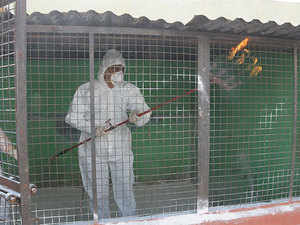
PARIS: Nepal reported an outbreak of severe H5N1 bird flu among backyard ducks near the capital Kathmandu, the World Organisation for Animal Health (OIE) said on Tuesday, citing the Nepalese Ministry of Livestock Development. 

It was the first outbreak of highly pathogenic bird flu in the country since 2017, OIE said in a report posted on its website. 

The virus was found in a flock of 5,633 ducks reared in a backyard in the Kathmandu district, located in the Bagmati zone. It killed 240 animals and the rest were disposed of. 


"Ducks reared in backyard system started to show torticollis and greenish white diarrhea and died. Dead ducks were disposed of properly," the ministry wrote in the report. Some strains of the H5N1 virus can be transmitted to humans. 


UNDERSTANDING AATMARAM - AN IMPORTANT PIECE OF KNOWLEDGE FOR ALL AND SPECIALLY FOR HINDUS WHO BELIEVE IN THEIR RITUALS.


I don't know how to begin as there is a lot going in my mind right now. Recently there had been a tragedy in our family. My father passed away on May 27, 2018..

He was 93 years old and left us all shocked and heart broken.

We cremated him at our Native place Rajpura-Punjab-India with proper rituals and wet eyes. After the cremation there is a Hindu ritual of collecting phool (bones) and ashes.

The day after we all went there to complete the ritual where I encountered a strange thing.
The priest searched in the ashes took a piece of bone which was located near my uncle’s heart and “there it is AATMARAM” he said.

Clueless for a moment I looked at it. It was a piece of bone looked more like a vertebra.  Although I am a CA., but before doing CA being from a science background I knew it is not a vertebra. Then what is it?

As I was about to ask what is aatmaram, the priest started explaining. “Not every deceased person has aatmaram after being cremated. This represents that Shri Yash Pal Singhal ji (my father) is a pure soul.” This increased my curiosity so I put all my focus on aatmaram. It looked like a person sitting crossed legs with his hands and fingers in dhyan mudra (position of meditation). I was speechless. It was like a new dimension of knowledge just opened in front of my sight.

Still a little sceptical I searched the internet later that night to find many post not only by the Indian origin but also from the foreign researchers. One of which took my attention. It stated “The Aatmaram is a piece of bone which is a part of the ribcage closest to the heart. It is here, that the soul resides. Although, the soul is said to be in the entire body but it is said that this is the centre point. If found intact, it looks like a person in a yogic sitting position with crossed legs and hands & fingers in a mudra. This aatmaram is supposed to signify the greatness and the purity of the person.”

Exactly! What I encountered during the day.

We may be living in the 21st century with all the researches and amazing new technologies and countries competing to reach mars etc. But we still do not have answers to many questions which god created. We do not study aatmaram in anatomy books. I asked a friend of mine who is a doctor and is into research related to bio mechanics. When I spoke to him it doesn't took me long to conclude that science doesn't even have a logical answer to it.

Sometimes we don’t need today’s logic to get correct answers.


HOW COMFORTABLE IS STAY OF UNITECH'S AJAY AND SANJAY CHANDRA IN TIHAR JAIL.

Image result for ajay chandraImage result for tihar jail PIC
Six cellphones, bottles of perfume, imported chocolates, 73 packets of ready-to-eat food and biscuits -- these were some of the items recovered from an SUV at the jail number 1 parking lot within the Tihar jail compound. On Wednesday evening, when a senior jail officer found the items inside a Toyota Innova and questioned the driver s identity, the man said his name was Vikrant Mahant. Questioning revealed he was an employee of Ajay and Sanjay Chandra, owner-directors of the real estate firm Unitech Ltd. The Chandra brothers have been in prison since April last year for allegedly duping over 500 home buyers in a proposed housing project in Gurgaon. Prison officers had another surprise waiting for them. When they went to inspect a room inside the jail where two brothers have been allowed by the Supreme Court to negotiate the sale of properties to pay off investors, they found more perfume bottles, chocolate boxes, one mini refrigerator, two cell phones, two cordless phones and two desktop computers. Tihar s director general Ajay Kashyap has ordered an inquiry to find out how the items came to be in the high-security jail. In October last year, the Supreme Court had allowed the Chandras to use video conferencing facilities from a makeshift office inside the prison to arrange a R750 crore deposit for grant of bail. 

Monday, May 28, 2018

MY RESPECTED FATHER BREATHED HIS LAST YESTERDAY ON MAY 27,2018

WITH PROFOUND GRIEF AND SORROW I WOULD LIKE TO INFORM ALL ABOUT THE SAD DEMISE OF MY RESPECTED FATHER MR.YASH PAL SINGHAL AT MY NATIVE PLACE RAJPURA -PUNJAB -INDIA.
MAY HIS SOUL REST IN PEACE.Image may contain: 1 person, indoorImage result for FLOWERS FOR DEAD ONE

In your hands, O Lord,
we humbly entrust our brothers and sisters.
In this life you embraced them with your tender love;
deliver them now from every evil
and bid them eternal rest.
The old order has passed away:
welcome them into paradise,
where there will be no sorrow, no weeping or pain,
but fullness of peace and joy
with your Son and the Holy Spirit
forever and ever.

Saturday, May 26, 2018

From ‘maund’ to ton: The story of measures in India Growing up as an NRI child, these bizarre units of measure were some of the most mysterious aspects of my parents’ culture: Tola. Furlong. Anna. Naya paisa. Cent. Para. Muram. Nazhika Last Published: Fri, May 25 2018. 12 27 PM IST

Sidin vadukut
The first of October this year will mark 42 years since the Standards of Weight and Measures Act came into effect. Photo: iStock
Thirty years ago, when I was but a schoolboy in Abu Dhabi, with strange hair and an adorable paunch, one of my daily domestic chores involved making a phone call. Each afternoon, after I had returned from school, consumed a substantial snack of some kind, and provided my mother with a thorough daily school report, I would sidle up to our landline telephone.
I would pick it up and dial one of the many Indian jewellery stores in Abu Dhabi. This was a unique phone number that took the caller directly to a recorded message. After no more than two rings, the automated voice message would say something like: “Today’s gold price is XYZ dirhams for 10 tolas.”
This ritual took place each afternoon. Afternoon after afternoon. And yet, to this day, I am not entirely sure what a tola is. Google tells me that it is around 11.66g. Who measures things in multiples of 11.66g? It makes no sense.
And then, during our annual vacation to Kerala, my grandfather would call me over and say something like, “Sidin, please go to the shop that is just 5 furlongs away and buy eight annas worth of yam.”
And I would have so many questions: What is a furlong? What is an anna? Who eats yam? Can you arrange for air-conditioning, why is this country so hot?
Growing up as an NRI (non-resident Indian) child, these bizarre units of measure were some of the most mysterious aspects of my parents’ culture. Tola. Furlong. Anna. Naya paisa. Cent. Para. Muram. Nazhika.
But, as a fascinating new paper in the latest edition of the Past & Present journal reminds us, the standardization of weights, measures and coinage in India took place not that long ago.
The first of October this year will mark 42 years since the Standards of Weight and Measures Act came into effect. In his paper, Rethinking Metrology, Nationalism and Development In India, 1833-1956, Ashish Velkar of the University of Manchester tells the riveting story of how India transitioned, slowly and hesitantly, from a plurality of standards during the colonial period to more modern, global protocols of measuring, weighing and counting money.
At first glance, this might seem like a natural transition for a nation to make. Especially one that is emerging from the colonial shadow and learning to stand on its own two feet. Surely a tendency towards standardization is one of the fundamental characteristics of a new nation state.
But read Velkar’s paper and you realize that there was nothing straightforward about this process. Indeed, standardizing Indian weights and measures remained a fiendishly difficult thing to do. Colonial attempts, first by the East India Company and then by the British government, enjoyed little success.
Why so? There appear to have been four reasons standing in the way of imperial standards.
First, there already existed a profusion of local and regional standards all over the subcontinent. Second, Velkar says, there was a strain of thinking prevalent both in Britain and across British Imperial administration that uniform standards did not matter, as long as there was some local standard that was enforced strictly.
Third, it seemed impossible to get anyone to agree on what these standards should be. For instance, in 1857, proposals were put forward to make the native maund the standard measure of weight for the railway networks, instead of the ton. There was just one problem—it turned out that the maund was itself measured differently in different places.
Finally, there was a problem of enforcement. Who was going to police all the weights and measures all over India? Who was going to pay for this policing?
Which is why even as late as 1946, Velkar reminds us, commodities such as fish were being measured in heaps, baskets, maunds, seers, tooku, kandi and shekda, depending on where in India you were doing this measuring, and for what purpose.
It is not surprising, therefore, that the push for standardization came not from the colonial authorities but from the nationalist movement. As ideas of central planning began to find fervour within the nationalist movement, Indian leaders began to put pressure on the colonial government. Standards were seen as central to the goal of building an Indian nation.
In 1933, Syama Prasad Mookerji suggested that India adopt the metric system—“the one language of measurement”—even if Britain did not. In 1944, the Indian Decimal Society was formed to lobby for the cause of decimalization. Unfortunately, one of its earliest opponents was Gandhi, who preferred the “traditional” hexadecimal system that the masses were more familiar with.
Eventually, India would have to wait till 1955, and the full force of Nehru’s influence, for the process of standardization and metrication to kick start in earnest (even then, compromises had to be made. Initially, it was proposed to divide the rupee into 100 cents. Later, this was quickly changed to the more “indigenous” naya paisa.)
Velkar’s paper is fascinating on multiple accounts. It tells a great story, of course. It also throws light on the competing, sometimes unexpected, priorities that motivated both the empire and the nationalist. But I think, above all, it reveals the complexities involved in building a nation.
Nations are made up of many things. Armies, central bank, ministries, airports, strategic petrol reserves. But also inches, and millimetres, and paisa and grams.
Déjà View is a fortnightly conversation on history. Read Sidin Vadukut’s Mint columns at www.livemint.com/dejaview

EPFO notifies 8.55% interest rate on PF for 2017-18, lowest in 5 years Employees’ Provident Fund Organisation (EPFO) has asked its field offices to credit 8.55% interest rate for 2017-18, the lowest rate since 2012-13 fiscal, into the PF accounts of around 5 crore subscribers Last Published: Fri, May 25 2018. 08 53 PM IST

The EPFO members got 8.8% in 2015-16 and 8.75% each in 2014-15 and 2013-14. Photo: Ramesh Pathania/Mint
New Delhi: Retirement fund body Employees’ Provident Fund Organisation (EPFO) has asked its field offices to credit 8.55% interest rate for 2017-18, the lowest rate since 2012-13 fiscal, into the PF accounts of around 5 crore subscribers.
The Labour Ministry has conveyed approval of the central government to credit 8.55% rate of interest for 2017-18 into PF accounts of members, according to an order issued by the EPFO to its more than 120 field offices. The finance ministry had ratified 8.55% interest rate on EPF for the last fiscal.
But it could not be implemented because of model code of conduct for Karnataka elections.
The labour ministry had sought Election Commission’s approval to notify rate of interest for crediting the same into members’ accounts by the EPFO in view of model code of conduct for Karnataka elections.
The EPFO’s Central Board of Trustees, headed by the labour minister, had decided to fix rate of interest at 8.55% for the last fiscal in its meeting held on 21 February 2018.
The labour ministry had sent the CBT’s recommendation over the interest rate to the finance ministry for its concurrence.
However, it could not be implemented for want of the finance ministry’s concurrence and was further delayed due to model code of conduct for Karnataka polls on 12 May. The EPFO had provided 8.65% interest for 2016-17.
The members got 8.8% in 2015-16 and 8.75% each in 2014-15 and 2013-14. In 2012-13, EPFO had provided 8.5% interest rate on EPF. Thus, at 8.55% for 2017-18, it is a five year low.

All 7 ITR forms for assessment year 2018-19 activated for e-filing: Income Tax Department The Income Tax Department today launched, activated all 7 Income Tax Return (ITR) forms for assessment year 2018-19 for e-filing by taxpayers, after more than a month of them being notified Last Published: Sat, May 26 2018. 05 23 PM IST

The new ITR forms mandate the salaried class assesses to provide their salary breakup, and businessmen their GST number and turnover. Photo: Pradeep Gaur/Mint
New Delhi: The Income Tax Department on Saturday launched and activated all the seven Income Tax Return (ITR) forms for e-filing by taxpayers, after more than a month of them being notified.
The Central Board of Direct Taxes (CBDT) had notified the new ITR forms for the assessment year 2018-19 on 5 April.
“All ITRs for AY 2018-19 are now available for e-filing,” the department said in a statement.
The tax department has launched the ITR forms gradually since 5 April as the taxpayers have been looking forward to file their returns before the stipulated deadline of 31 July.
All seven ITRs are to be filed electronically on the official web portal of the department except for some category of taxpayers, the CBDT had said.
The new ITR forms mandate the salaried class assesses to provide their salary breakup, and businessmen their GST number and turnover.
The ITR-1 called ‘Sahaj’ is largely used by the salaried class of taxpayers with income up to Rs50 lakh from salary, one house property only and additional income such as interest earned from fixed deposits and recurring deposits.
This time, the ITR-1 form seeks an assessee’s details in separate fields such as allowances not exempt, profit in lieu of salary and value of prerequisites among others. This form was used by three crore taxpayers during the last financial year.
Similarly, the ITR-2 form is used by individuals and Hindu Undivided families (HUFs), who have income from any sources except income from profits and gains of business or profession, including NRIs.
Individuals and HUFs having income under the head business or profession can file either ITR-3 or ITR-4 in presumptive income cases.
The rest of the forms are for different category of taxpayers.
The CBDT, which makes policy for the tax department, had said that some fields have been “rationalised” in the latest forms and that there is no change in the manner of filing of the ITRs as compared to last year.
In case of non-resident taxpayers, the requirement of furnishing details of “any one” foreign bank account has been provided for the purpose of credit of refund. The requirement of furnishing details of cash deposits made during a specified period (in the wake of the note ban of 2016) as provided in the ITR form for the AY 2017-18 has been “done away with” this time.
The field to either mention the 12-digit Aadhaar number or the 28-digit enrolment Aadhaar ID has been retained in the new forms.
The CBDT had said individual taxpayers of 80 years or more at any time during the previous year or an individual or HUF, whose income does not exceed Rs 5 lakh and who has not claimed any refund, can file ITRs in the paper form, using the ITR-1 or ITR-4.

What's been Modi Sarkar's biggest achievement?

May 25, 2018 08:27 IST

While GST and insolvency laws are among the major achievements of the Modi government, the list of failures include demonetisation, toxic banks, manufacturing hiccups and most prominently bizarre job creation figures.
Mihir S Sharma recaps four years of Modi Sarkar.
Illustration: Uttam Ghosh/Rediff.com
The scale of Narendra Modi's victory in the Lok Sabha elections four years ago, on May 16, 2014, was such that many observers believed a long-delayed course of economic reform would be implemented, using an unprecedented Lok Sabha majority in recent years.

In the years since, Modi's government has lived up to expectations in terms of the amount of energy it has brought to policy-making -- but its record is divided between hits and misses.
Hits
Politically, Modi's most important economic achievement has been the taming inflation since 2014.

In this, his government has been helped by the collapse in oil prices since he took office, and that has reduced prices all-round.
But the government has also been careful about increasing minimum support prices to farmers, which has helped control food inflation.
The most lasting economic achievement of this government is surely the introduction of the Goods and Services Tax or GST -- a comprehensive reworking of the entire indirect tax structure in India, which required a political consensus and a constitutional amendment.
While glitches attended its roll-out and the tax is not as simple as originally planned, many hope the GST Council will stabilise the tax and improve the tax-GDP ratio.
In terms of reforming welfare-focused economic schemes, the Modi government focused on increasing the efficiency of the transfer pipeline, using what it called the JAM trinity -- short for Jan Dhan, Aadhaar and mobile connectivity.
The number of basic bank accounts under the Jan Dhan scheme has vastly increased, as has the coverage of Aadhaar.
While the legal challenges to Aadhaar are yet to be settled, there is no doubt that the architecture for direct benefit transfers has been established.
The government will also point to its road-building record and the Ujwal DISCOM Assurance Yojana (UDAY) scheme, which transferred the debt of electricity utilities to the books of state governments, allowing them to buy and supply power once again.
But more influential perhaps will be the Insolvency and Bankruptcy Code (IBC), a big step towards greater flexibility for capital.
Misses
Modi's signature economic policy, however, must be his decision on November 8, 2016, two and a half years into his term, to withdraw high-value currency notes as legal tender overnight.
Demonetisation was a deeply divisive policy.
While politically popular, given that it had been sold as an assault on black money, most economists predicted it would have fewer benefits than costs.
So it has proved, with most of the cash withdrawn returning to banks and very little behavioural change in evidence.
Many hoped for a decisive shift to digital payments in the wake of demonetisation, but as time passes the use of cash in India appears to be returning to the pre-demonetisation norm.
While politically successful, in terms of economic policy demonetisation did not achieve its various stated aims.
The first big policy direction that Modi gave to the government, in his first address from the ramparts of the Red Fort on August 15, 2014, was ramping up manufacturing.
‘Make in India’ became a central slogan for the government in its first years, but there is little to show for it at the end of four years.
In fact, India went through a major trade slowdown and a crisis in private investment, which hampered attempts at growth revival.
The investment trough was partly caused because of neglecting the non-performing assets or NPAs in public sector banks.
The introduction of the IBC has meant that there is now a structured process to revive the assets caught up in the twin balance sheet problem.
Yet it is untested, and the larger question of what to do with PSBs remains unaddressed.
Half-way steps like recapitalisation, Indradhanush and the Banks Board Bureau have failed to restore confidence in the sector.
Politically, however, Modi will be most wary of his government's record on job creation.
The past year has been marked by sharp disagreements over how many jobs have been created.
Yet the government's shift of focus from the provision of jobs, under 'Make in India' to boosting entrepreneurship using the Micro Units Development and Refinance Agency Bank (MUDRA) scheme of small loans, tells its own story.
Many economists believe till structural reform of land and labour laws is undertaken, India will continue to under-perform in terms of job creation and growth.
Mihir S Sharma
Source: 

WE ARE PROUD OF THIS BRAVE SIKH POLICE OFFICER

'It was my duty to save that man'


May 26, 2018 08:16 IST
'The couple was not doing anything wrong and they have the right to sit wherever they want.'
'All that was going through my mind was that I had to do my Constitutional duty of saving this man.'
IMAGE: A screengrab from the video showing Sub-Inspector Gagandeep Singh using himself as a shield to protect a Muslim man from the irate mob. Photograph: Kind courtesy YouTube
Amid the vitriol and hatred that is shared on social media, there was a single, simple, story that made everyone smile on Friday.
A video of a Sikh police officer saving a Muslim youth from being attacked by an angry mob in Uttarakhand's Ramnagar district on Tuesday, May 22, has gone viral(external link).
The incident occurred near the Garjiya Devi temple in an isolated area.
The video shows, a young Sikh police officer -- now identified as Sub-Inspector Gagandeep Singh -- using his body to shield the young man from the crowd trying to assault him.

The incident, which was caught on camera, was quickly shared on social media, where people hailed Singh for his heroic act.
Speaking to Rediff.com/Syed Firdaus Ashraf, Singh says, "I have learnt from Guru Nanakji that we all must live in harmony and brotherhood and have concern for others."
Here is what happened in his own words

"I was on duty on May 22 when I witnessed a ruckus near the temple premises.
A mob had caught hold of a couple. When I reached the spot, the mob were beating up the man.
I inquired with people in the mob what the problem was and that's when I was told that the boy was Muslim and the girl with him a Hindu.
They were viciously beating him up. I just grabbed him and held him close to him.
I simply wanted to ensure that no one could hurt him anymore and he was safe.
The mob was out of control; if you saw the video, you could see that it was very difficult for me to remove the man from the situation.
All the drama began when the couple was found by the mob sitting near the Ganga river.
It is usual to see couples sitting there, but unfortunately for this couple, there was a mela taking place, which resulted in the large crowds.
I don't know what the couple was doing when the mob caught hold of them. I quickly flung into action when I noticed the chaos and saw that a crowd had congregated.
At that point of time, I wasn't afraid of the mob.
All that was going through my mind was that I had to do my Constitutional duty of saving this man.
People say I was brave, but I was simply doing my duty.
At that moment, only one thing was racing through my mind and that was no innocent should die because of this mob outrage.
I believe the Constitution of India says that no one has the right to hurt another person.
The couple was not doing anything wrong and they have the right to sit wherever they want and nobody should raise an objection.
I have learnt all these things in law and while doing my police training.
It was my duty to save that Muslim man.
As much I could do, I did my best.
Right now, I have come to know that the superintendent of police has ordered that I be given an award of Rs 2,500.
On that day, no one was arrested as there was no complaint lodged by anyone. Today, an FIR has been lodged in the case.
I feel the message that goes out by what I have done is that we should not spread hatred in society and no one has the right to put any prohibition on another individual.
Our Constitution has given the right to all that they have the freedom to sit anywhere and no one must raise an objection to it till the time they are not doing anything illegal.
I have learnt from Guru Nanakji that we all must live in harmony and brotherhood and have concern for others.
I did exactly that on May 22.
This was taught to me by my family and this is my culture.
We should care for every living being -- be it a bird, animal or human beings."
Syed Firdaus Ashraf / Rediff.com

Japanese opposition party elects first female leader

Renho Murata is third Japanese woman to attain high office in recent weeks in country where women are woefully under-represented in politics
Renho Murata
 Renho Murata easily defeated her two rivals for the leadership of the left-of-centre Democratic party. Photograph: Kimimasa Mayama/EPA
A former news anchor has struck a rare blow for Japanese women in public life by becoming the first female leader of the country’s biggest opposition party.
Renho Murata easily defeated her two rivals for the leadership of the left-of-centre Democratic party on Thursday, hours after she sparked a minor controversy by revealing she still held dual Japanese and Taiwanese nationality despite insisting earlier that she had renounced the latter while in her teens.
The 48-year-old, who was born in Japan to a Taiwanese father and Japanese mother, is expected to give her party a temporary boost, following a run of poor election results.
Murata – known simply as Renho – said the party’s priority was to re-establish itself as a serious alternative to the Liberal Democratic party (LDP), which together with its junior coalition partner dominates both houses of parliament.
“From here on, we face a giant ruling party,” she said after the vote. “I’d like to call on everyone to join me in creating a party that does not criticise but makes proposals ... so that one day we will become Japan’s choice.”
In July, Yuriko Koike was elected governor of Tokyo, and immediately confronted the city’s bureaucracy by postponing the relocation of Tsukiji market – the world’s biggest fish market – due to concerns over soil contamination at the new site.Murata is the third woman to attain high political office in Japan in the past two months, although women are still woefully under-represented in the country’s parliament.
Last month, Tomomi Inada, a rightwinger who has been tipped as a future prime minister, became Japan’s second defence minister.
Their appointments were made against a background of gender imbalance. According to the Inter-Parliamentary Union, women make up less than 10% of MPs in the lower house of Japan’s parliament, and 20% of those in the upper house. Inada is one of only three women in the 20-strong cabinet of the prime minister, Shinzo Abe, whose mission to fill 30% of public and private sector leadership positions with women by 2020 has got off to a disappointing start.
Murata, a former swimsuit model who worked as a journalist before being elected to parliament in 2004, seized the opportunity to lead the Democrats after the former leader, Katsuya Okada, said he was stepping down in the wake of the party’s poor performance in July’s upper house elections.
During its three years in government from 2009, the party was criticised for mishandling the planned relocation of a US marine base on the southern island of Okinawa and for its response to the triple meltdown at Fukushima Daiichi nuclear power plant in March 2011. The party, whose MPs include an uneasy mix of liberal and conservative defectors from other parties, has never recovered from its heavy general election defeat in late 2012.
A poll by the Asahi Shimbun this week showed support for the LDP at 40%, with the Democrats on just 7%.
Murata’s attempts to rebuild the party’s credibility got off to a shaky start, just hours before her expected victory was confirmed on Thursday.
Questioned by reporters, she acknowledged that she still held Taiwanese nationality, despite earlier claiming that she had become a naturalised citizen of Japan in 1985 at the age of 17.
“I would like to apologise for the confusion caused by my inaccurate recollection of what happened and the contradictions in my recent remarks,” she said, before confirming that she identified herself as Japanese. “I’ve always worked for the good of this, my own country, and I’ll continue to do so,” she said.
Japanese law requires people with dual nationality to choose one or the other before they reach the age of 22, although failure to do so is not a crime. Many retain dual nationality under a “don’t ask, don’t tell” policy.
The nationality debacle is likely to be seized on by her opponents, however. The conservative Yomiuri Shimbun newspaper described Murata’s confusion over her nationality as a “sorry state of affairs”.
Despite her assurances this week that she had taken steps to renounce her Taiwanese citizenship, the newspaper said in an editorial: “It is out of the question for a legislator – who is supposed to serve the interests of the nation, including in foreign affairs and national security – to leave their own nationality obscure.”
The Yomiuri suggested that some might question her loyalty to Japan, particularly over foreign policy issues where it is in disagreement with Taiwan.
“Although Taiwan is friendly towards Japan, it is in conflict with the Japanese standpoint regarding some issues, for instance, its ownership claims on the Senkaku islands,” the paper said. “If Renho retains her Taiwan citizenship, she could become the target of undesirable suspicions regarding her relations with Taiwan.”
The Senkakus are administered by Japan but also claimed by China and Taiwan.
During her leadership campaign, Murata vowed to protect the war-renouncing article of Japan’s postwar constitution, as speculation mounts that Abe will use his party’s big parliamentary majority to trigger changes that would end the military’s strictly defensive role.

Since you’re here …

… we have a small favour to ask. More people are reading the Guardian than ever but advertising revenues across the media are falling fast. And unlike many news organisations, we haven’t put up a paywall – we want to keep our journalism as open as we can. So you can see why we need to ask for your help. The Guardian’s independent, investigative journalism takes a lot of time, money and hard work to produce. But we do it because we believe our perspective matters – because it might well be your perspective, too.
I appreciate there not being a paywall: it is more democratic for the media to be available for all and not a commodity to be purchased by a few. I’m happy to make a contribution so others with less means still have access to information.
Thomasine, Sweden