Pages

Wednesday, June 8, 2022

INDIA IS BETTER THAN MOST MUSLIM COUNTRIES WHEN IT COMES TO POLITICAL,CIVIL FREEDOM :-TOI


Table with 4 columns and 16 rows. Currently displaying rows 1 to 16. Sorted ascending by column "Score"
Saudi Arabia 7 (Not Free)16
Libya 9 (Not Free)18
Afghanistan 10 (Not Free)19
Bahrain 12 (Not Free)210
Iran 14 (Not Free)410
UAE 17 (Not Free)512
Oman 24 (Not Free)618
Qatar 25 (Not Free)718
Iraq 29 (Not Free)1613
Turkey 32 (Not Free)1616
Jordan 33 (Not Free)1122
Kuwait 37 (Partly Free)1423
Pakistan 37 (Partly Free)1522
Maldives 40 (Partly Free)1921
Indonesia 59 (Partly Free)3029
India 66 (Partly Free)3333

Prophet remark row: Religious, political freedom in Muslim nations :-ET (extracts)

File: An Afghan policeman inspects inside a gurdwara after an attack in Kabul, Afghanistan. (Reuters Photo | Representative)

Synopsis

According to the Freedom House 2022 report, India (66) scores better on political and civil liberties than all these 15 countries. According to the Freedom in the World report, which assesses the real-world rights and freedoms enjoyed by individuals, Saudi Arabia has a score of just 7 out of 100.


(This story originally appeared in  on Jun 07, 2022)

NEW DELHI: India has been facing a major global backlash for the last two days over the controversial remarks made by two BJP spokespersons, one of whom has been suspended while the other removed.

Nupur Sharma and Naveen Kumar Jindal caused a furor in the Arab world with their derogatory remarks against Prophet Muhammed. As many as 15 countries, including Saudi Arabia, Indonesia, Kuwait and Qatar, strongly condemned the statements made by Sharma — the spokesperson of India's largest political party — during a TV debate.

While the central government has gone into a firefighting mode to quell any ill will with some of these nations, several people have pointed out that the countries.

A human rights counter
On its part, India has staunchly rejected criticism from Pakistan and bodies like the Organization of Islamic Cooperation (OIC) with a tough rejoinder.

Referring to criticism by Pakistan, the external affairs ministry said the "absurdity of a serial violator of minority rights commenting on the treatment of minorities in another nation is not lost on anyone."

"The world has been witness to the systemic persecution of minorities including Hindus, Sikhs, Christians and Ahmadiyyas by Pakistan. The world has been witness to the systemic persecution of minorities including Hindus, Sikhs, Christians and Ahmadiyyas by Pakistan," the MEA said.

On the remarks by OIC, the MEA said that India accords "highest respect" to all religions and that the statement by the 57-member grouping exposed its "divisive agenda" which is being pursued at the behest of "vested interests."

Religious, civil freedom in other countries
Indian diplomats, who were summoned by countries like Qatar, Iran and Kuwait, did the bulk of the firefighting by distancing the central government from the inflammatory comments.

The central government is careful not to draw further ignominy which could hurt long-standing diplomatic ties with these countries.

However, the human rights and liberties records of these countries don't paint a rosy picture either.

In fact, according to the Freedom House 2022 report, India (66) scores better on political and civil liberties than all these 15 countries.

According to the Freedom in the World report, which assesses the real-world rights and freedoms enjoyed by individuals, Saudi Arabia has a score of just 7 out of 100.

Bahrain (12), UAE (17), Oman (24) and Qatar (25) don't rank much higher themselves. Notably, these were among the first countries to lash out at India over the remarks.


In Cato Institute's Human Freedom Index 2019, most of the Muslim-majority nations that erupted in furor rank lowly when it comes to personal freedom.

Here too, countries like Saudi Arabia and Iran score way below the global average with extremely low levels of freedom.

A not-so-bright record
The US State Department, in its annual International Religious Freedom report, has also pointed out several examples of religious discrimination in these nations.

From religious violence to prohibition on conversion, most of these countries have drawn the scrutiny of NGOs and human rights organisations for showing intolerance towards minorities.

For instance, in Iran, Shia clerics and prayer leaders reportedly continued to denounce Sufism and the activities of Sufis in both sermons and public statements.

In Jordan, religious leaders reported continuing online hate speech, frequently through social media, directed towards religious minorities and those who advocated religious moderation.

In Libya, religious minorities said converts to other religions, as well as atheists, agnostics, and other non-religious persons, faced threats of violence or dismissal from employment and from their families and communities because of their beliefs or lack of belief.

The State Department report listed an example from Indonesia where, in April and May, reports of a “worldwide Jewish conspiracy” spread on social media that claimed Jews, Christians, and communists were using Covid-19 and related restrictions on public gatherings to destroy Islam.

In other hardline Islamist countries like Saudi Arabia, people reported that individuals who converted from Islam to Christianity almost always did so in secret, fearing the reactions of family members and the threat of criminal charges, up to and including "execution".

While the report also mentions instances of communal violence in India, several other think-tank indices show that the country is relatively more tolerant towards minorities than many other Islamic nations — especially those who have erupted in anger at the Prophet controversy.


Saturday, June 4, 2022

'Black day for Kashmir and the nation' :-Source rediff.com and used here for educational and letting more and more people know about what is happening in Kashmir despite BJP in power.

 By ARCHANA MASIH

'The people of Jammu and Kashmir are your own people. Do not use them as cannon fodder in your laboratory.'


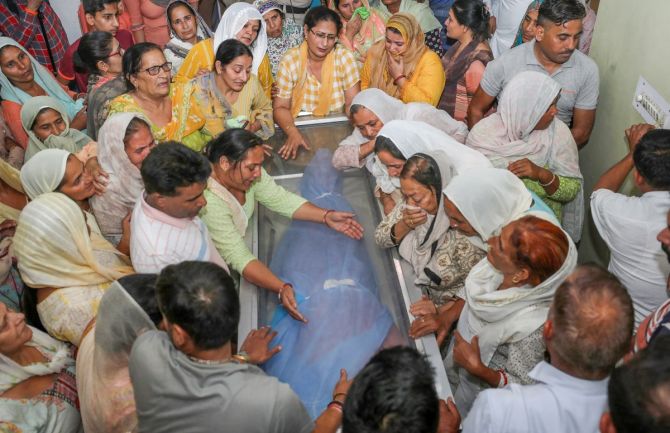
IMAGE: Family, relatives and others mourn Rajni Bala, the school teacher murdered by terrorists on May 30, mourn near her mortal remains at her residence in Samba, May 31, 2022. Photograph: PTI Photo

"The exodus of Pandits happened in 1990 -- and it is happening once again. In 1990 when the exodus happened, the V P Singh government was in power supported by the BJP. Today once again, the BJP is in power and migration is taking place," says Satish Mahaldar, chairman of the J&K Peace Forum and chairman, Reconciliation, Return and Rehabilitation of Migrants.

"Heads need to roll and replaced with those who know how to handle this conflict," the Kashmiri Pandit leader tells Rediff.com's Archana Masih in a phone interview.

The Kashmiri Pandits are angry, distraught and are protesting against at the spate of killings of members of their community. What are their worries, fears at the moment?

It is a black day for Kashmir and the nation. The exodus of Pandits happened in 1990 -- and it is happening once again.

In 1990 when the exodus happened, the V P Singh government was in power supported by the BJP. Today once again, the BJP is in power and migration is taking place.

Heads must roll from top to bottom and be replaced with those who understand the conflict.

Both Rahul Bhat [a clerk at the Chadoora tehsil office in Badgaon killed by terrorists on May 12] and Rajni Bala [a teacher gunned down at her school in Kulgam district on May 30] had repeatedly requested their HODs (heads of departments) and the deputy commissioner for transfer and relocation to a safe place.

Bhat's wife said his application was torn and thrown in the garbage.Rajni Bala's husband has also said that they repeatedly went to the CEO (chief education officer) in the district and requested for a transfer.

In J&K there has been no accountability for the past 30 years. It is time to make people accountable.

IMAGE: Kashmiri Pandits stage a protest in Srinagar after government employee Rahul Bhat's murder, May 18, 2022. Photograph: ANI Photo

What are the job opportunities for Pandits employed under the prime minister's special package and what measure of relief has it brought to Pandits in Kashmir?

The administration is discriminatory towards the minorities in terms of promotions and salaries. For example, the junior engineers appointed in 2010 under the PM package are still at the same post while those who applied in the open category have reached the level of deputy chief engineer.

Their salary is fixed at Rs 14,000 with a probation for two years.

A Delhi-based skilled worker is getting Rs 26,000 whereas a PM package employee in J&K is getting Rs 14,000; s/he is also supposed to sign a bond.

The lieutenant governor and administration say they have a cell for the redressal of problems faced by the Pandits. I challenge anyone in India to send an e-mail to the LG's office or J&K administration office and see if they get a response!

A helpline has been created to provide help for the concerns and complaints of the minorities two days ago.

After 32 years!
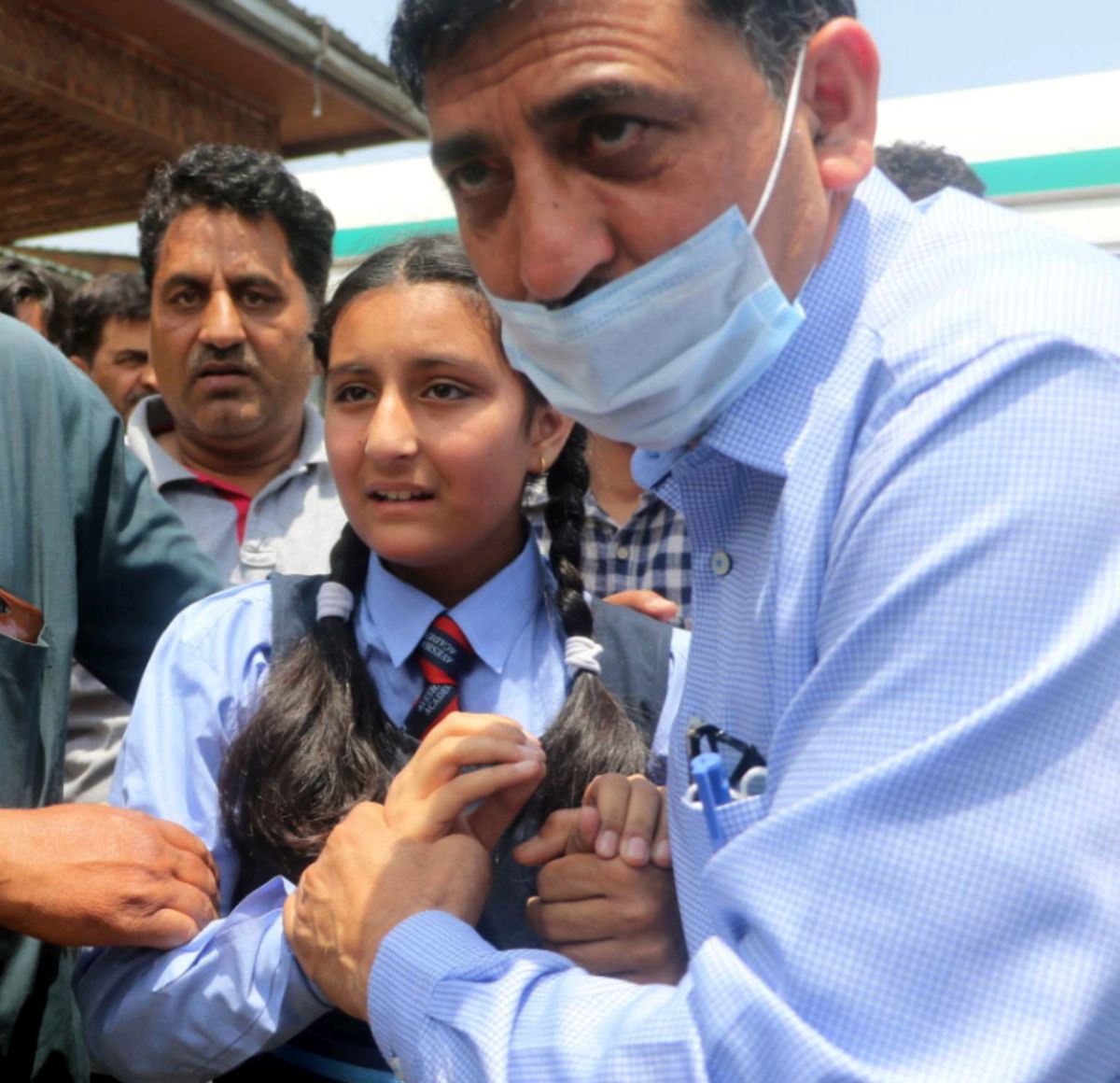
IMAGE: School teacher Rajni Bala's daughter weeps after she is informed that her mother was murdered by terrorists at the Government High School in the Gopalpora area of Kulgam, May 30, 2022. Photograph: ANI Photo

What are some of the measures desired by the Pandits for their safety and security?

Kashmir is a playground for Asia. There are different players from the region playing a dirty game in this playground.

For 32 years, the officers and bureaucrats of Kashmir are doing an experiment and treating the people as cannon fodder.

They have been unable to analyse this conflict and do not know what to do. They talk about employment and about governance, but what is happening on the ground is a contrast.

Bureaucrats, the ministry of home affairs and people at the helm do not know the root and proximate causes of this problem and what is triggering the problem.

The number of tourists coming to Kashmir is not an indicator that all is normal.

Abrogation of Article 370 was a party's agenda. They did it and congratulations to them, but that has not brought normalcy to Kashmir.

Heads need to roll among the bureaucrats who do not know how to handle this conflict. Graduates in Kashmir have knowledge about the conflict, but bureaucrats do not.

One million CRPF personnel are deployed in the Valley to deal with law and order and militancy. The CRPF is better geared to deal with civil issues rather than terrorists and are getting killed in the conflict.

Young boys are recruited as personal security officers with salaries between Rs 6,000-Rs 15,000. They do not have appropriate training and several have been killed in attacks by terrorists.

It is not about the BJP or Congress, or whether we need a Hindu or Muslim chief minister - my plea is that for the sake of the nation, please save your own people.

The people of Jammu and Kashmir are your own people. Do not use them as cannon fodder in your laboratory.

The home minister has called a meeting to discuss the spate of killings and the security situation in Kashmir.

That itself shows that the home minister is not aware about what is going on in Kashmir. Will there be meetings held after every such incident and some new jumla be spouted?
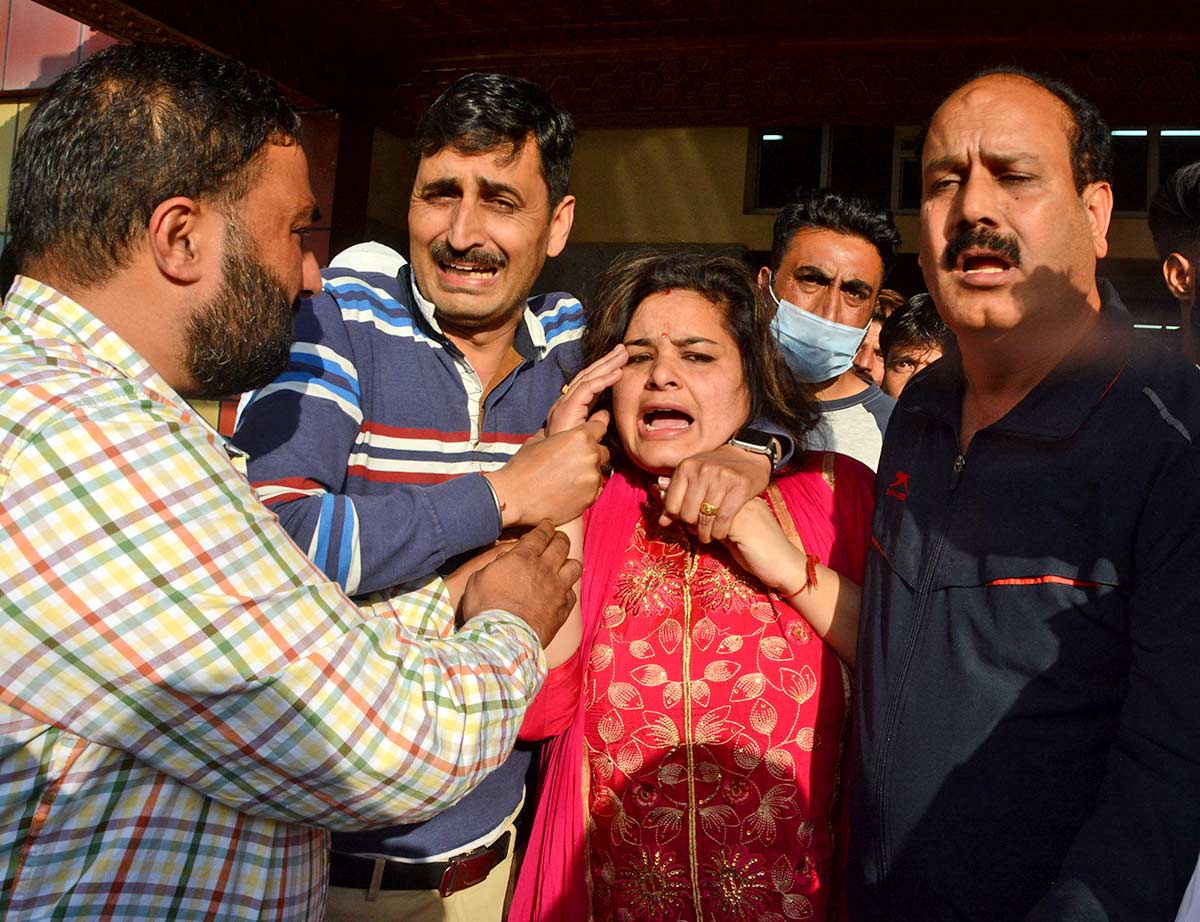
IMAGE: Rahul Bhat's family and friends in grief after he was murdered by terrorists at his office in the Chadoora area of Budgam in Srinagar. Photograph: Umar Ganie for Rediff.com

What immediate measures can be taken on the ground?

The local people do not trust the government. We need people on the ground who understand the conflict.

There are so many issues like economic opportunities, grievances, resource allocation, cultural bias, systematic discrimination, lack of political participation, poor governance, human rights abuses, narco trafficking etc.

The present relief and rehabilitation package was provided by Dr Manmohan Singh's government. It was a four-point programme -- employment was one aspect of that programme.

The remaining three points have not been touched upon as yet -- and even the employment aspect is not complete even after 8 years of the present government.

Those under the PM package suffer discrimination in terms of salaries, promotions, hierarchy.

The accommodation provided to them by the government is also woeful. The flats are very small for an entire family. In spite of being recently constructed, many flats are already falling apart. The government has to understand and correct their mistakes.

Let me give another example of the experiments that happen in Kashmir and how out of touch the government is: After the Abrogation of Article 370, a railway officer from Baroda House [HQ Northern Railway] was appointed secretary for commerce. What expertise will a railway officer have about commerce?

These are some of the things that constitute the tip of the iceberg. I urge the government to take this issue and understand it, look at the root and proximate causes for terrorism and see the factors triggering and exacerbating the problem.

The Pandits are protesting for relocation and are leaving Kashmir. What should the government be doing to ally their genuine fears?

The Government of India has to come up with a solution. Union Minister Dr Jitendra Singh, the MP from Udhampur in J&K, was on a 3-day visit to Kashmir, but did not visit the minorities.

It is time for the PMO, HM to visit Kashmir and interact with people, understand their problems, take up their problems as SOS.

The government has indicated that over 25 Union ministers will visit J&K in the next two months.

The did the same also after abrogation of Article 370.

IMAGE: Jammu and Kashmir Reconciliation Front members protest against the killings of Kashmiri Pandits and non-locals at the Ghanta Ghar at Lal Chowk in Srinagar, June 3, 2022. Photograph: Umar Ganie for Rediff.com

Do you believe terrorists have changed tactics by attacking soft targets?

Once again I will say, Kashmir is a playground for Asia. There are different players playing in this playground, every player is using his own equipment. The regional players are participating in a tournament in Kashmir with strong local support.

Unless there is local support, can anyone come from outside and play in my playground?

We are fooling ourselves by changing the goggles.

What has changed for the Pandits after the abrogation of Article 370?

The blunt answer is, things are as they were pre-2019. What we sustained pre-2019, we are doing the same post-2019.

In the business of conflict and war unless we walk the talk, things will not improve.

Feature Presentation: Aslam Hunani/Rediff.com

Friday, June 3, 2022

UK faces backlash over new graduate scheme that excludes Indian universities :-ET June 2 2022


Synopsis

The HPI route is an uncapped two-year UK work visa (three years for those with a PhD) for early career stage graduates. Graduates must have graduated from an eligible international university in the five years immediately before their application.


(This story originally appeared in  on Jun 01, 2022)
LONDON: The UK has been accused of snobbery over a new post-Brexit scheme to attract highly-skilled graduates from the most prestigious overseas universities to work in Britain as it excludes all universities in India.

Not one IIT made it to the lists of “top 50” international universities whose graduates may apply for the “High Potential Individual (HPI)” visa launched in Britain on Monday.

The HPI route is an uncapped two-year UK work visa (three years for those with a PhD) for early career stage graduates. Graduates must have graduated from an eligible international university in the five years immediately before their application.

To be eligible, an institution must have featured in the top 50 of at least two of the three ranking lists produced annually by QS, Times Higher Education and the Academic Ranking of World Universities. Though the scheme is open to anyone regardless of nationality, the lists of eligible universities exclude all universities in Africa, Latin America and South Asia.

The most recent list, for example, consists of universities based mostly in the USA, including Harvard and Yale, with the rest being in China, Europe, Australia, Hong Kong, Japan, Canada and Singapore. An Indian student would have to have been awarded a qualification (be that a bachelor’s degree, master's degree or PhD) from one of these institutions to be eligible to apply.

Indian National Students Association UK president Amit Tiwari said: “In the present day, India supplies the most foreign students to UK universities, so the fact that they are not part of this programme defies logic. Professors and R&D units value graduates from IIT or IIM. UK authorities need to stop treating Indian students like cash cows.”

“It is great that an Indian graduate from one of these top 50 universities can come and work in UK, but, on the other hand, how does this impact the attractiveness of UK universities to study,” said Sanam Arora, chairperson of Indian student body NISAU UK. The list is “Western-centric”, she added. “I would welcome an explanation on the methodology behind the choice of institutions to understand what has stopped top Indian universities like IIT and IIM from making the cut. Hopefully the Indian government will take this up with the UK.”

Ganapati Bhat, who graduated in manufacturing engineering from BMS College of Engineering, Bengaluru University, and is working in London as an enterprise data architect, said: “It is surprising that not a single Indian university or IIT is listed given they are also internationally recognised as elite institutions. Those students studying in IITs will lose out and only those who are able to go somewhere like Harvard, Stanford or those listed, can benefit from this scheme, meaning the UK loses  out on Indian talent too. Meanwhile, India wants to retain the best brains to study in India. With this new visa scheme, we can expect that more Indian students might explore US and Europe universities and this will not benefit India's plans to internationalise higher education.”

Phil Baty, chief knowledge officer at The Times Higher Education, said: “This current use of the rankings to determine emigration visas will clearly exclude many highly talented individuals studying at great universities around the world that just happen not to fit with the research-heavy focus of the current global rankings.”

A home office spokesperson said: “The list of the top 50 global institutes has been identified from three of the world's most reliable university rankings lists, which are widely cited by the education system and used in immigration systems globally. Graduates from the listed universities are eligible for the HPI route scheme regardless of nationality. Each of the eligible universities attracts students from across the globe to study. There are several other routes eligible for graduates from other universities, including the graduate, skilled worker and global talent route.”

No need to look for Shiv Ling in every mosque; court's decision on Gyanvapi should be accepted by all: RSS Chief :-ET -PTI Last Updated: Jun 03, 2022, 08:11 AM IST


Synopsis

Addressing the concluding ceremony of the Rashtriya Swayamsevak Sangh's third year officer training camp in Nagpur, he said that the RSS had already made it clear that its participation in the Ayodhya agitation was an exception and it would not undertake such agitations in future.


Nagpur: RSS chief Mohan Bhagwat on Thursday said the Gyanvapi dispute involves some issues of faith and the court's decision on it should be accepted by all, but also there was no need to find a 'Shiv Ling' in every mosque and start a new dispute every day. Addressing the concluding ceremony of the Rashtriya Swayamsevak Sangh's third year officer training camp here, he said that the RSS had already made it clear that its participation in the Ayodhya agitation was an exception and it would not undertake such agitations in future.

"Now the issue of Gyanvapi mosque (in Varanasi) is going on. There is history, which we cannot change. That history is not made by us, nor by today's Hindus or Muslims. It happened at the time when Islam came to India with invaders. During the invasion, temples were destroyed to weaken the fortitude of the people wanting freedom. There are thousands of such temples," he said.

But the Sangh did not want to say anything on this issue, Bhagwat said, adding, "We had said what we had to say on November 9 that there was Ram Janmabhoomi agitation. We joined in it, though it was against our nature, due to some historical reasons, and due to the situation at that time. We completed that work and now we do not want to pursue any more agitations."

Everyone involved in the Gyanvapi mosque-Kashi Vishwanath temple dispute should sit together and find a way with mutual consent, the RSS chief added.

But as this does not happen every time and people approach courts, the "decision of the court should be accepted by all considering the justice system as sacred and supreme," Bhagwat said.

"It is true that we have special, symbolic faith in such places, but one should not raise a new issue every day. Why escalate disputes? As to Gyanvapi, we have certain faith, some traditions, but why look for a Shiv Ling in every mosque?" the RSS chief said.

He was apparently referring to claims by Hindu petitioners in the Gyanvapi case that a Shiv Ling (a symbol of Hindu deity Shiva) has been found in a pond on its premises.

Muslims are not outsiders even though their way of worship came from outside, he said.

"Our tradition is the same and some nationalist Muslims have fought with Hindus in many freedom struggles, and they are ideals for the Muslims of our country," Bhagwat added.