Pages

Monday, May 27, 2024

Lakhs of mobile numbers are set to be disconnected. Here’s what triggered the move. :-read at ETPrime

India’s telecom companies are set to snap lakhs of mobile connections in coming weeks after alerts from the government and law enforcement agencies. These mobile connections are suspected to have been misused for cybercrime and obtained through forged documents.

Investigations revealed that a single handset was used for as many as 4,000 connections, triggering fears that it may have been used for cybercrime and financial fraud.

On May 9, the Department of Telecommunications (DoT) directed telcos to disconnect 28,220 mobile handsets and re-verify over 2 million mobile connections that were apparently misused.

But how did this happen in the first place? What triggered the probe? What laws were flouted?

What is the modus operandi that has been exposed?

Fraudsters, typically, use SIM cards (read: mobile connections) of different telecom circles and regularly change the combination of SIM and handset to duck the radar of law enforcement agencies as well as telcos.
For instance, an Odisha or Assam circle SIM could be used in Delhi NCR. Officials say to avoid the radar, fraudsters, typically, make only a few outgoing calls and then change the SIM as too many outgoing calls from the same number would raise eyebrows and lead to imminent detection by telco monitoring systems. Once a rogue handset/number was tracked down, a thorough probe transpired, unravelling the entire modus operandi.

What does the crackdown comprise of?

The DoT, the home ministry and state police forces teamed up to stop abuse of telecom resources for committing cybercrime and financial fraud. Their objective: to dismantle networks of fraudsters and protect citizens from digital threats.

A recent analysis carried out by the MHA and police revealed that 28,200 mobile handsets were abused for cybercrime. The DoT also learnt that a staggering 2 million numbers were used with these mobile handsets.

Subsequently, the department asked telcos to undertake pan-India blocking of the 28,200 rogue handsets and carry out immediate reverification of 2 million mobile connections linked to these handsets, and promptly disconnect those failing the re-verification test.

Typically, only around 10% mobile connections pass the re-verification and the rest get disconnected.

In another instance, DoT asked telcos to reverify around 6.8 lakh mobile connections suspected to have been taken through forged documents. It suspects these numbers were obtained using invalid, non-existent, or fake/forged KYC documents.

What triggered the crackdown?

There is no specific trigger. But for many months, the government has been proactively screening mobile connections to prevent potential scams. The DoT now uses artificial intelligence (AI) analysis through various modules like Sanchar Saathi, Chakshu amongst others to clamp down on fraudulent connections.

While the DoT keeps tabs on fraudulent connections, consumers can also report numbers to it. In the last one year, 17 million mobile connections have been disconnected. 186,000 handsets have been blocked for involvement in cybercrime.

A few months ago, the government had also launched a Digital Intelligence Platform (DIP) for coordination among stakeholders to curb misuse of telecom resources in cybercrime and financial fraud. The DIP is a secure and integrated platform for real-time intelligence sharing, information exchange and coordination among stakeholders including telcos, law enforcement agencies, banks and financial institutions (FIs), social media platforms and identity document issuing authorities. DIP is now accessible to over 650 stakeholders.

What laws were violated?

Government officials involved in the probe say the misuse of mobile connections for cybercrime/financial fraud is a clear violation of Indian Telegraph Rules, 1951. As per these rules, a subscriber shall be personally responsible for using his/her telephone.

No telephone shall be used to disturb or irritate any person for transmission of any message or communication which is of an indecent or obscene nature, or is calculated to annoy any person, or to disrupt maintenance of public order, or in any other manner, contrary, to any provision of law.

What are the available deterrents/remedies?

Telcos have been mandated to install fraud management and prevention systems in their networks and report any suspect subscribers to the government. As part of the terms of their Unified License, call detail records (CDRs) for outgoing calls made by customers need to be analysed, especially in cases where subscribers make innumerable outgoing calls day and night to various telephone numbers.

“The service provider should devise appropriate fraud management and prevention programmes and fix threshold levels of average per-day usage in minutes of the telephone connection; all telephone connections crossing the threshold of usage should be checked for bona fide use,” specifies a key clause in the Unified License agreement

The Vietnam trap: How Indians are being lured via this place to work for fraudsters :-ET Prime

Approximately USD900, free meals, and a lodging for a data entry job in Vietnam. This was one alternative staring at Dinabhandu Sahu. The other one was a debt of INR3.5 lakh and temporary jobs in Odisha.


Sahu picked Vietnam.

But things took a different turn once he reached there. Sahu was forced by the company which had advertised the job to go to Cambodia. There, he was made to create fake profiles – hundreds of them – to get people to invest in cryptocurrency scams. Sahu, who returned to India recently, shared his story with multiple media outlets.

As you read this, there are about 5,000 Indians stuck in Cambodia after they were lured by the promise of higher salaries, free meals, and accommodation, but were made to defraud fellow Indians just to get the meals. The reports have estimated this amount to be about INR500 crore.

Till May 20, over 360 Indians have been rescued from the region. The police have also been cracking down on Indian agents who are supplying people to work as cyber-slaves in other countries.

The scale of operations, which had come to light in the last couple of months, and what the people were made to do when they were moved to Cambodia, has been staggering.

Why did Indians accept the job in Cambodia?

They did not, mostly.

Many Indians who were rescued from Cambodia were recruited by unregistered agents in the country and were promised jobs in places like Singapore and Vietnam as data entry operators.

According to multiple media reports, based on interaction with victims, most of the victims are educated but unemployed. They were looking for better jobs and were inclined to move overseas. Most of them found these openings through social media posts, WhatsApp, or other messaging channels. The job descriptions appeared innocuous: data entry, digital sales and marketing executive, and customer service representative.

Ravi Shankar Ayyanar, commissioner of police, Visakhapatnam told the media that based on the initial conversations with those rescued, the victims had paid INR1.5 lakh to get the job abroad.

How did they reach Cambodia?

The Ministry of External Affairs (MEA) said in a statement that the victims are made to go through a simple interview process and then a typing test. Once they cleared the test, jobs with high salaries, along with accommodation and air tickets, were offered.

According to multiple media reports quoting victims, they were first given tourist visa to Thailand or Vietnam, and from there they are taken to Cambodia or Laos illegally.

A report by The Print said that after reaching Bangkok, victims are then taken to Cambodia border by car, where they were given two-month work permit. In the case of victims going to Laos, the MEA statement said that they are taken to the region illegally from Thailand and are made to work in the Golden Triangle Special Economic Zone in the region.

What happened there?

They are made to carry out online scams, especially targeting the Indian population.

Ayyanar, the police commissioner who was cited earlier, told the media that many of the people were taken to special economic zones in Thailand-Cambodia border, and were given intense training of 10 weeks. According to him, these include parcel scams, investment frauds, and romance traps.

Let us take Sahu, for instance. According to online media platform Scroll, he and others were forced to create fake profiles to get people to invest in cryptocurrency scams. He had a target of INR1 lakh worth of investments. Hundreds of Indians like Sahu were forced to defraud Indian customers, since failure to comply could mean they will be beaten or starved.

Based on Ayyanar’s comment to media platforms, many Indians who failed to deliver for days in a row were starved or given only one meal per day. Those meeting targets were able to receive daily meal.

What is the consequence?

Over the last few months, there has been a rise un cybercrimes targeting Indians through variety of scams like the parcel scam, investment and trading scams, and romance traps.

A source, who did not want to be named, said that the Indians who were lured were made to work on some of these. It is estimated that close to INR500 crore were stolen through them.

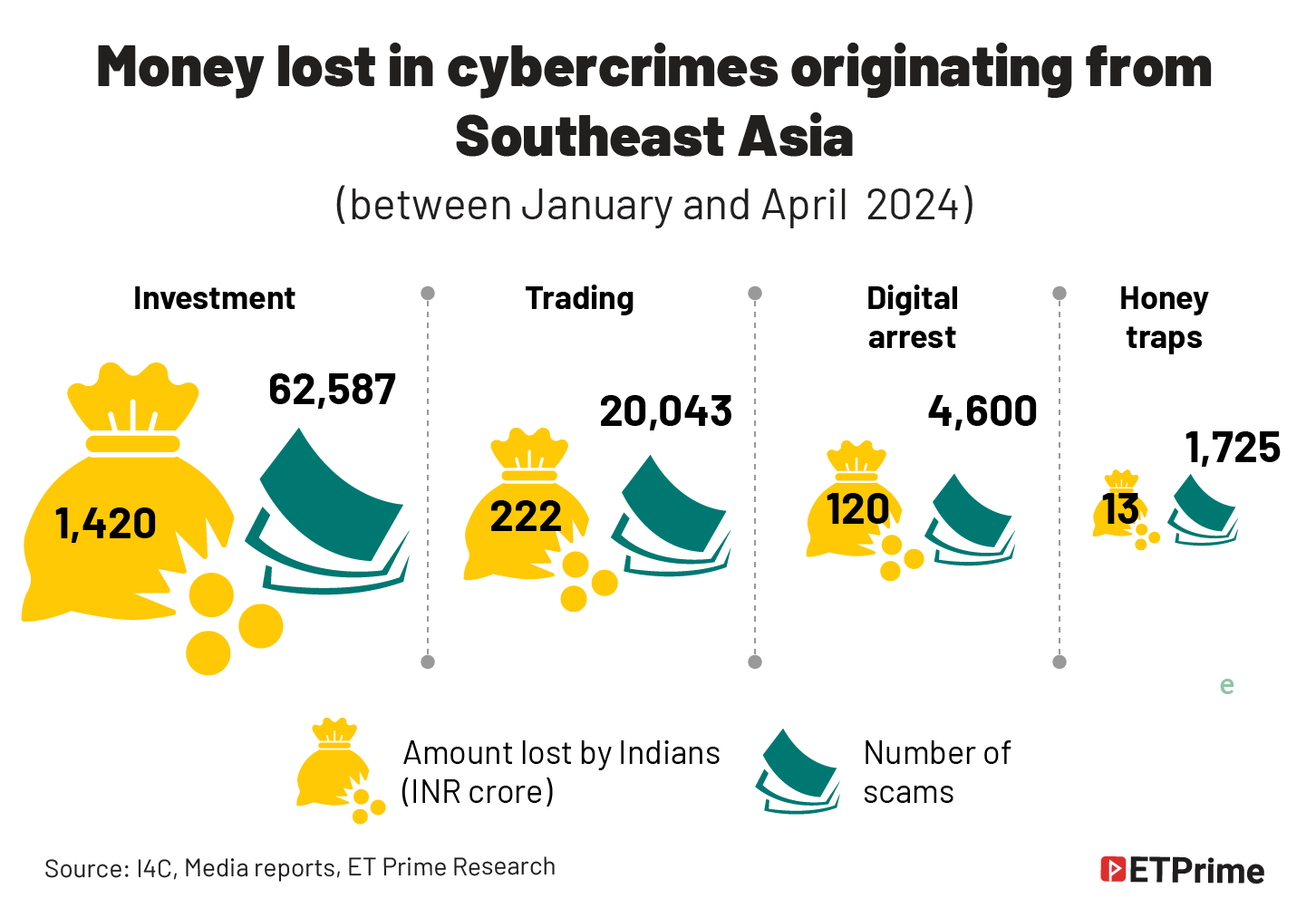
According to an analysis by Indian Cybercrime Coordination Centre (I4C), set up by the Ministry of Home Affairs, about 7,000 cyber-related frauds have been registered with the National Cybercrime Reporting Portal daily, and 45% of them have their origins in Southeast Asia running into crores.

Money lost in cybercrimes@2x
How is government tackling this?

Like mentioned earlier, so far 360 people have been rescued. But there are still thousands working under harsh conditions.

Recently, the MEA issued an advisory to Indians travelling to Cambodia and Laos for work. The Ministry of Home Affairs and MEA are also working with the Cambodian government and authorities to rescue the rest of them.

The Centre set up an interministerial committee of law enforcement agencies and intelligence agencies on May 16 to handle the rise in cybercrimes targeting Indian from the Southeast Asian countries, as shared by I4C chief executive Rajesh Kumar in a recent press conference in New Delhi.

He had also shared that I4C is actively monitoring and blocking platforms and accounts used for cybercrime like the Skype accounts and advertisements on platforms like Meta and Google, SIM cards, and bank accounts.

(Graphic by Sadhana Saxena)

THE GREATEST DISTANCE IN THE WORLD IS JUST 14 INCHES


NFRA to engage with some big listed companies on audit compliance Read more at: https://economictimes.indiatimes.com/industry


The National Financial Reporting Authority (NFRA) is planning to directly engage a few large listed companies for the first time by June-end to "sensitise" them about accounting standards and help curb corporate frauds, said people familiar with the matter.

The regulatory outreach could involve the NFRA's engagement with audit panels, independent directors, chief financial officers and others on the boards of these companies, said one of the persons.

The regulator is close to finalising a framework to hold such huddles and may invite listed companies, where large public interest is involved, for such meetings, according to another person."The idea is to encourage regular two-way communication between the audit committees of companies or those charged with their governance and the auditors," said one of the persons, who did not wish to be identified. "They will also be sensitised about compliance with the stipulated audit standards and its importance in early detection of stress and reading other warning signs." Company representatives will also get to air their views before the regulator on making the audit ecosystem more robust, said the people.

ET reported on January 18 reported on the NFRA's plan to engage such key persons of listed companies as they are "charged with the governance" of these entities. The move comes amid a heightened focus on the part of the authorities on protecting retail stock investors. Earlier this month, finance minister Nirmala Sitharaman exhorted market intermediaries to help preserve the trust of Indian households that have made a "generational shift" in deploying a larger part of their savings in the stock markets. Any efforts toward early detection of stress in listed companies or curbing corporate frauds - which can be done through accurate and transparent auditing of the company's financials - will serve the interest of both retail and other investors.

Audit firm inspection
The NFRA is undertaking the annual inspection of eight key audit firms, including the top five (EY, Deloitte, KPMG, PwC and Walker Chandiok & Co). focusing on the processes they follow and the standards they adopt, said the people cited earlier. It may wrap up the exercise by October, one of them said.

The regulator has also identified about 55-60 listed companies, which have been audited by these firms, to gauge their compliance and the quality of audit, said the people. The regulator is also assessing the top five audit firms' compliance with the suggestions made in its December 2023 reports in which it had flagged deficiencies in their work processes, including on non-audit services, according to people in the know.ET had first reported on January 9 that the NFRA was planning to undertake inspections of major audit firms annually.


Why Sebi's decision on AIF certification is need of the hour and should be welcomed :-ET


                                                             Gopal Srinivasan

                                           The writer chairman-MD, TVS Capital Funds


In a May 13 circular, Sebi mandated that 'at least one key personnel' on the investment team of the 'manager of an alternative investment fund (AIF)' should have NISM (National Institute of Securities Market) certification by passing the NISM Series-XIX-C exam. This regulation came into force from May 10 and will have to be complied with by May 9, 2025.

What does Sebi hope to achieve by setting down this rule for investment managers? One can only assume the following:

Positive signalling: It would send a powerful signal to teams and communities of the prowess of a certified fund manager.

Certification=legitimacy: Almost every other profession - lawyers, company secretaries and doctors - requires certification. Moreover, with changes to the regulatory regime, experienced professionals have undergone additional examinations to become insolvency professionals under IBC, chartered valuers, or chartered financial analysts. Certification brings legitimacy and is an invaluable tool for any profession's self-regulating ability.

Lifelong learning: As professionals, the value of adapting to changing business environments can't be understated. Taking this exam not only encourages young professionals, but also exemplifies a commitment to continuing education and evolution.

Sebi's decision may be met with scepticism, especially among the senior PE/VC community. However, it makes sense on several front:

Go Global: The market regulator has significantly altered how AIFs operate since introducing AIF guidelines in 2012. Each change has aimed to gain recognition for this asset class, contributing to the remarkable growth of AIF commitments in the past decade. It's time for Indian fund managers to position themselves as global leaders, challenging Western dominance.

Understanding the biz: The playbook and charter are clear. Achieving the 60% pass threshold should be easy for most practising managers, even without studying the material. But it's more than just dry legal governance. Reading NISM's exam material explains the rationale behind the AIF business model's features. It's satisfying to review them for a consistent understanding and application of the business model's specific terminology.

Creating a talent pool: It makes sense for the next generation of professionals, not to mention India's pressing need to create numerous funds and cultivate talent to manage them.

We should welcome the decision, but those of us who can't and are still having qualms over it can take refuge in the words of George Burns, 'You can't help getting older, but you don't have to get old.'

SHRADHANJALI TO MY BELOVED FATHER LATE SHREE YASH PAL SINGHAL ON HIS PUNYATITHI TODAY- MAY 27


Sunday, May 26, 2024

Pune man, brother duped of over Rs 2 crore in online share trading scam The victim, who is a resident of Charholi Budruk, lodged the FIR in this case at the Dighi police station :-The Indian Express


cybercrime man PuneOfficials said that cyber criminals fish for potential targets through social media posts or phone messenger texts. File photo

A Pune-based 53-year-old man and his brother lost Rs 2.45 crore to an online share trading scam.

The victim, who is a resident of Charholi Budruk, lodged the FIR in this case at the Dighi police station on Saturday.

The police said a cybercriminal added the complainant to a WhatsApp group and told him that he could earn huge profits through online share trading.

Later, the fraudster also added the complainant’s brother to the same WhatsApp group.

The police said the complainant followed the instructions given by the fraudster and created a ‘share trading account’, through which he and his brother started ‘buying shares’ as per the tips received on the WhatsApp group.Between January 5 and March 8, the complainant transferred Rs 1,67,80,000 and his brother transferred Rs 77,50,000 from their bank accounts to various other bank accounts through multiple online transactions, believing that the money was being invested in the share market.

“The complainant and his brother kept on transferring more money into fraudulent bank accounts… After a while, it was falsely shown to them that they had earned Rs 8 crore in the share trading business. The brothers then tried to withdraw the profit amount but failed. Then they realised it was a scam and filed a complaint with the police,”

Dhamal said the complainant and his brother are into private jobs and lost their valuable savings to the cyber scammers. “We have identified three bank accounts in which their money was transferred. Attempts are on to recover the money,” he said.

Officials said that cyber criminals fish for potential targets through social media posts or phone messenger texts. Those who respond are added to online groups where they are offered online lessons and are asked to log in to certain share trading applications designed by cybercriminals.

“These applications have intriguing and technical-sounding names to make them seem authentic and fraudsters also misuse many big names in the wealth management sector claiming affiliations. As victims start sending money to fraudulent accounts, the fake apps start deceitfully displaying unrealistically high returns, luring victims into further investing substantial amounts. The fraudulent apps often mimic legitimate trading platforms, creating a false sense of security even reflecting ups and downs in the market. When victims try to withdraw their earnings, the fraudsters vanish,” a senior police officer said.


Thief on a plane: How a frequent flyer stole a crore (and more) from cabin baggage on Indian flights.}ET


It is customary for airlines across the country to allow people in wheelchairs, usually senior citizens, to board flights first. It’s indeed fair practice and a polite gesture. You are old, tentative, you get to your seat, and struggle to put your cabin luggage in the overhead bin. And then you slump down in your seat. You expect some water and a cold towel, but what you don’t expect is Rajesh Kapoor from Paharganj.

That man has been marking old couples for a while, using priority boarding, to get into the aircraft just after senior citizens. As they sit down, Kapoor gets up and quickly opens their suitcase and runs his hands through, grabbing whatever valuables he can. He quickly zips the luggage back and sits down just in time before the pilot’s announcement, and enjoys the cirrus clouds at 35,000 feet, a little later.

Kapoor had been doing this across different flight sectors till April 11. That’s when a woman, travelling from Hyderabad to Delhi, complained to the police that jewellery worth INR7 lakh had been stolen from her handbag. Some investigating officer in Delhi joined the dots. Because on February 2, another passenger had complained to the police that valuables worth INR20 lakh had gone missing.

Kapoor’s risk-adjusted returns

Kapoor was arrested on May 13 after the Delhi Police was able to nail him with the help of airport security cameras, airline data, and call records. He took as many as 200 flights in less than one year alone, sometimes travelling multiple times in a day using his dead brothers’ credentials and phone number. He would keep his own phone switched off, turning it on only once in a while.
If Kapoor paid INR7,500 for his ticket on average, he may have spent nearly INR15 lakh on these 200 flights, but the returns in just four cases of theft directly nailed to him already are worth nearly INR1 crore, according to police data. Assuming he only got INR0.50 per rupee from his fence (who “bought” the stolen material), it would still be INR50 lakh for Kapoor. That’s a 3X return on investment in two years. That’s an eye-popping number, but it is also criminal, unfortunately for Kapoor.

Kapoor has deployed his theft money well. He owns a hotel called Ricky Deluxe in Paharganj (backpacker’s paradise), has a money-changing business, and a mobile phone-repair shop in Delhi.

Modus operandi: simple and swift

Kapoor used to board connecting flights like those from Delhi which carry passengers arriving from busy international hubs including Chicago and New York to Indian cities such as Amritsar, Hyderabad, and Bengaluru.

Senior citizens are often given priority boarding, so Kapoor would also pay to get priority boarding. During this phase of the flight, there are very few people in the cabin and the overhead bins are all open. Once there, Kapoor would select a target and slide her handbag backwards, rummage through it, steal items of use to him, and then slide it back. Kapoor even dared to ask some passengers who had kept their bags on their lap to keep them in the bin.

Most elderly people on such connecting flights are already hassled. They have gone through long immigration and other checks and that too after concluding long flights, potentially returning home after meeting their children who have settled in foreign countries including the US. Kapoor used to take advantage of their exhaustion.

“A thief can take your bag from the conveyor belts also. Those cases are very common. But I have never heard of this modus operandi before. This person seems to be a professional,” said a senior airline official who did not want to be named.

One of Air India’s senior cabin crew, too, says he has never heard of such a trick on a domestic flight ever. “On international [routes], there is an entire cartel. We never used to switch off the lights at night on Hong Kong flights from Delhi and Mumbai because of similar thefts,” he said.

But why Hong Kong alone?

“Many diamond merchants fly on this route,” this crew member added.

Could there be a cartel involved in this case, too? Possibly, airline officials themselves? How is it possible that Kapoor used to know which would be an important connecting flight accurately while does not appear to be from the airline or a travel agent background?

Speaking to ET Prime, the deputy commissioner of police at Indira Gandhi International Airport, Usha Rangnani, did not rule out this angle. She said the police is investigating if there was some connection, like a common crew on the flights he took etc., though the process is still at a “nascent stage”.

“He is a habitual offender and is also into satta and gambling,” added Rangnani. “Since we have caught him, so many more people have reached out to me alone saying their things were also stolen. We are investigating this further.”

ET Prime readers who are of the slightly older vintage will remember how when we travel on overnight trains, we tend to use small padlocks and a chain to secure luggage. On trains, luggage theft is common. Kapoor honed his stealing skills exactly on these “practice pitches”.

Kapoor began his thefts in 2005, when he was around 21, travelling on India’s massive train network and stealing from people’s bags as they slept in peace. Such thefts are common because one can see the brisk sale of chains and locks on most of the country's train stations.

Kapoor’s work-from-home period

Kapoor also took a break from stealing around 2018, ostensibly.

It is quite possible that during this “sabbatical” Kapoor tried his hand at stealing from the very guests that stayed at his hotel, Ricky Deluxe, also called Ricky Dx. His family lived on the top floor of this hotel.

“Worst (hotel)...our money was stolen from the room while it was locked...Can't recommend anyone to visit ever again...In an emergency you can't expect any staff to cooperate,” Omkar Kakeru wrote in his review in 2019, recalling his harrowing tale like most of the 167 reviewers of this one-star MakeMyTrip-rated property.

Many even called the hotel a “sanctuary of rats” which extorted extra money on check-outs. Some were even thrown out of the hotel before the check-out for no fault of theirs.

“Worst experience as owner’s family started fighting with each other and asked everyone to leave the hotel. It was difficult for us to manage the accommodation in the evening,” Shivam Tiwari wrote in his 2023 review.

Kapoor’s sabbatical was soon over.

Criminal imagination takes a flight
In 2022, Kapoor decided it was time to upgrade. He shifted his theft operations to flights, almost exclusively. He only started taking what the Delhi Police calls “premium” airlines like Air India and Vistara. Both are full-service airlines and fly abroad with the former going all the way to the US and the latter only to Europe.

Why did Kapoor shift to flights if he was doing well from 2005-22 on trains?

The first airline official quoted above said it could simply be that he became too “gutsy” from the windfall he made from train rides.

What was the cabin crew doing?
There is also the question of cabin crew who are supposed to be the gatekeepers of passenger luggage on flights. A senior airline official said this also reinforces his recent belief that some airline crew appear to have become less vigilant.

“I was travelling on a domestic flight earlier this month and a business-class corporate executive had to speak out so loudly to get the crew to get him his coat. This was after the aerobridge had already docked on the plane,” this official said, referring to the practice of crew returning the coats etc., to business-class passengers well before the flight lands. “Something is wrong with the alertness levels of the crew these days.”

Whether these maverick heists from cabin baggage before everyone boards were Kapoor’s alone or that of a cartel would only be known as the investigation progresses.

For now, Air India and Vistara have lost one of their “frequent fliers”.

Possibly Kapoor, like the stars of the hit movie Jab We Met, would have done well to stick to the train because as he may now find out, there is nothing “Deluxe” about a Delhi Police jail cell.