Pages

Thursday, October 20, 2022

Betting big on 5G: HFCL's gameplay of telecom growth, healthy order book, and right alliances :Riding on the expected telecom and 5G expansion, HFCL is well positioned with 5G-centric products and its optical fiber cables business. With a strong order book and an improving financial performance, the company will now hope for renewed investor interest India Forbes. Oct 19 2022


 (Mahendra Nahata Founder and Managing Director of HFCL)


On October 1, at a packed India Mobile Congress, a digital technology event in New Delhi, Mahendra Nahata, the founder and managing director of HFCL, a telecom enterprise and communications products provider, was seen exhibiting the new Wi-Fi 7 Access Points, built in collaboration with Qualcomm. This product will support peak data rates of over 10 gigabits per second (Gbps)—almost double the speed of current such products—and latency under 2 millisecond (low latency means minimum data transfer delay), compared to 5 Gbps and 10 ms of current Wi-Fi 6 products.

Reliance Industries’ Chairman and Managing Director Mukesh Ambani, whose subsidiary Jio Platforms is India’s largest telecom operator, launched the Wi-Fi 7 AP and an 8T8R radio unit while watching its features. Jio is an important customer of HFCL’s, forming around a fifth of its order book. HFCL has laid the 4G fiber-to-the-home (FTTH) network and also mobile services for Jio in North India.

Unlike previous Mobile Congress events, this year the talk of 5G technology had turned to reality from being a promise or need. In October, India’s 5G technology network was officially launched by Prime Minister Narendra Modi, with two of the largest telecom companies Jio and Bharti Airtel deploying their 5G network in phases.

In this scenario, a Wi-Fi 7 access point compliments the 5G rollout in India, offering extreme speeds and high capacity. It will improve connectivity and speed in high density places like airports, railway stations, shopping malls and factories.

Nahata started HFCL in 1987, once manufacturing transmission equipment in collaboration with Southeast Asian companies. But in the years and decades to follow, when India started to grow and expand its telecom networks, the optical fiber cables (OFC) business became its engine for growth. Since 2015, HFCL has shifted its focus towards exporting telecom equipment and optical fiber cables to over 30 countries at present, from 16 in FY15. Exports form 18 percent share of revenues, HFCL’s June-ended data shows.
Betting big on 5G: HFCL's gameplay of telecom growth, healthy order book, and right alliances

On the 5G Pulse   

HFCL’s business did mirror the development of India’s telecom expansion in early years, including manufacture of digital microwave radio transmission equipments, radio pagers and satellite video receivers. But as India started to build out its digital transformation journey, its need for OFC increased, being the backbone of digital infrastructure. An OFC network provides the fastest transfer speed and large bandwidth to both corporate businesses and homes.

According to 2021 Feedback Advisory data, the Indian OFC industry was valued at $530 million in FY20 and is expected to grow to reach $700 million in FY24.

Now consider that as of March, India’s total tower fiberisation is at just 33 percent, leaving plenty of room for growth, if it is to achieve 70 percent of tower fiberisation by 2025. And Nahata knew that HFCL has to play a role in that. HFCL has continued to build and expand its manufacturing facilities in Goa, Chennai and Hyderabad. A new facility is being set up to manufacture defence electronic products.

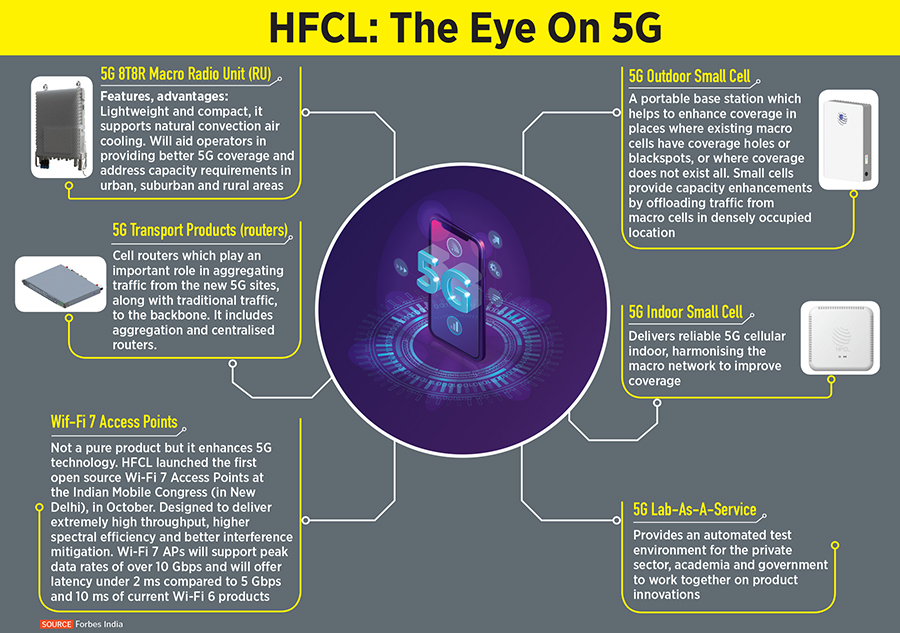
It is the same business acumen which has worked for Nahata and the company to concentrate on manufacturing and sale of 5G-centric products. “We are designing our own equipment and have IPRs for the same,” Nahata tells Forbes India on call. HFCL is designing an entire range of 5G related telecom equipment, including wireless access network 8T8R macro radio unit (see chart). Another product is a 120 Gbps cell site router which helps aggregate traffic from the new 5G sites to the backbone (a high speed line forming the fastest path through the network). The company is also working to develop global system integration services for 5G private networks and integration services.

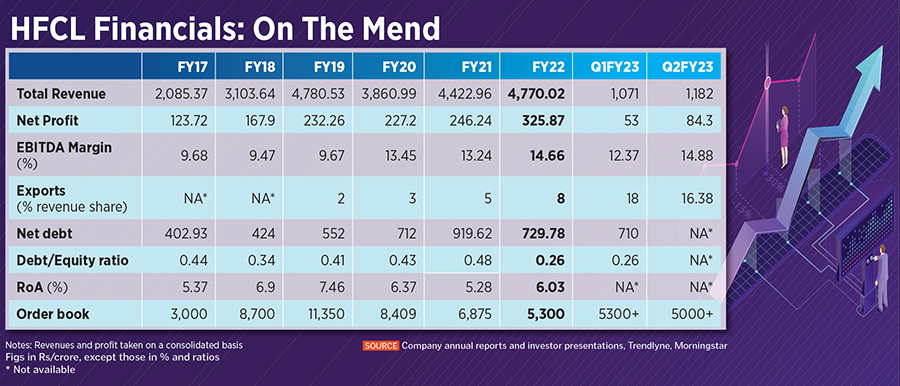
HFCL expects a 15-20 percent year-on-year (y-o-y) revenue growth that will be mainly driven by the growing OFC demand and production of 5G-led equipment. HFCL reported a 10.3 percent jump in total revenues to Rs1,182 crore in the September-ended quarter and net profit rose near 60 percent to Rs84.3 crore, in the earnings announced on October 18. The HFCL stock rose 1.7 percent to an intra-day high of Rs76.8 at the NSE after the earnings data.

Speaking about the Wi-Fi 7 AP, Nahata says: “This device helps achieve an even higher throughput. A Wi-Fi 5 AP could give a throughput of 4 to 5 GB.” This would be useful in areas which have large crowds and help telecom operators deliver better user experience at airports, railway stations or factories. A scaled down version of this product can also be used anywhere, he adds.

Betting big on 5G: HFCL's gameplay of telecom growth, healthy order book, and right alliances

Export Thrust, Challenging Sterlite

Nahata claims HCFL to have the highest market share—near 50 percent—in the domestic OFC market, with rival Sterlite Technologies estimated to command the balance. Sterlite predominantly exports its OFCs, with Europe and North America as its focus markets, where it holds a combined 33 percent market share.

Sterlite has a fiber capacity of 37 million fiber kilometers while HFCL has a capacity of 25 million fiber kilometers equivalent fiber optic cable. According to analysts, Sterlite has 50 million fiber kilometers (FKM) of optic fiber capacity for its 37 million FKM of optical fiber cable capacity while HFCL has a 10 million FKM of optic fiber capacity against 25 million FKM of optical fiber cable capacity. Thus, Sterlite is more backward integrated compared to HFCL. HFCL plans to increase this to 22 FKM in FY24.

Sterlite plans to invest Rs800 crore till FY24, to expand capacity to 42 million fiber kilometers. Similarly, HFCL plans to expand its OFC capacity to 35 million fiber kilometers through a funding of Rs 600 crore. HFCL has raised this capital through a qualified institutional placement (QIP) in December 2021. 

Both Sterlite and HFCL have adopted the strategy of selling telecom equipment as ancillary sales coupled with its optical fiber business.

“Demand for upgraded hardware required as a result of 5G and next generation Wi-Fi is propelling this growth in equipment business. It hopes to drive growth by expanding manufacturing capabilities in the telecom equipment business in coming years,” says Pratik Singhania, vice-president (research) at SageOne Investment Managers, a portfolio management service fund house for high net worth individuals.

Nahata says with demand for both OFC and 5G equipment business strong from global markets, the plan is to double exports to Rs750 crore in FY23, from around Rs380 crore in FY22. “We expect about 20 percent revenues to come via exports this fiscal year,” he says.

Singhania says Sterlite gets better realisation for its overseas OFC business, due to the R&D capabilities seconded by its 740-plus patents. “Sterlite is estimated to get approximately $1.5 per fiber kilometer more than the average supplier,” the analyst says. Sterlite is also close to commissioning optical fiber cable plant in USA as tax benefits are given to telecom companies who are expanding fibre footprint using made in USA products along with strong China plus One sentiment.

Betting big on 5G: HFCL's gameplay of telecom growth, healthy order book, and right alliances

Product-led Revenue, Stock Gains

During and after the pandemic, several corporates, including HFCL, saw delays in both execution of projects, which delayed operating cycles and resultant payments. Hence, the company has over the years focussed on increasing the share of revenues from products, rather than projects. Products form 50 percent of revenues in Q1FY23, compared to 43 percent in FY22. “An increase in product revenue will need less working capital and quick realisation of revenue,” Nahata says.

HFCL has an order book of over Rs5,000 crore, with half of the revenues coming from the OFC business and the balance from the mix of telecom business, defence electronics, railway communication products, BharatNet and Smart City projects. The book is also well diversified with revenues from several states including Punjab, Rajasthan, Uttarakhand, Himachal Pradesh, Uttar Pradesh, Delhi, Andhra Pradesh and Telangana.

HFCL is banking to continue to receive OFC orders towards the government’s ambitious BharatNet project, which aims to digitally connect all the gram panchayats (GPs) and villages of India. In Jharkhand state, it has deployed OFC in 1,789 GPs, the company said in April.

The mix of the 5G rollout and continuing 4G expansion in remote areas, FTTH penetration and BharatNet are expected to be “an Rs3 lakh crore” opportunity in the OFC space,” Ventura Research says in a July 2022 report.

SageOne’s Singhania expects Jio and Airtel to start giving out orders on 5G deployment in November-December this year, where the annual order would be Rs10,000 crores per annum. “This will be followed by BharatNet orders in early 2023 wherein the total order size is expected to be Rs 80,000 crores,” he says. Portions of these orders will come towards HFCL, besides other rivals.
Betting big on 5G: HFCL's gameplay of telecom growth, healthy order book, and right alliances
HFCL’s credit ratings have been improving as revenues grown, order book diversified and profitability improved in recent years. Care Ratings in July gave a Single A credit rating with a ‘stable’ outlook towards long-term credit loans and A2+ for short-term bank credit, compared to an earlier ‘negative’ rating in FY20.

HFCL, the Reliance Industries group and Jio are long business associates, which analysts see as a positive. Nahata is a director on the board of Reliance Jio Infocomm. “HFCL shares a long-standing relationship with the Reliance Group and family. This has particularly helped HFCL’s business in the last 2-3 years when Jio was expanding capacity. In the same period, while the HFCL management was stable, Sterlite was going through an internal management rejig,” Singhania says.

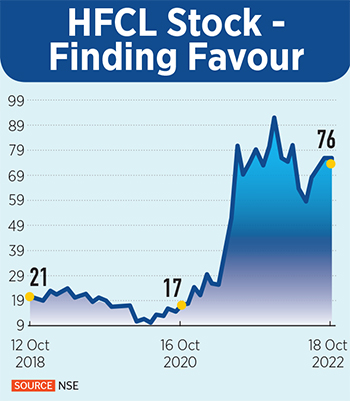
The HFCL stock has risen near four times or 265 percent in the past four years (see chart), echoing the improved business performance.

But for 19 years, between April 2003 and March 2022, the HFCL stock traded in a narrow range of Rs7 to Rs30 at the NSE, before moving up April 2022 onwards. The stagnation could have been due to a baggage of the past when Sebi had pulled up HFCL for violating norms governing prohibition of unfair trade practices, relating to a fraud by stock broker Ketan Parekh in 1999 for allegedly rigging stock market prices of 10 firms, including HFCL. HFCL settled the case through a consent order with Sebi in 2010.

The HFCL stock is not widely held by mutual funds (5.99 percent for the top 20 funds), according to data from Morningstar. The largest mutual fund shareholding includes Quant Money Managers (2.33 percent) and Vanguard Group (1.77 percent).

Usually the confidence in the stock improves as its price rises, so the next 2-3 quarters will be closely watched by investors, fund managers and the management. HFCL has been able to battle competition in its EPC business and the telecom equipment space (from Chinese manufacturers and local companies such as D-Link). It has now taken the lead ahead with 5G-centric products.

Ventura Research estimates HFCL’s revenue and net profit to grow at a CAGR of 20 percent and 30.4 percent respectively over the FY22-25E period.

After the envisaged capacity expansion, HFCL will have sizeable capacity in the OFC which will be near to the current capacities of Sterlite. With the telecom sector continuing to grow, a healthy order book indicating continuity, the right business alliances, HFCL and Nahata have ticked off the right boxes. They would now only hope that there are no delays in the 5G technology rollout.


Tuesday, October 18, 2022

THE WEST WILL SOON BE A THIRD WORLD


The hunger index, Transparency index, Ease of doing business, and UN, WHO, Nobel, G20 etc are all a product of the West to promote Christo-Western domination.

If you improve upon a Burger then you get an award, but if you invent a new Dosa then you are not even in the running. You have to fit into their mold. This is how Teresa of Kolkata gets an award, but not Aurobindo, or Sri Sri or Ramdev.
.
The West is dying. They have the highest crime rates, highest economic slowdown, and the drama of them having the 'Class' is not being accepted anymore.  
.
The West will soon be a Third world. It is time to do business in Odia, Kannada, Marathi and Gujrati. Learn Mandarin for foreign trade. 


Contributed by Sushil Sharma

Sunday, October 16, 2022

'Red flags in Byju's financials': MP Karti Chidambaram seeks ICAI review :-ET


Lok Sabha member Karti Chidambaram has asked chartered accountants' apex body Institute of Chartered Accountants of India (ICAI) to review the financials of the edtech startup.

In a letter to ICAI President Debashis Mitra, the Parliamentarian said there are various red flags in the company's financials for 2020-21 period, PTI reported.

On the expenses front, the letter said that 60% of the costs related to employees have been recognised as capital expenses rather than as operational  costs.

"If these costs were counted as a direct expense, instead of a capital expense Byju's total loss for FY2021 would have gone over Rs 5,000 crore. Such irregular accounting practices fail to give a clear picture of Byju's income, expenses and losses," said the letter dated October 14.

Citing various media reports, the Lok Sabha member said the company is not in a sound state of financial health and urged the ICAI to review its financial statements in the interest of consumers and employees.

After a delay of over 18 months, Byju's released its audited results in September. The firm's revenue from operations for the financial year ended March 2021 has been readjusted to Rs 2,280 crore even as the company incurred massive losses of Rs 4,588 crore, up from just Rs 262 crore in the previous fiscal.


Byju Raveendran, founder & CEO of Byju’s, had been briefing the company’s shareholders about the discrepancies, attributing it to business model changes due to the Covid-19 pandemic.

Earlier, the ministry of corporate affairs (MCA) had sent a communication to Byju’s asking it to explain why the financial accounts for FY21 were not submitted till now.

"While the audit delay was there, the narrative of fraud was wrong... there was no misreporting as you suggest… I have been on calls with many investors and nobody is concerned as they do not care about FY21 numbers but are looking at FY22 and FY23 numbers…," Raveendran had said then.


Notably, the edtech firm recently announced that it would cut – or “rationalise” – about 5% of its 50,000-strong workforce across departments such as product, content, media and technology in a phased manner.

This would translate to about 2,500 people losing their job. The final number may be different, but it would still be one of the largest layoffs by a major startup.


Saddened to hear of the passing of the magnificent Robbie Coltrane who played Hagrid with such kindness, heart and humour in the Harry Potter films. He was a wonderful actor, a friend to all and he will be deeply missed.🙏🏻🙏🏻


Friday, October 14, 2022

Tatas mull exit from UK steel business in absence of govt support :-Read full story at ET Prime


Tata Sons is considering Tata Steel's exit from its UK business with little hope of a £1.5 billion subsidy package for the proposed transition to green energy from the British government led by Liz Truss, said people with knowledge of the matter. Tata Sons has said the funding is needed to replace the carbon-intensive blast furnaces with electric arc furnaces over the next few years to keep the plant operational. Tata Sons doesn't see much point in an endless wait for help from the UK government, which is which is "sitting on the fence" and various exit options are being looked at, said one of the persons cited above.


THE MOST COMPLICATED SURGERY IN INDIA? ANY GUESS?


THE FATE OF THE CHIPS WILL DETERMINE THE FATE OF THE NATIONS

 OPINION


Every major economic superpower is using its money and its best mind to win this silicon battle .
A Human hair is 50-180 microns while novel coronavirus 0.1-0.5 micron. In comparison, today’s most advanced chips are about half the size of the novel coronavirus in diameter and are shrinking rapidly. The fate of nations depends on this infinitely small piece of silicon, which can devastate and shape our lives in myriad ways reliance on chips Let’s consider three different scenarios. First, Apple’s new A16 chip has more than 16 billion transistors. And Taiwan Semiconductor Manufacturing Company (TSMC), the world’s leading manufacturer of chips, just put one quintillion (ie 1 followed by 18 zeros) transistors on the iPhone chip. Every message we send, every picture we take, every call we make, all depends on some kind of chip. Apple uses its chips Cirrus Logic, Kioxia, Skywords and buys from TSMC, It’s designed in-house, and the super complex processes running the iPhone operating system make Apple a force of nature. But even a trillion dollar company like Apple is not able to manufacture its own chips. The A16 is built by a company in the same building called Building 18 in Taipei. TSMC’s fab is probably the most expensive and valuable factory in the world. Chips are manufactured today in only a few countries: Taiwan, South Korea, the US, Japan, the Netherlands and China. Second, Russia appears to be unable to dominate Ukraine in the war, partly because it is using more stubbornness than brain. Ukraine is using precision-guided missiles to fight Russia, which it recently bought from its Western allies. These missiles are powered by chips. While Russia does have some precision-guided missiles, it is unable to manufacture these on the required scale due to Western trade sanctions. Ukraine and US officials claim that what Russia has is a combination of some of the stolen chips, some made indigenously and some imported in the past. The US government’s well-known entity list ensures that this technology does not reach China and Russia and they cannot advance in the race for chips. Third, earlier this year, Toyota temporarily halted production on assembly lines at five domestic group plants in Japan due to a shortage of chips. If you are looking to buy a new car in the US, the wait times are really long. What is common in these scenarios is the importance of the chips. Not only the ability to make chips, but also the ability to integrate and synthesize them into complex systems will determine the fate of nations in the coming decades. Today, critical sectors such as defence, telecommunications, electronics and mobility are highly affected by chip shortages, which according to research studies will not end until 2023. If a natural disaster ever occurs in South Korea or Taiwan, it can add to the crisis. The US, the European Union, Japan, India and China have invested about $ 200 billion in the semiconductor sector, but its impact will not be visible now. America was ready to defend Taiwan, if there was aggression from China then perhaps no country in the world has the capacity to produce better and faster chips than Taiwan (and South Korea). ‘Don’t be Foxcond’ While India has taken a far-sighted move to subsidize chip manufacturing through a production-linked incentive scheme, there is a caveat that it should heed as it pursues global chip makers. It has been named ‘Don’t Be Foxcond’. Like Brazil and Vietnam in the past, in June 2018, Racine County in Wisconsin in the US was led to the proverbial garden path by Foxconn President Terry Gou along with US President Donald Trump and Governor Scott Walker. Mr. Gou secured a subsidy of about $5 billion and promised thousands of jobs and the world’s best LCD manufacturing plant. But everything remained on paper only. Despite people being uprooted from their homes to build a new factory, not a single chip or LCD panel was made there. Mr Trump also called the Wisconsin Valley Science and Technology Park the eighth wonder of the world. A manufacturing facility in municipal records, its designation was quietly changed to a ‘storage facility’ last month. Indian states, which are competing for chip manufacturing investment, should also keep in mind that setting up a chip unit requires static electricity and billions of gallons of clean water, which none of them offer today. Can do. Even LCD panel manufacturing is a dream for the future. For example, the proposed Racine plant that requires about seven million gallons of water per day was being called a violation of the Great Lakes Compact by environmentalists. For manufacturing chips, even more will be needed. If all goes well, India will reach there in the coming decade with prudent strategies and sensible leadership. The cost of a chip manufacturing plant is $15 billion-$20 billion that takes years to recover profitably, even if it runs throughout the year. With the turmoil in global supply chains due to COVID-19 and the Ukraine war, the game of chips has now become even more complicated. Every major economic superpower is using its money and its best mind to win this silicon battle. It will affect the lives of citizens in more ways than one. India can lose this war at its own risk.
g1


Vinay Kapoor thru Social Media

Thursday, October 13, 2022

'West didn't supply weapons to India but to Pakistan dictators': Foreign...

Moonlighting: What is it? What triggered the debate? And what is happening :-ET Sep 23 2022


The issue of moonlighting by tech professionals has ignited a fresh debate, polarising opinions and raising thorny legal questions.

What is it?

Moonlighting refers to a side job in addition to one's primary employment. In moonlighting, often such side jobs are taken by employees in secret, without informing the employer.

Why are IT companies against it?

Most new-age businesses are IP, know-how and data-driven, and there is always a risk of data and knowledge drain, specifically when the moonlighting is done for competing companies. Also, there is a concern that employees could be working for side jobs during office hours while working from home.

What started the debate

It was on-demand delivery platform Swiggy which introduced a the "Moonlighting" policy for its employees in August this year that will let them take up external projects to make more money. Swiggy said this could encompass activity outside of office hours or on weekends that does not impact their productivity on the full-time job or have a conflict of interest with the company's business in any way.

The justification

The overnight shift to remote working did away with long commutes, bringing relatively more fluid work schedules. It also yielded new opportunities for juggling smaller side projects in the free time for those keen enough to take them up.

When the pandemic struck, plenty of gigs from website development to app creation were up for grabs. Being short duration stints, these one-off projects were also seen by some as quick ways to supplement income. Since they did not involve full-time engagement, workers opting for such side jobs did not see it as a direct conflict of interest.

Who said what

Wipro Chairman Rishad Premji flagged the issue, equating it to "cheating".

Tech Mahindra CEO C P Gurnani said that it is necessary to keep changing with the times and added, "I welcome disruption in the ways we work."Mohandas Pai Pai said that while employees should not indulge in outside work during the time committed to their companies, nor leverage intellectual property, assets or resources of their employers for other purposes, individuals' free time is their own.

What IT firms doing to curb moonligting?

Indian IT major, Infosys has reportedly warned employees that moonligting could lead to termination of services.

Earlier this month, Wipro terminated 300 employees who were found to be moonlighting with one of its key rivals at the same time.


Tuesday, October 11, 2022

E-invoices must for businesses with over ₹5 crore turnover a year Read more at: https://economictimes.indiatimes.com


Businesses with annual turnover of over ₹5 crore will have to move to e-invoicing under goods and services tax (GST) from January 1. The GST Network has asked its technology providers to make the portal ready to handle the increased capacity by December, a government official privy to the development, told ET.

The official said the target is to bring all businesses with turnover above ₹1 crore under this framework by next fiscal year, which will further plug revenue leakages and improve compliance.

The GST Council had decided to implement electronic invoice in a phased manner. The aim is to bring all the small businesses under the formal economy. "As per the GST Council recommendation, e-invoicing will become mandatory for businesses over ₹5 crore turnover from January 1," the official said.

E-invoicing uses a standardised format that a machine can read.

It would help in syncing sales data of a small business vendor and large corporate clients, which is used to claim tax credit. This, the official said, would help in swift detection of false ITC claims, broaden GST base and improve compliance.

From October 1, businesses having aggregate annual turnover of Rs 10 crore and above have moved to e-invoicing for business-to-business (B2B) transactions.

E-invoicing for B2B transactions was first made compulsory for companies with turnover of ₹500 crore from October 1, 2020.

This threshold was then lowered to businesses with turnover of ₹100 crore from January 1, 2021 onwards and again was revised to companies having a turnover of ₹50 crore from April 1, 2021. From April 2022, it was extended to businesses with turnover above ₹20 crore.


Sunday, October 9, 2022

THE STORY OF DELHI's CONNAUGHT PLACE :-by Mr.Sandeep Uppal thru FB :-Grand Ole Times

Till the early years of the 20th century, Connaught Place was one large patch of wilderness. Or rather, a patchwork of villages surrounded by Delhi’s native trees such as Babool, Ronjh, Ker, Sangri, Hingot, Meswak, Khajoor, Dhaak, Palaash, Peepal, Banyan, Gular and Amaltas.
On Tuesdays the residents of Shahjahanabad, would venture out this far to visit the Hanuman temple. Besides devotees, hunters came this way, seeking Partridges and Quail in the forested patches which also had jackals and wild boar.
In 1912, a process of acquisition of several villages, including Jaisinghpura and Raja Ka Bazar began. The rulers of Jaipur, who owned the land, declared they were willing to part with their properties but it took more than a decade for the paperwork to be wound up.
The largest plot of land was Jaisinghpura, as it was owned by Sawai Jaisingh. He built Jantar Mantar and the Hanuman Temple on this land. The peasants and retainers, who had settled on these properties, were relocated in Karol Bagh and Pahar Ganj.
The area around the Raisina Hill was finalised for locating the Viceregal Lodge, the Secretariat and the Council House. The foundation stone of the Council House, now known as Parliament House, was laid by the first Duke of Connaught.
The area to the northeast of this central hub, consisting of land belonging to Jaisinghpura and some other villages, was chosen for a high end market and residential complex.
To be continued...

41

Saturday, October 8, 2022

Govt wants to check Vodafone Idea funding progress before owning stake < .. Read more at: https://telecom.economictimes.indiatimes.com


 The government would like to see Vodafone Idea (Vi) present a clear fund-raising plan before it converts the cash-strapped telco's accrued interest on deferred adjusted gross revenue (AGR)-related dues into equity, officials familiar with the matter said.

"If the promoters (Aditya Birla Group and Vodafone Plc) are not willing to put in more money into the company, they should dilute their stake and bring in a new investor. Just depending on government support won't do any good to the company," said one of the officials who asked not to be named.

At present, discussions are going on between the Department of Telecommunication (DoT) and Vi regarding the equity conversion proposal.Another official said the government is not shying away from the equity conversion but the company should also take some initiative to raise capital. A third official said the telco had indicated that fund raising was on the anvil, but the government wants to see concrete moves.

The DoT is taking a cautious approach as it feels that Vi will find it difficult to compete against financially stronger rivals Reliance Jio and Bharti Airtel by just depending on government support, and without substantial external funding.

The government in September 2021 had approved a relief package for the telecom sector, which among other steps, allowed carriers to defer payment of AGR-related dues by four years. It had also allowed telcos to convert the interest on such accrued dues into government equity. Vodafone Idea had opted for such an equity conversion in January, 2022.

"The Cabinet has cleared the proposal (for equity conversion) and it will be adhered to by the government. But taking equity is meant to be an interim (relief) measure, so that the firm can recover. The company still must fight on its own in the market," said  ..