Pages

Wednesday, February 15, 2023

How secret London talks led to Air India's gigantic plane order :-ET


Air India's record aircraft deal has put the Tata Group-owned airline in the league of aspiring global carriers.

On Tuesday, it provisionally agreed to acquire almost 500 jets from Airbus and Boeing to take on domestic and international rivals.

Striking the largest ever deal by one airline took months of secret talks carried out a stone's throw from Britain's Buckingham palace and culminating in a celebration over coastal Indian curries, according to people involved in the talks.

Confidentiality was lifted on Tuesday as leaders hailed the accord in a diplomatic embrace between leading G20 nations. Tata Group, which regained control of Air India last year after decades of public ownership, put out just six paragraphs.

Its low-key announcement illustrates a rising breed of private airline owners transforming a financially-risky Indian airline sector, alongside the publicity-shy founders of IndiGo.

The deal was in the making for over a year, insiders said, recounting details of the process on condition of anonymity.

Serious talks began last summer and continued until days before Christmas when outlines were agreed. As the astonishing scale of the deal began to crystallise, Reuters reported in December the parties were nearing a record 500-plane agreement.

The epicentre of dealmaking was St James' Court - a luxury Victorian hotel near Buckingham Palace in London's West End.

In the hothouse atmosphere of a classic aircraft industry negotiating ritual known as a "bake-off", negotiators from the airline, planemakers and engine giants camped out at the Tata-owned hotel and neighbouring suites for days at a stretch.

They were chasing a bigger slice of a fast-growing market that has seen many airline growth plans rise and fall.

Now, Boeing had a chance to restore its position in India's single-aisle jet market and narrow Airbus' large lead. Airbus wanted a bigger piece of the wide-body market led by its rival. With bulging order books, neither could sweep the whole order.

At stake was India's bid to win back the custom of visitors and its own diaspora from highly efficient Gulf carriers. Politics set the context but talks were commercial - and tough.

"The convergence of the political will of the country to regain sovereignty of international connectivity, combined with the ambition of the mighty Tata ... if things are done right it has all the ingredients to be really solid," Airbus Chief Commercial Officer Christian Scherer told Reuters on Tuesday.

'METHODICAL, TOUGH'
The contest for attention played out across London on a chilly day in December as Airbus found itself in talks with Air India on one side of the capital, while fighting Qatar Airways in court over the fate of similar A350 jets just two miles away.

Airbus and Qatar Airways later settled their contractual and safety row, but Air India jumped ahead of Qatar in the queue for smaller jets though sources say the Gulf airline also won hefty damages.

Negotiations led by Air India's chief commercial and transformation officer, Nipun Aggarwal, and Yogesh Agarwal, head of aircraft acquisitions, often stretched into the night with sellers churning out new "best offers" fuelled by room service.

"Air India negotiated hard and the team is very sharp despite having no prior aviation experience. They compare with some of the best dealmakers in the business," one person said.

A second person who watched the billions fall into place said the Air India negotiators were "methodical, tough and very sophisticated".

The London negotiations ended with a dinner at the hotel's Michelin-starred Indian restaurant Quilon, renowned for its seafood and coastal cuisine from places like Goa and Kerala.

While the major focus in any jet deal is the battle between planemakers, engines are often key and can speed or hold up the wider deal. Plans for announcements on the anniversary of Tata's Air India takeover slipped as engine talks wore on.


The biggest overall winner, insiders say, is General Electric which picks up the lion's share of the lucrative engine deals, with its CFM joint-venture with Safran beating Raytheon-owned rival Pratt & Whitney on Airbus A320neos. Rolls-Royce also got a boost from the sale of 40 Airbus A350s.

Highlighting the long road to strategic deals in aviation, GE's victory had been in the making for about 10 years.

In 2014, it won a tender for 27 engines for Air India A320s. Soon after it convinced Vistara to take on its engines for seven aircraft which later translated into an order for 70 planes. The turning point was IndiGo, which switched from Pratt & Whitney after technical issues that Pratt says have been resolved.

Analysts caution many obstacles remain to Air India's plans. It needs better service and efficiency to make a serious dent in the powerfully entrenched hubs of Doha and Dubai.

But India's potential will continue to lure dealmakers. CAPA India reports IndiGo is exploring its own order for 500 jets.


Adani Group looks to repay $500 million bridge loan to fund acquisition of Holcim cement units :-ET


Mumbai: The Adani Group is in talks with lenders to repay the $500 million bridge loan facility it had availed of to purchase a controlling stake in Holcim's cement units last year, said two people with knowledge of the matter.


Aditya Birla Group in talks with global banks for Vi equity infusion :-ET Feb 14 2023


Mumbai: Aditya Birla Group has initiated an exercise to raise funds at the promoter level for an equity infusion into Vodafone Idea (Vi) Ltd and is in discussions with global banks for raising term debt to subscribe to a preferential allotment of shares.

These funds will be used to part-finance the planned ₹5,000-crore equity infusion by the promoters into Vi, following the Indian government's decision to convert dues worth ₹16,133 crore into equity, said two people directly aware of the matter.


Tuesday, February 14, 2023

Japan averts recession but Q4 GDP rebound much weaker than expected :-ET FEB 14,2023


Japan's economy averted recession but rebounded much less than expected in October-December as business investment slumped, a sign of the challenge the central bank faces in phasing out its massive stimulus programme.

While private consumption is holding up against headwinds from rising living costs, uncertainties over the global economic outlook will weigh on Japan's delayed recovery from the scars of the COVID-19 pandemic, analysts say.

The world's third-largest economy expanded an annualised 0.6% in the final quarter of last year after slumping a revised 1.0% in July-September, government data showed on Tuesday.

The increase in gross domestic product (GDP) was much smaller than a median market forecast for a 2.0% rise, due to a downswing in capital expenditure and inventory.

"With other advanced economies heading into recessions, we still expect net trade to drag Japan into a recession as well in the first half, especially since business investment is weakening faster than we had expected," said Darren Tay, Japan economist at Capital Economics.

Private consumption, which accounts for more than half of Japan's GDP, rose 0.5% in the fourth quarter, matching a median market forecast.


But capital expenditure fell 0.5%, more than market forecasts for a 0.2% decline, the data showed.External demand added 0.3 percentage point to growth, against a 0.4 point contribution projected by analysts.

"From a negative growth in July-September, the rebound isn't very impressive," said Toru Suehiro, chief economist at Daiwa Securities.
"We can expect consumption to pick up as service spending stabilises. But it's difficult to project a strong recovery partly due to pressure from rising inflation," he said.

Japan has seen an increase in the number of overseas visitors since ending in October some of the world's strictest border controls to prevent the spread of the COVID-19 pandemic.Policymakers hope a rebound in domestic consumption, driven by savings accumulated during the pandemic, will last long enough for wages to pick up and cushion the blow on households from rising food and fuel costs.

With inflation exceeding the Bank of Japan's 2% target, the outlook for the economy and wages will be key to how soon the central bank could phase out its massive stimulus programme.


Monday, February 13, 2023

Pakistan crisis continues as milk price hits Rs 210 in Karachi :-ET


Milk prices in Karachi have been increased to Pak Rs 210 from Pak Rs 190 per litre by shopkeepers in the state amid uncertain economic conditions.

Loose milk, which has been increased to Pak Rs 210 from Pak Rs 190 per litre by some shopkeepers and live broiler chicken which has seen an increase of Rs 30-40 per kg in the last two days, taking the cost to Rs 480-500 per kilogram, reported IANS citing Dawn.

Earlier this month, the live bird was available at Rs 390-440 per kg while it was being sold between Rs 380-420kg in the last week of January, 2023.
\The chicken meat is now being sold at Rs 700-780 a kg which was Rs 620-650 per kg a few days ago, Dawn reported.

Boneless meat price hit a new peak of Rs 1,000-1,100 per kg, showing a jump of Rs 150-200 per kg in the same period.

Boneless poultry meat rate has crossed the price of boneless veal which is currently being sold at Rs900-1,000 per kg, while meat with bones is selling at Rs 800-850 per kg.

On loose milk, Karachi Milk Retailers Association media coordinator Waheed Gaddi claimed that "over 1,000 shopkeepers are selling milk at an inflated rate. These are actually shops of wholesalers/dairy farmers and not our members."

He said: "Our 4,000 retail members have kept the price unchanged at Rs 190 per litre."

In case the price hike announced by dairy farmers and wholesalers is not reverted, retailers will be bound to charge Rs 220 per litre instead of Rs 210 from the consumers as per new rate calculation after Rs 27 per litre jump in procurement price, he added, Dawn reported.

On Dec 16, 2022, retailers got an increase of Rs 10 per litre from the commissioner of Karachi to sell milk at Rs 180 per litre, but majority of retailers continued to sell milk at Rs 190 per litre, rejecting the official rate. At that time, the official wholesale rate was also increased from Rs 160 per litre to Rs 170.

(With inputs from IANS)


"SATTVIK CERTIFICATION"


You must have heard "Halal Certified", but have you heard about *"Satvik Certified"* of *"Sattvik Council"*?

Yes, the Government of India has constituted a "Sattvik Council" which is issuing "Sattvik Certificate" like "Halal Certificate". This means that now in India, wherever or whatever product has the level of "Sattvik Certified", it will be guaranteed that only pure Sattvik things will be found at that place and there will be no name of non-vegetarian food in that place or in that product. And first of all the level of *"Sattvik Certified" pure vegetarian food is being given to the Ministry of Railways, Government of India, in the trains running on all the routes of the country's famous train *"Vande Bharat" Express*.* Website: https://www.sattvikcouncilofindia.org/ *An introduction to Sattvik Council of India* Sattvik Council of India (SCI) is the “World's First Vegetarian” food safety and regulatory compliance for vegetarian and allied adherents. It came up with an ideology to take initiative and create a Food Safety Environment especially for the vegetarian’s consumers of India and global markets by creating SOPs in all applicable areas potential for guaranteeing 100% vegetarian environment and further transforming Sattvik Certification into education and training of the personnel for establishing a robust food safety and quality system. Sattvik India has designed the standards that standardise claims and defines vegetarianism in the most robust and credible way that it sets out the highest standards to ensure vegetarian consumers have confidence and is awarded transparency and authenticity that is currently demanded by the market. Sattvik Certification in a modern day furnish food safety regulation and Quality Management System to the vegetarian consumers which is developed on sound scientific and hard core vedic ancient principles to protect consumers from risks of food borne illness and death. Adopting industry-leading best practices, food safety regulations are getting increasingly outcome-based and transparent. We at the SCI always visualize the potential and importance of quality certification, specialized for the vegetarian societies of the world and aims at meeting the consumers’ expectations by providing ‘safe food supply’, capable enough to meet the basic quality and safety standards and requirements referring to food hygiene, labeling and certification, use of food additives, limits for pesticide residues etc. The certification procedure by the Council would reinforce the consumers’ assurance and confidence in the food supply system by making a positive impact on the current food processing techniques. Sattvik Council of India is initiating in the same direction and has the same ideology and further is working with Government of India and other Governments around the world to promote the cause. Address: Gopal Das Bhawan, Barakhamba Road, Delhi - 110001, INDIA Phone: +91-11-40503001 Email: info@sattvikcouncilofindia.org Customer care (Toll Free)
+91-9667803001

Adani-Hindenburg row: Centre agrees to setting up of expert panel by SC for strengthening regulatory mechanism ;-Mint. Updated: 13 Feb 2023, 05:41 PM IST Edited By Anwesha Mitra


As the Adani-Hindenburg controversy rages on, the Centre on Monday said that it had no obejctions to the setting up of a Supreme Court committee for strengthening regulations. The SC was hearing pleas relating to the Adani stocks rout after the Hindenburg report.

The SC has asked the Centre to come on Friday and apprise it about the remit of the committee.The government also told the apex court that SEBI, other bodies are equipped to deal with situation. It however insisted that the remit of the panel would have to be very specific and ensure that the flow of money and investments was not affected by any “unintentional" message. 

“The government has no objection to forming a committee. But, the remit of the committee, we can suggest. We can provide names in a sealed cover," said Solicitor General Tushar Mehta who was appearing for the Centre and SEBI.

The SC has 

The top court has now listed two PILs, alleging exploitation of innocent investors and "artificial crashing" of the Adani Group's stock value, for hearing on Friday.

More to come…


Does RHI Magnesita India (NSE:RHIM) Have A Healthy Balance Sheet? Simply Wall St Simply Wall St Published February 02, 2023 ;-


NSEI:RHIM
Source: Shutterstock

Warren Buffett famously said, 'Volatility is far from synonymous with risk.' When we think about how risky a company is, we always like to look at its use of debt, since debt overload can lead to ruin. Importantly, RHI Magnesita India Limited (NSE:RHIM) does carry debt. But should shareholders be worried about its use of debt?

Why Does Debt Bring Risk?

Debt is a tool to help businesses grow, but if a business is incapable of paying off its lenders, then it exists at their mercy. Ultimately, if the company can't fulfill its legal obligations to repay debt, shareholders could walk away with nothing. While that is not too common, we often do see indebted companies permanently diluting shareholders because lenders force them to raise capital at a distressed price. By replacing dilution, though, debt can be an extremely good tool for businesses that need capital to invest in growth at high rates of return. The first step when considering a company's debt levels is to consider its cash and debt together.

View our latest analysis for RHI Magnesita India

How Much Debt Does RHI Magnesita India Carry?

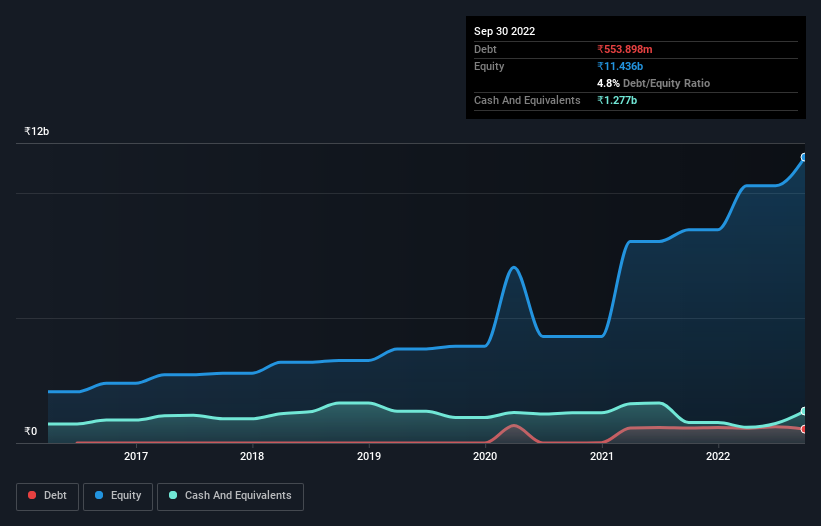
The image below, which you can click on for greater detail, shows that RHI Magnesita India had debt of ₹553.9m at the end of September 2022, a reduction from ₹598.7m over a year. But it also has ₹1.28b in cash to offset that, meaning it has ₹723.6m net cash.

debt-equity-history-analysis
NSEI:RHIM Debt to Equity History February 2nd 2023

A Look At RHI Magnesita India's Liabilities

The latest balance sheet data shows that RHI Magnesita India had liabilities of ₹7.22b due within a year, and liabilities of ₹428.5m falling due after that. On the other hand, it had cash of ₹1.28b and ₹6.56b worth of receivables due within a year. So it actually has ₹186.3m more liquid assets than total liabilities.

This state of affairs indicates that RHI Magnesita India's balance sheet looks quite solid, as its total liabilities are just about equal to its liquid assets. So while it's hard to imagine that the ₹148.2b company is struggling for cash, we still think it's worth monitoring its balance sheet. Succinctly put, RHI Magnesita India boasts net cash, so it's fair to say it does not have a heavy debt load!

On top of that, RHI Magnesita India grew its EBIT by 84% over the last twelve months, and that growth will make it easier to handle its debt. When analysing debt levels, the balance sheet is the obvious place to start. But ultimately the future profitability of the business will decide if RHI Magnesita India can strengthen its balance sheet over time. So if you want to see what the professionals think, you might find this free report on analyst profit forecasts to be interesting.

Finally, while the tax-man may adore accounting profits, lenders only accept cold hard cash. RHI Magnesita India may have net cash on the balance sheet, but it is still interesting to look at how well the business converts its earnings before interest and tax (EBIT) to free cash flow, because that will influence both its need for, and its capacity to manage debt. Over the last three years, RHI Magnesita India reported free cash flow worth 6.7% of its EBIT, which is really quite low. That limp level of cash conversion undermines its ability to manage and pay down debt.

Summing Up

While it is always sensible to investigate a company's debt, in this case RHI Magnesita India has ₹723.6m in net cash and a decent-looking balance sheet. And we liked the look of last year's 84% year-on-year EBIT growth. So we don't think RHI Magnesita India's use of debt is risky. There's no doubt that we learn most about debt from the balance sheet. But ultimately, every company can contain risks that exist outside of the balance sheet. For example RHI Magnesita India has 2 warning signs (and 1 which is concerning) we think you should know about.


Grooming Gangs: Britain's Shame | Maggie Oliver on the failures of Rochd...

NCLT directs Insolvency proceeding against Zee Learn, after Yes Bank's plea The National Company Law Tribunal (NCLT) has directed to initiate insolvency proceedings against Zee Learn, following a petition filed by private sector lender Yes Bank Ltd Topics :-Business Standard


The National Company Law Tribunal (NCLT) has directed to initiate insolvency proceedings against Zee Learn, following a petition filed by private sector lender  Ltd.

 Ltd (YBL) had claimed a default of Rs 468.99 crore by the Essel Group company.

Out of the default amount of Rs 468.99 crore, the principal amount was Rs 410.67 crore and Rs 58.32 was interest. The date of default was August 2, 2021.

A two-member bench of the Mumbai  said the application made by the financial creditor  is complete in all respects as required by law.

"It clearly shows that the Corporate Debtor (Zee Learn) is in default of a debt due and payable, and the default is in excess of the minimum amount stipulated under section 4(1) of the IBC," said .

Therefore, the debt and default stand established and there is no reason to deny the admission of the Petition.

"In view of this, this Adjudicating Authority (NCLT) admits this Petition and orders initiation of CIRP against the Corporate Debtor," it said.

CIRP stands for Corporate Insolvency Resolution Process.

YBL moved  last year and  received notice over the petition on April 25.

 mainly operates in the education segment. It has a chain of K-12 schools, Mount Litera Zee School, and a pre-school network -- Kidzee.

(Only the headline and picture of this report may have been reworked by the Business Standard staff; the rest of the content is auto-generated from a syndicated feed.)


Adani Group says balance sheet of companies "very healthy" Adani Group companies "have strong cash flows, and our business plan is fully funded," a group spokesperson told Reuters. REUTERS FEBRUARY 13, 2023 / 04:54 PM IST moneycontrol news


 The corporate empire of Gautam Adan has been thrown into a tailspin after the Hindenburg Research report alleged malpractices.(Representative image)

Adani Group said on Monday the balance sheet of each of its portfolio companies was "very healthy" and that it has strong corporate governance and secure assets, amid a stock rout in the wake of a short-seller report.

Adani Group companies "have strong cash flows, and our business plan is fully funded," a group spokesperson told Reuters, responding to a media report that the group halved its revenue growth target and plans to scale down fresh capital expenditure.

Each entity will review its own capital market strategy once the current market stabilizes, the group said, adding it was "confident in the continued ability of our portfolio to deliver superior returns to shareholders."


Six fixed income investments that outshine in uncertain interest rate scenario Given the uncertainty around the future movement of interest rates, the yields provided by these debt investment products look attractive DHURAIVEL GUNASEKARAN FEBRUARY 13, 2023 / 12:32 PM IST moneycontrol news


Last few years were challenging for fixed income investors. Ever since the pandemic broke out, central banks across the globe worked hard to boost economies by cutting policy rates. This, in turn, lowered the yields, made overall fixed income products, including bank FDs, small savings schemes offer poor returns. While the central banks were fighting for economic growth, rising inflation turned out to be a nightmare, of late. This made most of the key economies to reverse their stance and increase rates. Since May 2022, the RBI, too, has increased the repo rate by 250 basis points to 6.5 percent to contain inflation. Though the rising yields have improved the returns from fixed deposits and accrual-focussed funds such as liquid funds and ultra-short duration funds, it inflicted some mark-to-market losses on duration-based funds. Experts believe that the central bank is likely to opt for lower interest rate hikes if the inflation shows the signs of abating. However, there is not much clarity on how the future interest rate movements will be. Lakshmi Iyer, CEO-Investment Advisory, Kotak Investment Advisors Limited says that the Monetary Policy Committee (MPC), in its recent meeting held on February 8, hasn’t given any implied or explicit indication of a future pause in rate action. The incremental rate actions continue to be determined by incoming data – both global as well as domestic. Given the high and uncertain interest rate environment going ahead, we list out six fixed income investment products that could deliver better return to the fixed income investors.
Over the last one year, the yields at the short end of the yield curve rose significantly thanks to consecutive rate hikes and tight liquidity in the banking system. Iyer is of the opinion that the nature of the yield curve remains flat and hence risk reward seems tilted towards the middle part of the yield curve – 2027-2030 segment. Here we list out the attractive debt option within the 3-5 years segment.
2/8
Over the last one year, the yields at the short end of the yield curve rose significantly thanks to consecutive rate hikes and tight liquidity in the banking system. Iyer is of the opinion that the nature of the yield curve remains flat and hence risk reward seems tilted towards the middle part of the yield curve – 2027-2030 segment. Here we list out the attractive debt option within the 3-5 years segment.
Short duration funds (SDFs) are debt mutual fund schemes investing mostly in bonds with a short to medium maturity. SDFs invest in bonds with a Macaulay Duration of 1 to 3 years. Bonds with short maturity are relatively less sensitive to interest rate movements than those with long maturity. SDFs are the preferred choice in a rising and higher rate environment as the proceeds of the short maturity papers can be redeployed in bonds with higher yields. This should improve the fund’s performance. Consider investing in these if you have a minimum three-year view, to take home tax efficient returns.
3/8
Short duration funds (SDFs) are debt mutual fund schemes investing mostly in bonds with a short to medium maturity. SDFs invest in bonds with a Macaulay Duration of 1 to 3 years. Bonds with short maturity are relatively less sensitive to interest rate movements than those with long maturity. SDFs are the preferred choice in a rising and higher rate environment as the proceeds of the short maturity papers can be redeployed in bonds with higher yields. This should improve the fund’s performance. Consider investing in these if you have a minimum three-year view, to take home tax efficient returns.
Investors keen on visibility of the returns expected from debt funds and defined time frame in mind may find target maturity funds (TMFs) attractive. TMFs are passively managed debt mutual funds (either exchange traded funds or index funds) tracking fixed-income indices. TMFs have a predetermined maturity date and hold debt securities that are constituents of the underlying index. These indices typically comprise government securities, state development loans (SDL) or/and high-quality bonds issued by public sector enterprises. Now, TMFs of 3+ years maturities are yielding around 7.5%. This provides attractive investment opportunity for investors with at least three years of investment horizon.
4/8
Investors keen on visibility of the returns expected from debt funds and defined time frame in mind may find target maturity funds (TMFs) attractive. TMFs are passively managed debt mutual funds (either exchange traded funds or index funds) tracking fixed-income indices. TMFs have a predetermined maturity date and hold debt securities that are constituents of the underlying index. These indices typically comprise government securities, state development loans (SDL) or/and high-quality bonds issued by public sector enterprises. Now, TMFs of 3+ years maturities are yielding around 7.5%. This provides attractive investment opportunity for investors with at least three years of investment horizon.
Conservative investors have been investing in fixed deposits issued by banks and companies. The FD market now gives a lot more options as there are now small finance banks and new-age banks with their own FD products. The assured returns appeal makes many opt for FDs. After the hike in policy interest rates by the RBI, banks and non-banking finance companies have announced an increase in interest rates on offer. Do not invest in FDs with very high interest rates as this is also an indication of high credit risk.
5/8
Conservative investors have been investing in fixed deposits issued by banks and companies. The FD market now gives a lot more options as there are now small finance banks and new-age banks with their own FD products. The assured returns appeal makes many opt for FDs. After the hike in policy interest rates by the RBI, banks and non-banking finance companies have announced an increase in interest rates on offer. Do not invest in FDs with very high interest rates as this is also an indication of high credit risk.
Tax-free bonds were issued by state-run infrastructure finance companies in the period between FY12 and FY16. These bonds were listed on the bourses and are now traded in the cash segment of the BSE and NSE. Investors can buy these bonds — through their demat accounts — from the secondary market. These bonds pay interest annually, which is tax-free. These bonds have been preferred the most by the large investors for short term. With 5.3 percent YTM, tax-free bonds are still an attractive buy for investors in higher income-tax slabs. For those in the 39 percent tax slab, that results in a pre-tax yield of 8.7 percent. Select bonds with higher liquidity and higher YTM in the secondary market that match your time horizon.
6/8
Tax-free bonds were issued by state-run infrastructure finance companies in the period between FY12 and FY16. These bonds were listed on the bourses and are now traded in the cash segment of the BSE and NSE. Investors can buy these bonds — through their demat accounts — from the secondary market. These bonds pay interest annually, which is tax-free. These bonds have been preferred the most by the large investors for short term. With 5.3 percent YTM, tax-free bonds are still an attractive buy for investors in higher income-tax slabs. For those in the 39 percent tax slab, that results in a pre-tax yield of 8.7 percent. Select bonds with higher liquidity and higher YTM in the secondary market that match your time horizon.
Non-convertible Debentures (NCDs) are fixed income instruments issued by corporates to raise long-term funds through public issues. They are issued for a specific tenure of, say, one to seven years and pay interest periodically or at the end of maturity. Many NCDs that were issued to retail investors (whose face value is mostly Rs 1,000) are listed on the exchanges and traded like equity shares. A few of them are traded with reasonable liquidity and near fair value. Investors with a medium risk profile, looking for options other than bank and corporate FDs, may consider buying these NCDs. Vishal Goenka, Co-Founder IndiaBonds says, “everyone is familiar with the benefits of a well-diversified portfolio and addition of taxable NCDs aids in portfolio diversification. Aside from the predictable cashflows, Taxable NCDs also offer protection against the volatility of equity markets”. Note that these NCDs are prone to credit and interest-rate risks. So, one should consider NCDs with a higher rating, better Yield-to-maturity (YTM) and ample liquidity on the exchanges.
7/8
Non-convertible Debentures (NCDs) are fixed income instruments issued by corporates to raise long-term funds through public issues. They are issued for a specific tenure of, say, one to seven years and pay interest periodically or at the end of maturity. Many NCDs that were issued to retail investors (whose face value is mostly Rs 1,000) are listed on the exchanges and traded like equity shares. A few of them are traded with reasonable liquidity and near fair value. Investors with a medium risk profile, looking for options other than bank and corporate FDs, may consider buying these NCDs. Vishal Goenka, Co-Founder IndiaBonds says, “everyone is familiar with the benefits of a well-diversified portfolio and addition of taxable NCDs aids in portfolio diversification. Aside from the predictable cashflows, Taxable NCDs also offer protection against the volatility of equity markets”. Note that these NCDs are prone to credit and interest-rate risks. So, one should consider NCDs with a higher rating, better Yield-to-maturity (YTM) and ample liquidity on the exchanges.
Government securities (g-secs) are debt instruments issued by the RBI on behalf of the Central Government. State governments also raise money by issuing such instruments, which are called State Development Loans. Treasury bills (T-Bills) are short-term instruments with a maturity of 3, 6 and 12 months, while dated g-secs have a maturity period of 1 to 40 years. Since the Government of India backs these bonds, they are virtually credit-risk-free investments. However, these bonds are exposed to interest rate risks, which can be avoided if held till maturity. Retail investors can buy these bonds either offline or online. Retail investors can buy g-secs at primary issuance using RBI’s Retail Direct platform, that is, when a bond is first issued by the government. Or, they can participate in the secondary market, which is called the NDS OM (Negotiated Dealing System Order Matching). The other ways to invest directly in g-secs is through a trading and Demat account, which can be opened at any bank or NBFC in India. Retail investors can buy government bonds from stockbrokers and place bids online on the goBID web portal or the NSE goBID mobile application. In an auction held on February 10, 2023, the RBI has set the yields for the 2-year maturity paper at 7.14%. The remaining two auctions for this financial year will be held on Feb 17, 2023 and Feb 24, 2023 respectively. The RBI is likely to announce the indicative calendar for issuance of Government dated securities for the first half of the FY2023-24 anytime soon. Investors can also consider gilt mutual fund schemes, which are a more convenient and tax efficient way to invest in g-secs.
8/8
Government securities (g-secs) are debt instruments issued by the RBI on behalf of the Central Government. State governments also raise money by issuing such instruments, which are called State Development Loans. Treasury bills (T-Bills) are short-term instruments with a maturity of 3, 6 and 12 months, while dated g-secs have a maturity period of 1 to 40 years. Since the Government of India backs these bonds, they are virtually credit-risk-free investments. However, these bonds are exposed to interest rate risks, which can be avoided if held till maturity. Retail investors can buy these bonds either offline or online. Retail investors can buy g-secs at primary issuance using RBI’s Retail Direct platform, that is, when a bond is first issued by the government. Or, they can participate in the secondary market, which is called the NDS OM (Negotiated Dealing System Order Matching). The other ways to invest directly in g-secs is through a trading and Demat account, which can be opened at any bank or NBFC in India. Retail investors can buy government bonds from stockbrokers and place bids online on the goBID web portal or the NSE goBID mobile application. In an auction held on February 10, 2023, the RBI has set the yields for the 2-year maturity paper at 7.14%. The remaining two auctions for this financial year will be held on Feb 17, 2023 and Feb 24, 2023 respectively. The RBI is likely to announce the indicative calendar for issuance of Government dated securities for the first half of the FY2023-24 anytime soon. Investors can also consider gilt mutual fund schemes, which are a more convenient and tax efficient way to invest in g-secs.

Used here for educational purposes only.

Vodafone Idea in talks to refinance Rs 3,000-4,000 crore of loans :-ET


Kolkata|Mumbai: Vodafone Idea (Vi) has started fresh talks with key lenders, including State Bank of India, Punjab National Bank and HDFC Bank, to refinance ₹3,000-4,000 crore of loans, bankers familiar with the matter said.

Refinancing of some debt will help free up cash for Vi, which urgently needs to pay substantial vendor dues - to tower companies like Indus Towers and network equipment makers such as Ericsson and Nokia.


Sunday, February 12, 2023

Aero India: HAL to display scale model of 'Next Gen Supersonic Trainer' for first time :-ET

 The Hindustan Aeronautics Limited will display for the first time the scale model of Hindustan Lead in Fighter Trainer (HLFT-42), at the Aero India to be held here from Monday. HLFT-42 is the 'Next Gen Supersonic Trainer' that will play a "critical role" in modern combat aircraft training with state-of-the-art avionics like Active Electronically Scanned Array, Electronic Warfare Suite, Infrared Search and Track with Fly by Wire control system, the HAL said.

As part of the five-day aerospace and defence show at the Air Force Station Yelahanka, the Bengaluru-headquartered company will display 'Aatmanirbhar Formation' flight of 15 helicopters consisting of all variants of Advanced Light Helicopter, 'Prachand' Light Combat Helicopter, and Light Utility Helicopter.

In a statement, the HAL said that it will showcase its full spectrum training capabilities and its range of products and technologies centred on the theme 'Innovate. Collaborate. Lead.

The HAL's major attraction at its indoor pavilion will be the scale model of Indian Multi Role Helicopter, next generation HLFT-42 and models of LCA Mk 2, Hindustan Turbo-shaft Engine-1200, RUAV, LCA Trainer, and Hindustan-228, it said.

The HAL said it will promote indigenously-built platforms to visiting defence delegations and hold business meetings with Original Equipment Manufacturers and customers besides signing agreements and contracts with its business partners for various The HAL's major attraction at its indoor pavilion will be the scale model of Indian Multi Role Helicopter, next generation HLFT-42 and models of LCA Mk 2, Hindustan Turbo-shaft Engine-1200, RUAV, LCA Trainer, and Hindustan-228, it said.


The HAL said it will promote indigenously-built platforms to visiting defence delegations and hold business meetings with Original Equipment Manufacturers and customers besides signing agreements and contracts with its business partners for various projects.

CATARACT IS THE THIRD BIGGEST CAUSE OF BLINDLESS.WHAT ARE THE FIRST TWO?????