Pages

Thursday, March 2, 2023

Pay up abroad, but play around in India. Are global firms taking Indian regulators for a ride? :_ET -Used here for CA and CS students for their knowledge.

 In December, US audit regulator Public Companies Accounting Oversight Board (PCAOB) imposed sanctions on seven entities belonging to the KPMG global network for violations of professional auditing standards, quality control standards and other rules.


Among them was KPMG India and its partner Sagar Pravin Lakhani, who settled the matter for USD1 million (INR8.2 crore today) and USD75,000 (INR61 lakh), respectively.

PCAOB found that during the course of that audit, Lakhani and other members of the KPMG India engagement team signed off on dozens of blank work papers.

The blank work papers were replaced with completed work papers, in many cases after the issuance of the audit report, but the sign off dates were not updated. “As a result of this practice, the work papers did not appropriately reflect the dates on which the audit work was actually completed and reviewed. KPMG India was aware that its audit software allowed personnel to modify or update audit documentation without modifying the sign off date,” PCAOB said in its release.

Regulatory experts say PCAOB penalises such shortcomings without the need for any proof of any actual misstatement in the accounts, much less without any need of evidence of any loss suffered by anybody. PCAOB did not name the Indian banking company, whose books were audited and signed off by Lakhani in July 2017. According to the regulator’s website, Lakhani had audited two Indian banks namely ICICI Bank and HDFC Bank that year. ET Prime could not ascertain which of these the violations pertained to.
While KPMG and its partner settled with the US regulator and agreed to make improvements to the processes and IT systems, their behavior with the Indian regulator has been far from cordial.

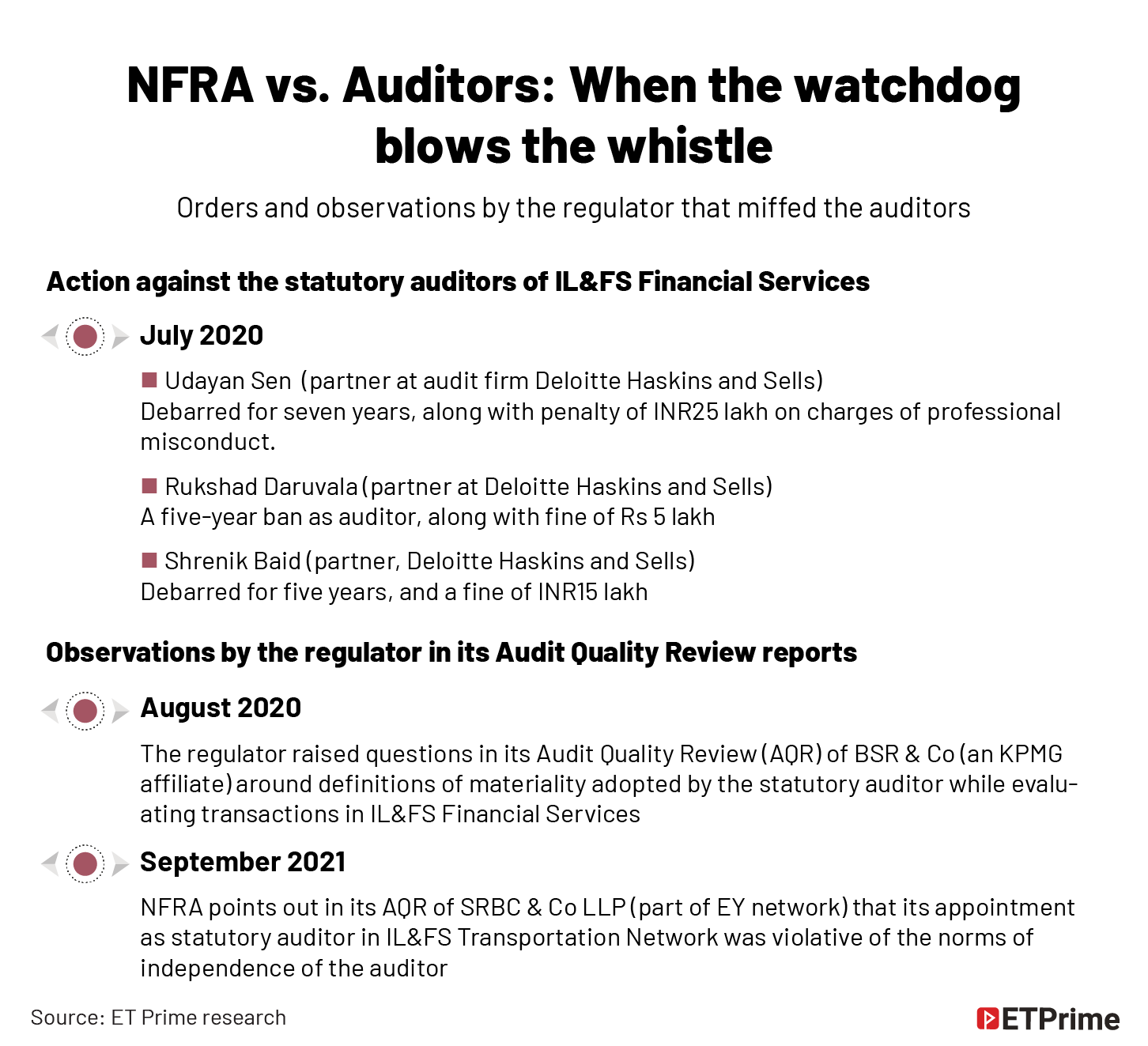
In August 2020, NFRA published an Audit Quality Review Report (AQRR) of BSR and Co's audit of IL&FS Financial Services. BSR and Co is a KPMG network firm.

An entire section of the AQRR dealt with "Integrity of the Audit File and Audit Firm's IT Controls Review".

NFRA concluded that the IT tool used by the auditor for audit documentation does not comply with certain fundamental security requirements of logs monitoring, authentication, and access control protocols. “The platform does not fully meet the audit (inspection) requirements as well. The audit firm has compromised authenticity and reliability of the electronic audit documentation. The deficiencies are systemic and structural in nature and arise from compromise of basic principles of IT security, requirements of SQC-1, SA 220 and SA 230. This renders the audit documentation unreliable.”

The regulator said there was no certainty that the “audit documentation was completed in a time frame contemporaneous with the actual audit procedures performed, and without performing any further audit procedures or changes other than administrative changes, after the audit report date”.

In not rectifying these deficiencies, the audit firm is guilty of serious professional misconduct, the AQRR on the IL&FS Financial Services audit by BSR & Co said.

NFRA's review of the IT systems seems far more detailed than PCAOB seems to have done. NFRA’s report shows the extent of detail that the NFRA has gone into, and the numerous opportunities offered to BSR to provide their explanations.

"KPMG/BSR clearly know who they can take liberties with, and who not, and, clearly, how. In "Silver Blaze", Sherlock Holmes draws attention to the curious incident of the dog in the night. The abuse of the justice system to generate (useful, to the wrongdoer) delay is commonplace. But what is the signal when a watchdog (seemingly) acquiesces in this delay?"

— R Sridharan, former chairperson, NFRA

The report presents evidence of each one of these explanations being gone into with an open, objective mind, and NFRA's conclusions on each point have been explained on the basis of undeniable evidence.

However, BSR’s response did not show any attempt to address these deficiencies. Many of them are far more serious than what is covered by the PCAOB's order. Not only that, NFRA has proved serious misstatements that have occurred as a result in the published accounts. The loss to the public interest has been colossal with the IL&FS collapse threatening to derail the entire financial system. Government and regulators had to take various measures to bring stability to the system.

“Going by the scale of the penalties levied by the PCAOB for the violations that they have sanctioned, NFRA's AQRR should have had catastrophic consequences,” says former NFRA chairperson R Sridharan.

NFRA issued SCNs (show cause notices) to both – the firm, and the relevant Partners — in January 2021. Promptly, stay orders were obtained from the Delhi High Court.
NFRA vs. Auditors- When the watchdog _blows the whistle @2x
“KPMG/BSR clearly know who they can take liberties with, and who not, and, clearly, how. In "Silver Blaze", Sherlock Holmes draws attention to the curious incident of the dog in the night. The abuse of the justice system to generate (useful, to the wrongdoer) delay is commonplace. But what is the signal when a watchdog (seemingly) acquiesces in this delay?” Sridharan wondered.

The jurisprudence of audit regulation
US regulator PCAOB has been the pioneer in audit regulation.

The same approach as that of the PCAOB, barring a few details, has been built into the International Audit and Assurance Standards Board (IAASB) Standards of Auditing (SoA). The Institute of Chartered Accountants of India adopted the IAASB SoA virtually verbatim, and these now have statutory basis in India as they have been built into the rules issued under the Companies Act, 2013 (CA).

The SoA mandates specific actions by the auditors. These are now statutory duties cast on the auditors under the CA. Non-compliance with the SoA is professional misconduct. This position has been laid down with zero ambiguity even by the ICAI.

Though case law on audit regulation is yet to come up in India, there are judgements on other laws which clearly lay down that non-compliance with any statutory duty is misconduct.

As per the SoA, and therefore under the law, the only acceptable evidence of compliance, or adequate proof of non-compliance, with the mandatory procedures, is the evidence recorded in the audit file as and when the procedures are performed.

For this reason, the audit file acquires great sanctity. As a corollary, nailing down an auditor is relatively an easy job. The audit file does all that is required. With this framework of law, auditors caught for non-compliance can very easily understand that their situation would be hopeless.

An analogy would be of a burglary caught fully on video, with several unimpeachable witnesses to the whole operation. This is why they are keen to settle. Over 90% of all orders passed by the PCAOB, since its inception in 2002, have been settlement orders.

“It helps that the US has a justice system that is ruthlessly efficient, and extremely severe, in the punishments that it deals out (compared to India's). You can take chances with this system only at unacceptably high levels of risk,” Sridharan says.

Corporate law experts agree.

Murali Neelkantan, principal, Amicus says companies will settle only when they perceive a real threat of a higher penalty imposed after adjudication that can be avoided by the settlement. “In the Indian regulatory and judicial system, it seems like there is little chance that there will be any regulatory penalties in the short term. And even when the regulator does occasionally impose penalties, the order will be appealed”.

Typically, courts and tribunals routinely grant a stay on recovery of those penalties and often even overturn the decision of the regulator.

Neelkantan adds, “You only have to look at the number of Sebi orders that are overturned by SAT after many years and the many more which have been stayed for years on end. Even when SAT does confirm the penalty, there are appeals that can take many years”. It is therefore an incentive for companies to use the slow judicial system to their benefit and take their chances rather than pay any penalties.

Neelkantan points out that the only time there have been settlements with Sebi is when the cost of litigation is likely to be significantly more than the settlement amounts. “How much of the penalties ordered by the Competition Commission of India in the last 20 years have been paid?,” he asks rhetorically.

If there is a quick and effective enforcement of the law there will be an incentive for companies to settle rather than litigate, say experts.

J Sundharesan, a board strategist and compliance expert also feels much is wrong with our courts system. “We have seen over the last 70 years or so whenever there is a problem it is referred to the courts. Even when we know that the justice delivery system is much delayed than in developed countries. What we need is speedy delivery of justice through fast-track company related courts, so that people do not take cover under the legal cases.”

Also, regulators need to identify capable hands internally for faster delivery of justice. “Sometimes the right cases go to the wrong person (which delays the delivery system),” adds Sundharesan.

There are numerous instances over the years where foreign firms operating in India seem to take the country’s laws and institutions lightly.

Some examples are Union Carbide in the Bhopal gas leak case, Citibank and others in the 1992 securities scam, and the Big Four accounting firms in Satyam and IL&FS matters.

In the IL&FS cases, both Deloitte and EY network firms and their partner firms have moved court on the issue of jurisprudence questioning the constitutional validity of the NFRA legislation.

Both KPMG and Deloitte have spent millions in settlements in the UK for lapses in the audit of troubled companies. According to a recent report in The Guardian, KPMG reached a GBP14.4 million settlement with the accounting regulator the Financial Reporting Council (FRC) last May, after former staff were accused of forging documents and misleading the regulator over audits for companies that included Carillion.

It came after a tribunal upheld allegations that KPMG and former staff created false meeting minutes and retroactively edited spreadsheets, before sharing those documents with the FRC.

The penalty was one of the largest for a UK auditor, second only to the GBP15 million fine issued to Deloitte in 2020 over its historic audits of the software company Autonomy, The Guardian report said.

Will a settlement mechanism be effective?

The Technical Advisory Committee of the NFRA had suggested that the NFRA should explore the possibility of bringing a settlement mechanism in India. However, NFRA took a view that the ecosystem is not conducive to give enough bite to such a system.

Professor R Narayanaswamy, who headed the TAC till December told ET Prime, “Take the conduct of PwC in Satyam in India and in the US. The PwC settles the matter quietly in the US by paying significant amounts to settle the case with the Securities and Exchange Commission (SEC), the PCAOB).

Again, KPMG India settled with the PCAOB for an egregious, even when

judged by Indian practices, violation of auditing requirements in a recent case but it disputes the findings in NFRA’s audit quality reviews in courts instead of going to the appellate tribunal.”

According to Narayanaswamy, there could be several reasons for foreign firms responding differently to actions by the authorities in India from those in their home jurisdictions. “First, enforcement of laws in India is mostly weak and uncertain. Often, the authorities don’t care to act quickly and they mostly blunder when they do act. Second, it takes years for the actions to wind their way through the courts and tribunals because of the slow judicial processes. Finally, there’s a capacity problem because the Indian authorities mostly lack the technical and human resources of the requisite quality to understand a matter and decide on what to do.”

Narayanaswamy recalled having seen the FIR (first information report) filed by the police authorities in an accounting fraud case, and it was impossible to understand what the matter is all about.

He says, “The police are not trained well to investigate white-collar crime with the result the charges are poorly drafted, the section numbers are wrongly mentioned, and the process of collecting and presenting evidence is deeply flawed. The charges are then easily dismissed by the courts. In contrast, the indictments filed by investigators in the US and the UK are drafted rigorously and are intended to stand judicial scrutiny. The documentation by the authorities in India doesn’t come across as professional or earnest. Given all of these, all it takes for anyone is to game the system and get stay after stay from courts.”

Narayanaswamy says that there’s no effective class action by shareholders or lenders in India. “The Companies Act, 2013 has a provision for class action but I don’t know of any case in which it has been invoked.”

Not just the foreign firms
It is not just the foreign firms, even the local audit firms take liberties with the legal system. ET Prime had documented the cat and mouse game NFRA had to engage with Chaturvedi and Shah, in what appeared to be an open and shut case in the matter of audit of DHFL, another troubled company.

The matter continues to remain in courts and NFRA is yet to pass any order in the matter more than 18 months after this report.

The matter of jurisdiction of NFRA over auditors is a key point of contention in this matter also, where the next hearing is likely to happen in March. This creates the impression that the matter needs to be addressed in totality and NFRA’s hands need further strengthening.

Vijay Kapur, former director, ICAI concedes that the regulatory infrastructure (for auditors) has always been very poor. It was largely ICAI that was responsible for regulation till 2013. Though the concept of an independent regulator was mooted in Companies Act in 2013, it was only in 2018 that the NFRA started its operations. "The process of investigating and penalising auditors has always been very tortuous, procedural, and time-consuming," he says.

Experts agree that though the NFRA has come into the picture over the last four years or so, it has not been allocated any meaningful resources. "In today’s environment you cannot be an effective regulator if you do not have the best of talent and technology available with you. There is also a basic problem in the way our regulators are even staffed," adds Kapur.

Experts feel NFRA needs a big push.They need to be strengthened in terms of resources — technical, talent and financial resources. And then, they have to deliver. Auditors have also tended to take advantage of the turf war between the two regulators.

What do the audit firms say
NFRA and KPMG did not comment on e-mailed queries.

Audit firms take the position that comparison of the two cases and two regimes are unfair as there are numerous differences. According to them, NFRA is a young regulator which needs to mature and stand the test of judicial scrutiny. They also feel that without any settlement mechanism available under the NFRA regime, it would be unfair to compare settlements in the US and the UK with judicial challenges in India.

They also point to the fact that the courts have not dismissed the petitions and therefore taking a view on this sub-judice matter would amount to second guessing the wisdom of the judges.

Ajay Bahl, co-founder & managing partner, AZB & Partners, says, “The suggestion that Indian chartered accountants and firms are getting into frivolous litigation with the regulator is completely incorrect and based on misunderstanding what the issues are, and why they are defending their position.”

Bahl, a CA himself, adds, “The present issues that are sub-judice are what we believe are important questions of law which need to be decided and courts will give the right answer after examining the matter.”

Bahl also feels The comparison between PCAOB and NFRA is unfair as circumstances are different. “There cannot be a wholesale comparison of the PCAOB regime versus NFRA. There are key differences as to how PCAOB reports are written, from how NFRA reports were written, particularly in the past. You cannot create a comparison of regimes and super impose outcomes of one on the other or judge which is better as they are two different regimes/processes. Overall NFRA will have a positive effect on the upliftment of the standard of financial reporting. The change can come through a mixture of indictment, threat of indictment and dialogue.”

Sridharan cites the Kingman Review on the Financial Reporting Council (FRC) — accounting body for the UK. In 2018, John Kingman, a former banker and bureaucrat, was asked by the government to undertake a critical review of the FRC. He recommended that the FRC should be replaced by a new body which, among other things, "is respected by those who depend on its work, and where necessary feared by those whom it regulates".

If NFRA has to attain such a status, clarity on the law is absolutely essential. It will be the prayer of various stakeholders in the work done by these audit firms that the courts will oblige soon.

(Graphics by Sadhana Saxena)
(Originally published on Mar 1, 2023, 04:00 AM IST)

Don’t miss out on ET Prime stories! Get your daily dose of business updates on WhatsApp. click here!While KPMG and its partner settled with the US regulator and agreed to make improvements to the processes and IT systems, their behavior with the Indian regulator has been far from cordial.


In August 2020, NFRA published an Audit Quality Review Report (AQRR) of BSR and Co's audit of IL&FS Financial Services. BSR and Co is a KPMG network firm.

An entire section of the AQRR dealt with "Integrity of the Audit File and Audit Firm's IT Controls Review".

NFRA concluded that the IT tool used by the auditor for audit documentation does not comply with certain fundamental security requirements of logs monitoring, authentication, and access control protocols. “The platform does not fully meet the audit (inspection) requirements as well. The audit firm has compromised authenticity and reliability of the electronic audit documentation. The deficiencies are systemic and structural in nature and arise from compromise of basic principles of IT security, requirements of SQC-1, SA 220 and SA 230. This renders the audit documentation unreliable.”

The regulator said there was no certainty that the “audit documentation was completed in a time frame contemporaneous with the actual audit procedures performed, and without performing any further audit procedures or changes other than administrative changes, after the audit report date”.

In not rectifying these deficiencies, the audit firm is guilty of serious professional misconduct, the AQRR on the IL&FS Financial Services audit by BSR & Co said.

NFRA's review of the IT systems seems far more detailed than PCAOB seems to have done. NFRA’s report shows the extent of detail that the NFRA has gone into, and the numerous opportunities offered to BSR to provide their explanations.

"KPMG/BSR clearly know who they can take liberties with, and who not, and, clearly, how. In "Silver Blaze", Sherlock Holmes draws attention to the curious incident of the dog in the night. The abuse of the justice system to generate (useful, to the wrongdoer) delay is commonplace. But what is the signal when a watchdog (seemingly) acquiesces in this delay?"

— R Sridharan, former chairperson, NFRA

The report presents evidence of each one of these explanations being gone into with an open, objective mind, and NFRA's conclusions on each point have been explained on the basis of undeniable evidence.

However, BSR’s response did not show any attempt to address these deficiencies. Many of them are far more serious than what is covered by the PCAOB's order. Not only that, NFRA has proved serious misstatements that have occurred as a result in the published accounts. The loss to the public interest has been colossal with the IL&FS collapse threatening to derail the entire financial system. Government and regulators had to take various measures to bring stability to the system.

“Going by the scale of the penalties levied by the PCAOB for the violations that they have sanctioned, NFRA's AQRR should have had catastrophic consequences,” says former NFRA chairperson R Sridharan.

NFRA issued SCNs (show cause notices) to both – the firm, and the relevant Partners — in January 2021. Promptly, stay orders were obtained from the Delhi High Court.
NFRA vs. Auditors- When the watchdog _blows the whistle @2x
“KPMG/BSR clearly know who they can take liberties with, and who not, and, clearly, how. In "Silver Blaze", Sherlock Holmes draws attention to the curious incident of the dog in the night. The abuse of the justice system to generate (useful, to the wrongdoer) delay is commonplace. But what is the signal when a watchdog (seemingly) acquiesces in this delay?” Sridharan wondered.

The jurisprudence of audit regulation
US regulator PCAOB has been the pioneer in audit regulation.

The same approach as that of the PCAOB, barring a few details, has been built into the International Audit and Assurance Standards Board (IAASB) Standards of Auditing (SoA). The Institute of Chartered Accountants of India adopted the IAASB SoA virtually verbatim, and these now have statutory basis in India as they have been built into the rules issued under the Companies Act, 2013 (CA).

The SoA mandates specific actions by the auditors. These are now statutory duties cast on the auditors under the CA. Non-compliance with the SoA is professional misconduct. This position has been laid down with zero ambiguity even by the ICAI.

Though case law on audit regulation is yet to come up in India, there are judgements on other laws which clearly lay down that non-compliance with any statutory duty is misconduct.

As per the SoA, and therefore under the law, the only acceptable evidence of compliance, or adequate proof of non-compliance, with the mandatory procedures, is the evidence recorded in the audit file as and when the procedures are performed.

For this reason, the audit file acquires great sanctity. As a corollary, nailing down an auditor is relatively an easy job. The audit file does all that is required. With this framework of law, auditors caught for non-compliance can very easily understand that their situation would be hopeless.

An analogy would be of a burglary caught fully on video, with several unimpeachable witnesses to the whole operation. This is why they are keen to settle. Over 90% of all orders passed by the PCAOB, since its inception in 2002, have been settlement orders.

“It helps that the US has a justice system that is ruthlessly efficient, and extremely severe, in the punishments that it deals out (compared to India's). You can take chances with this system only at unacceptably high levels of risk,” Sridharan says.

Corporate law experts agree.

Murali Neelkantan, principal, Amicus says companies will settle only when they perceive a real threat of a higher penalty imposed after adjudication that can be avoided by the settlement. “In the Indian regulatory and judicial system, it seems like there is little chance that there will be any regulatory penalties in the short term. And even when the regulator does occasionally impose penalties, the order will be appealed”.

Typically, courts and tribunals routinely grant a stay on recovery of those penalties and often even overturn the decision of the regulator.

Neelkantan adds, “You only have to look at the number of Sebi orders that are overturned by SAT after many years and the many more which have been stayed for years on end. Even when SAT does confirm the penalty, there are appeals that can take many years”. It is therefore an incentive for companies to use the slow judicial system to their benefit and take their chances rather than pay any penalties.

Neelkantan points out that the only time there have been settlements with Sebi is when the cost of litigation is likely to be significantly more than the settlement amounts. “How much of the penalties ordered by the Competition Commission of India in the last 20 years have been paid?,” he asks rhetorically.

If there is a quick and effective enforcement of the law there will be an incentive for companies to settle rather than litigate, say experts.

J Sundharesan, a board strategist and compliance expert also feels much is wrong with our courts system. “We have seen over the last 70 years or so whenever there is a problem it is referred to the courts. Even when we know that the justice delivery system is much delayed than in developed countries. What we need is speedy delivery of justice through fast-track company related courts, so that people do not take cover under the legal cases.”

Also, regulators need to identify capable hands internally for faster delivery of justice. “Sometimes the right cases go to the wrong person (which delays the delivery system),” adds Sundharesan.

There are numerous instances over the years where foreign firms operating in India seem to take the country’s laws and institutions lightly.

Some examples are Union Carbide in the Bhopal gas leak case, Citibank and others in the 1992 securities scam, and the Big Four accounting firms in Satyam and IL&FS matters.

In the IL&FS cases, both Deloitte and EY network firms and their partner firms have moved court on the issue of jurisprudence questioning the constitutional validity of the NFRA legislation.

Both KPMG and Deloitte have spent millions in settlements in the UK for lapses in the audit of troubled companies. According to a recent report in The Guardian, KPMG reached a GBP14.4 million settlement with the accounting regulator the Financial Reporting Council (FRC) last May, after former staff were accused of forging documents and misleading the regulator over audits for companies that included Carillion.

It came after a tribunal upheld allegations that KPMG and former staff created false meeting minutes and retroactively edited spreadsheets, before sharing those documents with the FRC.

The penalty was one of the largest for a UK auditor, second only to the GBP15 million fine issued to Deloitte in 2020 over its historic audits of the software company Autonomy, The Guardian report said.

Will a settlement mechanism be effective?

The Technical Advisory Committee of the NFRA had suggested that the NFRA should explore the possibility of bringing a settlement mechanism in India. However, NFRA took a view that the ecosystem is not conducive to give enough bite to such a system.

Professor R Narayanaswamy, who headed the TAC till December told ET Prime, “Take the conduct of PwC in Satyam in India and in the US. The PwC settles the matter quietly in the US by paying significant amounts to settle the case with the Securities and Exchange Commission (SEC), the PCAOB).

Again, KPMG India settled with the PCAOB for an egregious, even when

judged by Indian practices, violation of auditing requirements in a recent case but it disputes the findings in NFRA’s audit quality reviews in courts instead of going to the appellate tribunal.”

According to Narayanaswamy, there could be several reasons for foreign firms responding differently to actions by the authorities in India from those in their home jurisdictions. “First, enforcement of laws in India is mostly weak and uncertain. Often, the authorities don’t care to act quickly and they mostly blunder when they do act. Second, it takes years for the actions to wind their way through the courts and tribunals because of the slow judicial processes. Finally, there’s a capacity problem because the Indian authorities mostly lack the technical and human resources of the requisite quality to understand a matter and decide on what to do.”

Narayanaswamy recalled having seen the FIR (first information report) filed by the police authorities in an accounting fraud case, and it was impossible to understand what the matter is all about.

He says, “The police are not trained well to investigate white-collar crime with the result the charges are poorly drafted, the section numbers are wrongly mentioned, and the process of collecting and presenting evidence is deeply flawed. The charges are then easily dismissed by the courts. In contrast, the indictments filed by investigators in the US and the UK are drafted rigorously and are intended to stand judicial scrutiny. The documentation by the authorities in India doesn’t come across as professional or earnest. Given all of these, all it takes for anyone is to game the system and get stay after stay from courts.”

Narayanaswamy says that there’s no effective class action by shareholders or lenders in India. “The Companies Act, 2013 has a provision for class action but I don’t know of any case in which it has been invoked.”

Not just the foreign firms
It is not just the foreign firms, even the local audit firms take liberties with the legal system. ET Prime had documented the cat and mouse game NFRA had to engage with Chaturvedi and Shah, in what appeared to be an open and shut case in the matter of audit of DHFL, another troubled company.

The matter continues to remain in courts and NFRA is yet to pass any order in the matter more than 18 months after this report.

The matter of jurisdiction of NFRA over auditors is a key point of contention in this matter also, where the next hearing is likely to happen in March. This creates the impression that the matter needs to be addressed in totality and NFRA’s hands need further strengthening.

Vijay Kapur, former director, ICAI concedes that the regulatory infrastructure (for auditors) has always been very poor. It was largely ICAI that was responsible for regulation till 2013. Though the concept of an independent regulator was mooted in Companies Act in 2013, it was only in 2018 that the NFRA started its operations. "The process of investigating and penalising auditors has always been very tortuous, procedural, and time-consuming," he says.

Experts agree that though the NFRA has come into the picture over the last four years or so, it has not been allocated any meaningful resources. "In today’s environment you cannot be an effective regulator if you do not have the best of talent and technology available with you. There is also a basic problem in the way our regulators are even staffed," adds Kapur.

Experts feel NFRA needs a big push.They need to be strengthened in terms of resources — technical, talent and financial resources. And then, they have to deliver. Auditors have also tended to take advantage of the turf war between the two regulators.

What do the audit firms say
NFRA and KPMG did not comment on e-mailed queries.

Audit firms take the position that comparison of the two cases and two regimes are unfair as there are numerous differences. According to them, NFRA is a young regulator which needs to mature and stand the test of judicial scrutiny. They also feel that without any settlement mechanism available under the NFRA regime, it would be unfair to compare settlements in the US and the UK with judicial challenges in India.

They also point to the fact that the courts have not dismissed the petitions and therefore taking a view on this sub-judice matter would amount to second guessing the wisdom of the judges.

Ajay Bahl, co-founder & managing partner, AZB & Partners, says, “The suggestion that Indian chartered accountants and firms are getting into frivolous litigation with the regulator is completely incorrect and based on misunderstanding what the issues are, and why they are defending their position.”

Bahl, a CA himself, adds, “The present issues that are sub-judice are what we believe are important questions of law which need to be decided and courts will give the right answer after examining the matter.”

Bahl also feels The comparison between PCAOB and NFRA is unfair as circumstances are different. “There cannot be a wholesale comparison of the PCAOB regime versus NFRA. There are key differences as to how PCAOB reports are written, from how NFRA reports were written, particularly in the past. You cannot create a comparison of regimes and super impose outcomes of one on the other or judge which is better as they are two different regimes/processes. Overall NFRA will have a positive effect on the upliftment of the standard of financial reporting. The change can come through a mixture of indictment, threat of indictment and dialogue.”

Sridharan cites the Kingman Review on the Financial Reporting Council (FRC) — accounting body for the UK. In 2018, John Kingman, a former banker and bureaucrat, was asked by the government to undertake a critical review of the FRC. He recommended that the FRC should be replaced by a new body which, among other things, "is respected by those who depend on its work, and where necessary feared by those whom it regulates".

If NFRA has to attain such a status, clarity on the law is absolutely essential. It will be the prayer of various stakeholders in the work done by these audit firms that the courts will oblige soon.

(Graphics by Sadhana Saxena)
(Originally published on Mar 1, 2023, 04:00 AM IST)

Don’t miss out on ET Prime stories! Get your daily dose of business updates on WhatsApp. click here!

Why CA, CS firms & professionals should find a new course ;-Feb 27 2023 Read more at: https://economictimes.indiatimes.com:-Used here for educational purposes for CA and CS students.


Roman poet Juvenal's 2,000-year-old question, 'Who will guard the guards?' has vexed policymakers down the ages. The latter know that society and the economy can't function without regulations. But regulators often create rents for themselves by creating transmission losses between how laws are written, interpreted, practised and enforced. In this context, India's ongoing systematic law rationalisation, digitisation and decriminalisation is not a passing shower but climate change for India's 3.5 lakh chartered accountants (CA) and 50,000 company secretaries (CS). This move from deals to rule requires a reimagination of their capabilities.

The CA and CS community has been an essential part of India's economic ecosystem. It carries the gifts and wounds of the economic system created by the toxic 1955 Avadi Congress resolution, which set India on a path to a socialist cul-de-sac that handicapped India's private sector by creating vast amounts of regulatory cholesterol that, in turn, sabotaged mass prosperity, corroded capital markets and bred corruption.

CAs and CSs became like licence raj entrepreneurs whose essential skill was 'good relationships with authorities'. But animals bred in captivity find it hard to live in the jungle. Most licence raj entrepreneurs struggled after 1991 because their regulatory arbitrage skills lost to hungrier first-generation entrepreneurs.

The 1991 reforms were important but incomplete. They didn't fully address the causes of India's massive employer informality. India's 63 million enterprises only end up in 23,500 companies with a paid-up capital of more than ₹10 crore because of excessive employer regulatory cholesterol; 69,000-plus compliances, 6,700-plus filings and 26,000-plus jail provisions. Reforms in the last decade around ease-of-doing business and better enforcement have manifested themselves in steps like identifying shell companies, faceless tax assessment, a simpler tax regime, GST subsuming multiple in indirect taxes, PAN becoming the universal enterprise number, pre-filled tax returns, automatic notifications for TDS filings, mandatory e-invoicing, faceless assessments, and SPICe+ (Simplified Proforma for Incorporating a Company Electronically Plus) integrated web form.

The CA and CS community has not fully internalised the implications of the paperless, presence-less and cashless capabilities of India Stack - Aadhaar, Unified Payments Interface (UPI), DigiLocker and Open Network for Digital Commerce (ONDC) - that a National Open Employer Compliance Grid will soon complement. Thankfully, policy is a significant threat to vast chunks of existing business for traditional practitioners whose skill was 'management'.

In 2017, Prime Minister Narendra Modi reminded the country's CAs that massive bank and investor losses from accounting fraud would not have been possible without the active cooperation of the accounting community. Of course, drunk driving is not an argument against cars, and many rogue practitioners are no longer in the business. But the full implications of the new landscape in public equity markets (growth and governance are the only premiums), bank loans ('political telephone technology' is not working), private equity investors (governance and supervision is coming back in fashion) and policy shift from deals to rules do not seem to be fully processed by traditional CA and CS firms with 'good departmental relations'. Their reimagination needs strategy, talent and technology.

Most domestic firms have been opportunistic. They make what they sell rather than sell what they make. But having five Indian CA and CS firms competing with multinational firms worldwide requires doing less so they can do more. The unfair advantage of multinational firms does not arise from their capital but from their brand, talent and technology choices.

Talent is obvious. Few domestic accounting and secretarial firms have made generational transitions to a new generation of partners. Most are resigned to be training centres for multinational firms. Domestic firms must become meritocracies because the best human capital wants to work for organisations they have a chance to lead. Their technology deficit is painful, but deflation in technology costs from cloud storage, software as a service (SaaS) platforms, AI, machine learning, etc, offer firms an opportunity to recalibrate their capabilities and competitiveness.

India's reform choices are delivering results. Its economy rose from 10th to 5th in global size rankings in the last decade. Over 50% of India's foreign direct investment (FDI) since 1947 has come in the last five years. India is at the start of an economic super-cycle. But its soft and hard infrastructure in accounting and compliance lags behind our ambitions.

If traditional CA and CS firms and professionals don't reinvent themselves, a new generation of firms staffed and owned by professionals will emerge. These will fuel India's dreams with robust and modern financial and compliance scaffolding, and raise India's soft power by operating globally.


Wednesday, March 1, 2023

STATUTORY AND TAX COMPLIANCE CALENDAR FOR MARCH 2023


1. Income Tax TDS challan cum statement Jan-23 2-Mar-23 Due date for furnishing of challan-cum-statement in respect of tax deducted under section 194-IA, 194-IB & 194-IM in the month of January 2023.


2. Income Tax TDS/TCS Liability Deposit Feb-23 7-Mar-23 Due date of depositing TDS/TCS liabilities under the Income Tax Act, 1961 for the previous month. 

3. GST GSTR-7- TDS return under GST Feb-23 10-Mar-23 GSTR 7 is a return to be filed by the person who is required to deduct TDS (Tax deducted at source) under GST.

4. GST GSTR-8- TCS return under GST Feb-23 10-Mar-23 GSTR-8 is a return to be filed by the e-commerce operators who are required to deduct TCS (Tax collected at source) under GST.

5. GST GSTR-1 Feb-23 11-Mar-23

  ​(a) ​GST Filing of returns by a registered person with aggregate turnover exceeding INR 5 Crores during the preceding year.
  (b)  Registered person, with aggregate turnover of less than INR 5 Crores during the preceding year, opted for monthly filing of return under QRMP".


6. GST IFF (Invoice Furnishing Facility) Feb-23 13-Mar-23 GSTR-1 of a registered person with turnover less than INR 5 Crores during the preceding year and who has opted for quarterly filing of return under QRMP.

7. GST GSTR -6 Feb-23 13-Mar-23 Due Date for filing return by Input Service Distributors.
​
8. Income Tax Advance Tax FY 2022-23 15-Mar-23 "
 (a) Fourth installment of advance tax for the assessment year 2023-24;
 (b) Due date for payment of the whole amount of advance tax in respect of the assessment year 2023-24 for assessee covered under presumptive scheme of section 44AD / 44ADA".

​

​9. Income Tax Form 24G Feb-23 15-Mar-23 Due date for furnishing of Form 24G by an office of the Government where TDS/TCS for the month of February 2023 has been paid without the production of a Challan.


10. Labour Law Provident Fund / ESI Feb-23 15-Mar-23 Due Date for payment of Provident fund and ESI contribution for the previous month.


11. Income Tax TDS Certificate Jan-23 17-Mar-23 Due date for issue of TDS Certificate for tax deducted under sections 194-IA, 194-IB & 194-M in the month of January 2023.


12. GST GSTR - 3B Feb-23 20-Mar-23

(a)  GST Filing of returns by a registered person with aggregate turnover exceeding INR 5 Crores during the preceding year.

(b)  Registered person, with aggregate turnover of less than INR 5 Crores during the preceding year, opted for monthly filing of return under QRMP."

13. GST GSTR -5 Feb-23 20-Mar-23 GSTR-5 to be filed by Non-Resident Taxable Person for the previous month.


14. GST GSTR -5A Feb-23 20-Mar-23 GSTR-5A to be filed by OIDAR Service Providers for the previous month.


15. GST Due date of Payment of Tax Feb-23 25-Mar-23  Due date of payment of GST liability by the registered person whose aggregate turnover was less than INR 5 Crores during the preceding year and who has opted for quarterly filing of return.


16. Income Tax TDS challan cum statement Feb-23 30-Mar-23 Due date for furnishing of challan-cum-statement in respect of tax deducted under section 194-IA, 194-IB & 194-M in the month of February 2023.


17. Income Tax Form No. 3CEAD FY 2021-22 31-Mar-23 Country-By-Country Report in Form No. 3CEAD for the previous year 2021-22 by a parent entity or the alternate reporting entity, resident in India, in respect of the international group of which it is a constituent of such group.


18. Income Tax Form 67 FY 2021-22 31-Mar-23 Uploading of statement [Form 67], of foreign income offered to tax and tax deducted or paid on such income in the previous year 2021-22, to claim foreign tax credit [if the return of income has been furnished within the time specified under section 139(1) or section 139(4).


*​Note 1: Opting for QRMP Scheme- Due Date for filling GSTR - 3B with Annual Turnover up to 5 Crore in State A Group (Chhattisgarh, Madhya Pradesh, Gujarat, Maharashtra, Karnataka, Goa, Kerala, Tamil Nadu, Telangana, Andhra Pradesh, Daman & Diu, and Dadra & Nagar Haveli, Puducherry, Andaman, and the Nicobar Islands, Lakshadweep).
 
*Note 2: Opting for QRMP Scheme- Due Date for filling GSTR - 3B with Annual Turnover up to 5 Crore in State B Group (Himachal Pradesh, Punjab, Uttarakhand, Haryana, Rajasthan, Uttar Pradesh, Bihar, Sikkim, Arunachal Pradesh, Nagaland, Manipur, Mizoram, Tripura, Meghalaya, Assam, West Bengal, Jharkhand, Odisha, Jammu and Kashmir, Ladakh, Chandigarh, Delhi).


CA (Dr.)-Raj Chawla

Explained: Japan, South Korea Foreign Ministers skip G20 meet, what it means for India :-newsnine


The decision of Japan and South Korea to send junior ministers to attend the G-20 Foreign Ministers meeting will weigh heavily on New Delhi which has invested a lot of diplomatic capital to make the event a grand success

The story

As the two-day meeting of G-20 Foreign Ministers begins in New Delhi on Wednesday, India is set to don the robes of global peacemaker by attempting to bridge the divide between western and non-western countries over the war in Ukraine.

US Secretary of State Antony Blinken, Chinese Foreign Minister Qin Gang and Russian Foreign Minister Sergey Lavrov among others will be hosted by Foreign Minister S Jaishankar on the premises of the Rashtrapati Bhavan in the National Capital Delhi.

The meeting will be shadowed by the global energy and food security triggered by the Russian invasion of Ukraine. While Moscow has termed the invasion as a “special military operation”, the US has blamed the Kremlin for threatening “rules-based order”.

The script

Three sessions have been planned for the G-20 Foreign Ministers’ meeting. The first session will host discussions on “food and energy security” followed by another discussion on “strengthening multilateralism and need for reforms” and later “development cooperation”.

The second session will host bilateral meetings between Foreign Ministers during which Jaishankar is expected to meet with some of the guests which will be followed by lunch.

The third session will take up the issues of “counter-terrorism: new and emerging threats”, “global skill mapping and talent pool” and “humanitarian assistance and disaster relief”. The meeting will culminate with a statement which is where India’s diplomatic strategy will be put to a test.

Explain more, please

India confronts the challenge of bridging the divide that has appeared in the grouping of the world’s 20 leading economies over the Russian invasion of Ukraine. Earlier this month, the G20 Finance Ministers’ meeting failed to evolve a consensus on a joint statement on the reference to the Ukraine war.

Ahead of the Foreign Ministers meeting, western and non-western blocks have reasserted their conflicting positions on the Ukraine war, which is likely to impact the proceedings of the meeting in New Delhi.

At the end of the meeting, the G-20 declaration is likely to be issued. While India has stayed away from explicitly condemning Moscow for the invasion of Ukraine, Prime Minister Narendra Modi has categorically stated that “this is not the era of war”.

In Indonesia which held the G-20 presidency last year, the grouping could not arrive at a consensus on a joint declaration and New Delhi is likely to adopt the same path when the meeting ends on March 2.

The crucial misses?

Japan’s Foreign Minister Yoshimasa Hayashi will not attend the meeting and the country will be represented by State Minister for Foreign Affairs Kenji Yamada, according to Japan’s foreign ministry statement. South Korea’s Foreign Minister Park Jin is also skipping the meeting.

The decision of the foreign ministers of two crucial countries and allies of India to skip the G-20 meeting is likely to weigh heavily on New Delhi which has invested a lot of diplomatic capital in making the event a grand spectacle of India’s growing clout in international affairs.

Japan’s message to India?

While India and Japan are strategic allies and trade partners who are also part of the Quad grouping, a US-led alliance against China dubbed as the ‘Asian NATO’, it is not clear why Tokyo decided to send a junior foreign minister to such an important event in New Delhi.

Dr Satoru Nagao, a foreign policy fellow at US-based Hudson Institute, tweeted that India will be “very upset” if Hayashi skips the G20 Foreign Ministers’ meeting “because India is concentrating their efforts on the G20. For high pride Indians, it will be shane (sic). It will affect later, seriously. Foreign Minister Hayashi must go.”

Despite being partners, India and Japan have taken contrasting positions on the war in Ukraine and Hayashi’s visit was expected to bring synergy to bilateral relations between the two countries. By having a junior minister attend the G-20 meeting, is Japan sending a message to India?

South Korea’s ‘domestic engagement’

On February 24, South Korea announced that its foreign minister Park Jin would skip the meeting due to the “schedule of parliament” and the junior foreign minister Lee Do-hoon will replace him in New Delhi. According to a report in Khyunghyang Shinmun, a Seoul-based daily, Jin had expected to meet with his newly-appointed Chinese counterpart Qin Gang but the meeting could not be arranged.

Jin had also expected to meet Hayashi on the sidelines of the G-20 meeting but after learning that his Japanese counterpart will not attend the meeting, South Korea also decided to give the meeting a skip.

(Disclaimer: The views expressed in this article are those of the author alone. The opinions and facts in this article do not represent the stand of News9.)

Jenhangir Ali


Oscars 2023: 'Naatu Naatu' song from 'RRR' to be performed at the award ceremony :-livemint March 1, 2023


"Naatu Naatu" was shot in August 2021 in Ukraine as a part of the final leg of shooting of the film RRR. Filming took place at the Mariinskyi Palace (Ukraine Presidential Palace) in Kyiv, a few months before the onset of the Russian invasion of Ukraine.


RRR actors Jr. NTR and Ram Charan in the song Naatu Naatu.

In yet another achievement for the SS Rajamouli's 'RRR' movie, the popular song 'Naatu Naatu' which is nominated in the 'Best Original Song' category will be performed at the 95th Academy Awards by singers Rahul Sipligunj and Kaala Bhairava in their Oscar debut. The song's music is composed by M.M. Keeravaani, while its lyrics are written by Chandrabose.

'Naatu Naaatu' which has already become a mass hits has a list of award under its name.In January, 'Naatu Naatu' won the Golden Globes in the 'Best Original Song' category. Five days later, 'RRR' bagged two more awards at the 28th edition of the Critics Choice Awards. One is for the best song and another is for 'best foreign language film.' Since then, 'RRR' and 'Naatu Naatu' are riding high on the global chart.What makes the song appeal to the masses is its universal appeal through a joyous vibe and a hook of a dance step that's a rage. Also, the culture of the country is reflected in the lyrics with every line evoking sentiments about the food and the flora and fauna of the nation.

“Naatu Naatu" has become a viral sensation outside of the film, racking up more than 122 million views on YouTube and inspiring a TikTok challenge where users attempt to recreate the acrobatic dance-off. South Korean Ambassador Chang Jae-bok’s 53-second rendition has received more than 4.8 million views since it was posted Sunday on Twitter.

'Naatu Naatu' was shot as a part of the final leg of the shooting. Filming for it took place at the Mariinskyi Palace (Ukraine Presidential Palace) in Kyiv, a few months before the onset of the Russian military invasion of Ukraine.

The song was also released in Hindi as 'Naacho Naacho', in Tamil as 'Naattu Koothu', in Kannada as 'Halli Naatu' and in Malayalam as 'Karinthol'. Its Hindi version was sung by Rahul Sipligunj and Vishal Mishra.

The hook step, performed by Jr NTR and Ram Charan, went viral on social media and the duo often recreated the viral portion of the dance in the film's promotions.

The cross-cultural hit is nominated in the original song category alongside "This Is A Life" from "Everything Everywhere All at Once," "Applause" from "Tell It Like a Woman," and "Lift Me Up" from "Black Panther: Wakanda Forever," all of which are part of the scheduled performances for the 95th annual ceremony, Variety reported.

David Byrne, Stephanie Hsu and Son Lux will also take the stage at the Oscars to perform "This Is a Life," the Oscar-nominated song from Everything Everywhere All at Once, as will Rihanna, who will sing the Oscar-nominated song "Lift Me Up" from Black Panther: Wakanda Forever.

The 95th Oscars will be held on March 12, at the Dolby Theatre in Hollywood. This time around, not just one, but three Indian significant movies are competing for the coveted Oscars Awards 2023 nominationsThe 95th Oscars, hosted by Jimmy Kimmel, will be broadcast live on March 13 in India.

*With agency inputs


Wildlife Board approves IAF mountain radar in Ladakh Read more at: https://economictimes.indiatimes.com


With the National Board of Wildlife giving its approval, the decks have finally been cleared for the induction of the Indian Air Force's mountain radar in Ladakh, just off the proposed new IAF base. A slew of new operational tracks to ensure better strategic connectivity to the critical boundary trijunction off Dokalam has also been approved.


India experienced warmest February this year since 1877: IMD


India reported the warmest February this year since 1877 with average maximum temperatures touching 29.54 degrees celsius, the weather office said on Tuesday while linking it with global warming. The India Meteorological Department (IMD) said most parts of the country are expected to experience above-normal temperatures while the southern peninsula and parts of Maharashtra are likely to escape the brunt of harsh weather conditions.

Addressing a virtual press conference, S C Bhan, the Head of the Hydromet and Agromet Advisory Services of IMD said there was little probability of heat waves in March, but most parts of the country could experience extreme weather conditions in April and May.

The monthly average maximum temperature for February was the highest since 1877, Bhan told reporters in response to a question, linking the rising trend to the phenomenon of global warming.

"The entire globe is living in an era of global warming. We are living in a warming world," Bhan said when asked whether the high temperatures were an indication of climate change.

The monthly average minimum temperature over the Indian region was the fifth highest during this February since 1901.

Rainfall average over the country is most likely to be normal (83-117 per cent of long period average) in March, Bhan said. The LPA of rainfall over the country as a whole during March based on data from 1971-2020 is about 29.9 mm.

He said below-normal rainfall was expected over most areas of northwest India, west-central India and some parts of east and northeast India.

Bhan said currently, La Nina conditions were prevailing over the equatorial Pacific region, which was expected to weaken and turn to El Nino Southern Oscillation (ENSO) neutral conditions during the pre-monsoon season.

He said it was too early to forecast the impact of El Nino conditions on the monsoon season. "April would be a better time to forecast the impact of El Nino on the monsoon. We will issue a forecast mid-April," Bhan said.


SILENCE IS THE UNIVERSAL LANGUAGE AND SIR CHARLIE CHAPLIN SPOKE THAT LANGUAGE