Pages

Saturday, October 21, 2017

First Indo-Russia tri-services exercise INDRA-2017 begins


First ever Tri Services Joint Exercise

First ever Tri Services Joint Exercise

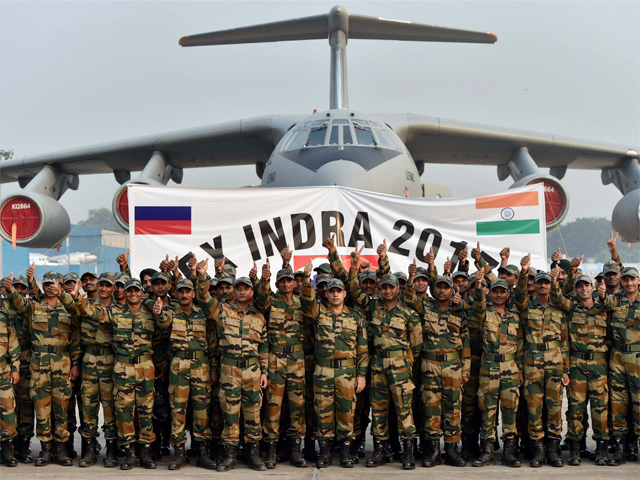
Giving the Indo-Russian defence cooperation a major boost, Exercise INDRA-2017, the first ever Tri Services Joint Exercise between Indian and Russian Armed Forces is being conducted in the Eastern Military District of Russia.

Exercise INDRA, in its previous nine avatars, has been conducted as a single service exercise alternately between the two countries.
1/7
Default Agency

Arrival of Indian Naval Ships

Arrival of Indian Naval Ships

The Indian Army, Navy and Air Force have been holding bilateral exercises separately with their Russian counterparts but it is is for the first time that the two countries are carrying out a tri-services exercise.

The year 2017 marks a major milestone as this Exercise has been upgraded to involve all the three Services of the Armed Forces (Army, Navy and Air Force), which further accentuates the importance of Joint Services in the present world environment.
2/7
Default Agency

Indian contingent

Indian contingent

Exercise INDRA-2017 is being conducted at the 249th Combined Army Range Sergeevisky and in the Sea of Japan near Vladivostok.

The Indian contingent will comprise of 350 personnel from Army, 80 from Air Force, two IL 76 aircraft and one Frigate and Corvette each from the Navy.
3/7
AP
Russian Contingent

Russian Contingent

The Russian Federation Armed Forces is represented by approximately 1000 troops of the 5th Army, Marines and Ships of Pacific Fleet and aircraft from Eastern Military District.
4/7
Default Agency

Professional Interactions

Professional Interactions

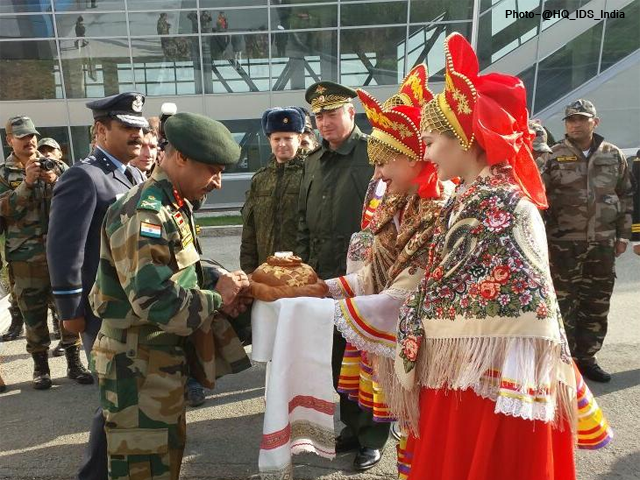
The scope of the exercise includes professional interactions, establishment of joint command and control structures between the Indian and Russian forces and elimination of terrorist threat in a multinational environment under the United Nations mandate.


In Pic- Traditional Russian welcome to Indian Contingent led by Major General ND Prasad
5/7
Default Agency

Landmark Event

Landmark Event

Exercise INDRA-2017 will strengthen mutual confidence, inter-operability and enable sharing of best practices between both the armed forces. It will be a landmark event in the history of Indo-Russian defence cooperation.

India is already working on significantly ramping up its defence capability and has lined up billions of dollars worth of procurement proposals as part of military modernisation.
6/7
Default Agency
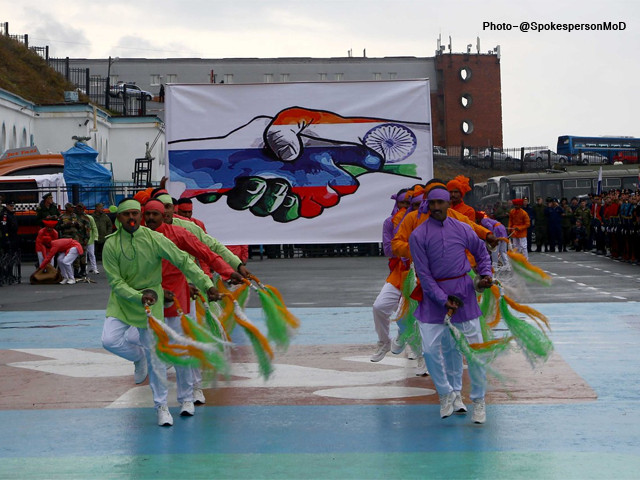
Ex INDRA: Opening Ceremony marked by a smart march-past by Indian Contingent

Ex INDRA: Opening Ceremony marked by a smart march-past by Indian Contingent

Friday, October 20, 2017

US to monitor India's foreign exchange reserves


ET Bureau|
Updated: Oct 20, 2017, 01.37 AM IST


By Gayathri Nayak


MUMBAI: The US Treasury has said that it would keep a watch on India’s increasing foreign exchange reserves as Mint Street continues to accumulate the dollar to arrest the appreciation of the rupee. 

“The Treasury will be closely monitoring India’s foreign exchange and macroeconomic policies,’’ said the Treasury in a report titled Foreign Exchange Policies of Major Trading Partners of the United States. The report was submitted to the US Congress. A watch does not mean anything adverse or positive at this point, but it could become a point of discussion whenever there are negotiations on trade-related matters between the world’s two biggest democracies. 


Over the first half of 2017, there has been a notable increase in the scale and persistence of India’s net foreign exchange purchases, which have risen to around $42 billion (1.8% of GDP) over the four quarters through June 2017. India has a significant bilateral goods trade surplus with the United States, totalling $23 billion over the four quarters through June 2017, the report said. 

Treasury has established thresholds for the three criterias that determine whether there is a need for enhanced analysis and vigilance of any country’s foreign exchange policies. These include bilateral trade surplus with the United States of at least $20 billion, and a current account deficit of at least 3% of gross domestic product (GDP) with the US. 

Furthermore, a persistent, one-sided intervention occurs when net purchases of foreign currency are conducted repeatedly and it totals at least 2 percent of an economy’s GDP over a 12-month period. 
“India is very close to meeting this criterion (the last of the three) for the four quarters ending June 2017, with net purchases of foreign currency slightly below 2% of GDP,” the report said. 

The Reserve Bank of India (RBI) has been aggressively intervening in the currency markets in the recent past to arrest a steep appreciation of the rupee against the dollar. Currently, as of October 6, India’s foreign exchange reserves were at $398 billion after having crossed $400 billion mid-September. But if one factors in the RBI’s forward market purchases, India’s reserves could be well over $420 billion, estimate economists. 

The report aims to highlight US concerns on protecting American workers and companies, and create a level playing field when competing internationally. It also looks to monitor economic policies closely to ensure that the trading partners do not indulge in unfair currency practices. 

Is it illegal for an unmarried couple (who have no plans of marriage whatsoever) to book a hotel room in India? If not, why do hotels make it hard to do so?

Quora:-Replied by Mayank Gaur

Thursday, October 19, 2017

Big US companies like Boeing, Pratt & Whitney head to Uttar Pradesh to meet Yogi Adityanath next week

About 20 companies such as Boeing, Pratt & Whitney, Merck, Medtronic & Cargill to visit state; delegation to meet CM Yogi Adityanath & health minister on Monday
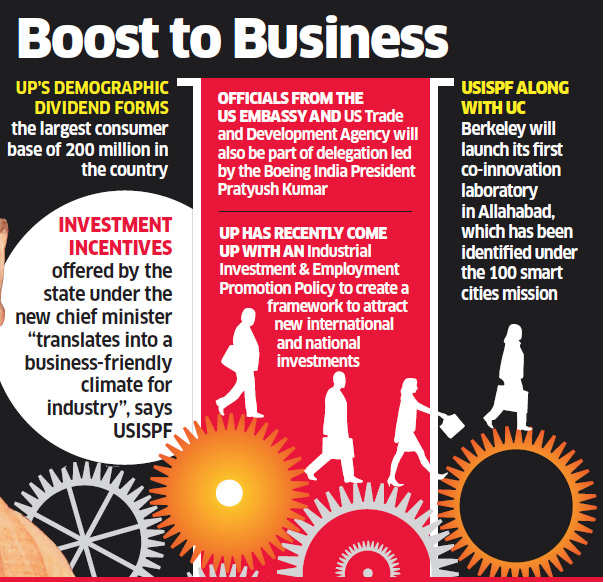
NEW DELHI: Nearly 20 major US companies like Boeing, Pratt & Whitney, MerckBSE 7.32 %, Medtronic and Cargill are heading to Uttar Pradesh next week to explore investment opportunities in the state with the new BJP government headed by Chief Minister Yogi Adityanath. The delegation, visiting under the aegis of US-India Strategic Partnership Forum (USISPF), will be interacting with UP Health Minister Siddharth Nath Singh and the chief minister on Monday in Lucknow. 


USISPF in a statement to ET said UP’s demographic dividend forming the largest consumer base of 200 million in the country and investment incentives offered by the state under the new chief minister “translates into a business-friendly climate for industry.” 

Officials from the US Embassy and US Trade and Development Agency (USTDA) will also be a part of the delegation led by the Boeing India President Pratyush Kumar. Others in the delegation include Azure Power CEO, Inderpreet Wadhwa Cargill India Chairman Siraj Chaudhary as well as executives from Facebook, Adobe, Coca Cola, Mastercard, Mosanto, Uber, HoneywellBSE 0.28 %, P&G, Oracle and GE Health. 

Big US companies like Boeing, Pratt & Whitney head to Uttar Pradesh to meet Yogi Adityanath next week
UP Chief Secretary Rajive Kumar will brief the delegation on investment opportunities along with the UP Industries Development commissioner and principal secretary for industries. UP has recently come up with an Industrial Investment & Employment Promotion Policy to create a framework to stabilize and make existing industries more competitive and to attract and realize new international and national investments in the industrial sector. 

A session on healthcare has also been organised to help US companies like Merck Sharp & Dhone Corp (MSD), GE Healthcare and Medtronic to focus on initiatives, programs and best practices to overcome roadblocks to greater access and affordability for health care services in UP. Executives from Mastercard, Azure Power, Cargill and Pratt & Whitney will also discuss technology, innovation and entrepreneurship opportunities with UP functionaries. 

USISPF along with UC Berkeley will launch its first co-innovation laboratory in Allahabad, which has been identified under the 100 smart cities mission. The co-Innovation lab initiative will provide local solutions to local problems by roping in young innovators and startups primarily in the areas of energy, transportation, waste management, healthcare, artificial intelligence, climate and smart agriculture, the USISPF said. 


Wednesday, October 18, 2017

Trump celebrates Diwali at White House, hails contributions of Indian-Americans

Trump and his daughter Ivanka was joined by senior Indian-American members of his administration including Nikki Haley, his Ambassador to the United Nations and Seema Verma, Administrator, Centers for Medicare and Medicaid Services.

ByPTI

Trump celebrates Diwali at White House, hails contributions of Indian-Americans
United States (US) President Donald Trump has celebrated his first Diwali at the White House during which he hailed the incredible contributions of the Indian-American community and said he valued his very strong relationship with Prime Minister Narendra Modi.
Trump and his daughter Ivanka was joined by senior Indian-American members of his administration including Nikki Haley, his Ambassador to the United Nations and Seema Verma, Administrator, Centers for Medicare and Medicaid Services.
Ajit Pai, Chairman of the US Federal Communications Commission and Raj Shah, Trump's Principal Deputy Press Secretary also joined Diwali celebrations yesterday.
"As we do (celebrate Diwali) so, we especially remember the People of India, the home of the Hindu faith, who have built the world's largest democracy," Trump said in a Facebook post along with a video of his Diwali celebrations inside the Oval Office. Trump said he greatly valued his "very strong relationship" with Prime Minister Modi.
Trump said he was deeply honoured to be joined by so many administration officials and leaders of the Indian-American community in celebrating Diwali -- the festival of lights.In his remarks, Trump said Indian-American neighbours and friends have made incredible contributions to the country – and to the world.
"You have made extraordinary contributions to art, science, medicine, business and education. America is especially thankful for its many Indian-American citizens who serve bravely in our armed forces and as first responders in communities throughout our great land," he said. "Today, we proudly celebrate this holiday in the people's house. In so doing, we reaffirm that Indian-Americans and Hindu-Americans are truly cherished, treasured and beloved members of our great American family," Trump added.Diwali, he said, is one of the most important celebrations in the Hindu religion.
"A time of peace and prosperity for the New Year, it is a tradition that is held dear by more than 1 billion Hindus worldwide and more than 2 million Hindus in the United States. It is also celebrated by millions of Buddhists, Sikhs, and Jains in America, India and around the world," he said.The tradition of Diwali celebration at the White House was first started by President George Bush.During his term it was celebrated mostly in the India Treaty Room of the adjacent executive office building, which is part of the White House complex.
President Bush never personally participated in the White House Diwali celebrations.In the first year of his presidency, former president Barack Obama lit the ceremonial Diya in the East Room of the White House.In his last year in office in 2016, Obama for the first time observed the festival of lights in the Oval Office.

GRAND AYODHYA TODAY EVENING


Ayodhya, also known as Saketa, is an ancient city of India, believed to be the birthplace of Rama and setting of the epic Ramayana. It is adjacent to Faizabad city in the central region of the Indian state of Uttar Pradesh.
Image may contain: night, outdoor and water

IN TRUE RAJASTHANI COLORS ON THIS DIWALI-MY SON AND WIFE

Image may contain: 2 people, people smiling, hat

UNDERSTANDING MEANING OF EQUALITY AND EQUITY

No automatic alt text available.

SARVOTTAM LORD GANAPATI - BY MY SON CA VARUN SINGHAL


Image result for varun singhal san francisco

HAPPY DIWALI TO ALL


Are Indians living in US happy?

The majority of Indians in the US are associated with either engineering or medical profession. The fraction of Indians who are billionaire businessmen on the one hand and who are working-class on the other is quite small. So, most belong to the American middle class to upper middle class economic background.
When you are an employee in a company, you are under constant pressure to perform and grow. Add to that, Indians are generally expected to work more for a lower salary than their American counterparts. This adds to the annoyance. Those who gain from the effort they put in will be happy and satisfied. On the other hand, those who don’t reach the expected level of achievement will be disappointed. This case is true in India as well. But there is a difference. In India, you work to live. The expectations are much lower. You have your family, your relatives and your native place and so you are just expected make enough money to live a comfortable live. Many of your close relatives would be much poorer than you. So, you won’t feel miserable. But, in the US, you live to work. Profession/dollars is the one and only one reason why you left everything behind. So, when even that doesn’t work out well, you get really disappointed. Some even go into depression.
Now, coming to the personal life. Since you are on your own, you have to do all the household chores and raise your children with little support. Moreover, as your children grow, they go farther from the culture in which you were raised. The conflicting moral values of both the cultures can be difficult to deal with.
Conclusion: No doubt, there are a lot of monetary gains and professional satisfaction that make Indians happy in the US. However, there are also pains that are hard to escape from.

What India wants: 3 takeaways for Modi from this year's Pew survey

What is the secret of Modi's mass support? Maybe he has been able to to convince people that whatever he is doing is for the long-term good of the country.Image result for pic of india flag

Even after three years in power, a time when most leaders face anti-incumbency, Prime Minister Narendra Modi's popularity has not waned. That's also despite his shock decision to ban high-currency notes last year that left a large number of people jobless, inconvenienced the middle class and pulled the economy down. 


Add to that the introduction of the Goods and Services Tax (GST) a few months ago that has not only hit the economic growth but also left traders confused and fuming -- even the government admits that both the decisions have created a negative impact, but for the short term. 


What is the secret of Modi's mass support? Maybe he has been able to convince people that whatever the immediate consequences of his steps, he is doing it all for the long-term good of the country. 
A new survey by US-based Pew Research Center seems to support this theory. It can also offer Modi insights into how he is viewed and what people expect from him. 


Growth is the key 

The survey finds that most of Indians trust their government. "In India, where the economy has grown on average by 6.9% since 2012, 85% (of people) trust their national government," Pew Research said in a report based on the survey on governance and trust in key countries. 
The linking of economic growth with people's trust in Modi indicates that a continued slowdown in the economy can turn masses away from him. India's Gross Domestic Product (GDP) growth slid to a three-year low of 5.7 per cent during the first quarter (April-June) of the current financial year. If the decline continues, it can erode Modi's mass support. 

Less-cash policy, JAM seem to be working 


The survey finds that India is one of the three countries in the Asia Pacific where people support technocracy (a government comprising an elite of technical experts). "Asian-Pacific public generally back rule by experts, particularly people in Vietnam (67%), India (65%) and the Philippines (62%)," it said. Indian public's liking for technocracy lies in the fact that people see hope of development through technology and not through ideology. Despite his critics opposing Modi's emphasis on a cash-less economy, e-governance, big data and the JAM (Jan Dhan, Aadhaar and mobile) trinity for development at the grassroots level, the technological initiatives are liked by people who trust technology more than political ideas. The lesson for Modi is that people support him not for the ideology but for his secular technological initiatives. 
Any tilt towards Hindutva and away from developmental technology can cost him dear.

Stay bold 

Fifty-five per cent of respondents polled in India said a system in which a strong leader could make decisions without parliamentary or judicial interference is a “somewhat” or “very” good way of governing their country. This seems to be a less than ideal situation but if seen in proper context it makes sense. India's corrupt leaders and bureaucracy inspires little hope in people who look up to strong individuals who sound honest and committed. 
Modi knows this and plays to this sentiment. His sudden decision to ban high-currency notes may have serious downsides but he sent people the message that he can bend the system for target corruption. The criticism by opposition that demonetisation was an autocratic step does not wash with people because they want autocracy, albeit the one that claims to be working for them. According to the survey, roughly half of both Indians (53%) say the military rule would be a good thing for their countries. 


This does not show people's dislike for democracy but for the corrupt regimes democracy has thrown up so far. Modi's positioning as a strong leader who can do what he decides to appeals to this sentiment. Here, the lesson for Modi is if he grows mild and pulls out no other tough measure after demonetisation and GST, his popular support may weaken.