Pages

Saturday, December 31, 2016

Recovering Russia lures investors, even after bumper year of returns

By Reuters | Updated: Dec 30, 2016, 09.48 PM IST 

LONDON/MOSCOW: It's been a tough couple of years for Vladimir Miroshnikov, head of business development at Rolf, one of Russia's biggest car dealerships. But like many foreign investors, he's banking on an economic turnaround in 2017. 

Russian car sales, once growing around 50 percent a year, dropped off a cliff in 2015 after the rouble's 2014 collapse and fell a further 10 percent in 2016. 

Miroshnikov remains cautious, saying the next few months will be tough and seeing the possibility of "a recovery only in the second half of 2017". However, he told Reuters he expects sales will at least stop falling over the year as a whole. 

Foreign investors are more enthusiastic in hoping for a revival in economic growth and consumer demand after two years of recession. Even after roughly 50 percent gains on Russian stocks and rouble bonds in 2016, analysts and fund managers interviewed for this article remain almost unanimously bullish on the country. 

Russia figures among the top 2017 trades for Deutsche Bank, Goldman Sachs, UBS, JPMorgan, Rabobank and Bank of America Merrill Lynch among others, with Goldman predicting it "to move from a recovery to a growth phase". 

On the face of it, the stars do seem aligned for Russia. 

Data showed manufacturing expanding in December at its fastest pace since March 2011, a signal that the economy is starting to grow again. 

Prices for oil, its lifeblood, will average $57 a barrel, according to analysts' forecasts in Reuters polls, $10 higher than in 2016. And if the central bank brings inflation down to its 4 percent target, ordinary Russians should have more money to spend. 

Two other factors have added impetus to the trade. 

First, Republican Donald Trump won U.S. elections on Nov. 8 with a promise to improve ties with Russia, holding out the possibility of easing sanctions imposed after Moscow's 2014 annexation of Crimea from Ukraine. 

And on Dec. 7, Glencore and Qatar teamed up to pay $11 billion for a stake in state oil firm Rosneft, confirming Russia's allure for international investors. 

Some are confident that the sanctions, tightened over Russia's role in a separatist rebellion in eastern Ukraine, will go after the new U.S. administration takes over. 

"I like Russia for some very simple reasons: The most obvious reason is Trump, because sanctions will be lifted," Luca Paolini, chief strategist at Pictet Asset Management, said. 
"But it is a little more complicated than that. It is one of the few emerging markets where we feel it is cyclical...where we think there is some decent potential in almost every scenario." 

Hopes related to sanctions got a setback this week as Washington imposed fresh curbs on Russian intelligence agencies over the hacking of political groups during the U.S. election campaign. 

But many reckon Trump will roll back the measures once he takes office in January. President Vladimir Putin said on Friday that Moscow would not expel anyone in retaliation, adding that he would wait for the actions of Trump before deciding on any further steps in relations with the United States. 

Take the politics out, and Russia looks attractive relative to many big emerging market (EM) economies. Unlike countries such as Mexico or Turkey, it has a balance of payments surplus, making it less vulnerable to the rise in global borrowing costs. 

Russia is favoured by bond investors too because falling inflation may bring 150-200 basis points in official interest rate cuts next year. That will keep inflation-adjusted bond yields at among the highest in the world. 

"There is a lot more acceptance now that Russia is in a good place," said Yerlan Syzdykov, head of emerging debt at Pioneer Investments. 

Syzdykov holds more Russian bonds than their weight in emerging market indexes, but Pioneer is also bullish on Moscow-listed stocks, he said, adding that the fund was looking to "put more money into cyclical recovery stories". 

Corporate results have been encouraging. Earnings-per-share, a key profitability indicator, recently surpassed their 10-year average for the first time since 2012. 

In recent months analysts have revised up their estimates of Russian companies' earnings at a faster pace than the rise in oil prices, Thomson Reuters Datastream shows. 

COSTS 

But some are sceptical. VTB Capital analyst Maria Kolbina, for instance, says Russians' real incomes will need to grow by 5-7 percent annually for a couple of years for consumer demand to recover significantly. 

Russia also scores poorly on all measures of corruption and transparency; its fortunes remain tied to oil exports and a recent report by the anti-monopoly service found state ownership of the economy had doubled since 2005 to 70 percent. 

But Pictet's Paolini says asset prices reflect these concerns. Russia has historically traded at a discount to other emerging markets and even after the 2016 gains, shares' ratio to forward earnings is half the emerging markets average. 

"Russia's PE is still very low, I would be worried if you had a strong performance and very expensive valuations. But that is not the case, Russia's PE is 6, Brazil is 14," Paolini said. 


Many also see positive structural changes afoot. 

"When people say nothing is changing, they think of corruption and, true, there doesn't seem to be much change on that front. But the move to inflation targeting and a floating currency is a huge structural change," said David Hauner, head of EEMEA cross-asset strategy and economics at Bank of America Merrill Lynch (BAML). 

Hauner advised clients last year to load up on rouble bonds, a bet which paid off handsomely. He predicts at least 10 percent returns next year, against zero from emerging debt overall. 

BAML is also overweight Russian equities and Hauner said hefty dividend payouts and falling inflation were not yet reflected in share prices. 

"The PE gap relative to EM has not improved at all, even though Russia has fundamentally improved," he said. "The only negative thing to say about  Russia is that everyone likes it, so if something goes wrong it could be quite painful." 


Friday, December 30, 2016

Going digital? 5 frauds you need to beware of

Dec 30, 2016, 10.13 AM IST
By Ramki Gaddipati, 

The recent demonetisation move in India has pushed us to move to a cash-free economy. This shift, which would have otherwise taken three years, is now expected to take just three to six months. Digital payments have also recently hit record transactions. 

With digital payments witnessing record transactions and more and more people joining the
cashless bandwagon, there is an obvious question on everyone's mind: are digital transactions safe? The pace of the development and integration of new technologies is much faster than the pace at which security protocols and defence mechanisms are implemented. This is what makes these technologies vulnerable to cyber-fraud. For example, 3.2 million card details were stolen in October in India - making the theft India's biggest data breach. 

Members of India's new digital economy need to be aware of the vulnerabilities in the digital
and mobile payment systems. Here are the key ways in which digital payments can be breached. 

1. Key Logger: Just like tap dancers are strongly aware of how and when their tap shoes strike the floor, a key logger is a software that records the key-strokes made by the user on the keyboard. Static passwords like 3D PINs or banking passwords, that are entered regularly, are vulnerable to cyber-fraud through a key logger, as it can record regularly typed in passwords without the user's knowledge. Using a dynamic PIN is a smart solution to the breach caused by key loggers. It is also beneficial to use apps that have an in-app secure swipe instead of the ones that require the keying in of an OTP. 

2. Social Engineering: Those calls that seem to come from the bank might not really be from the bank itself. Credit and debit cards are used at many online merchants and marketplaces. Even if these online transaction use OTPs and CVVs, someone may call the cardholder and pretend to be a representative of the bank, acting as if an online transaction needs to be confirmed, and subsequently ask the cardholder to share the the received OTP. When the OTP is disclosed by the cardholder, a fraudulent transaction can take place. 

3. OTP Pop-Ups: As One Time Passwords have a limited time validity (in minutes), they are
believed to be secure. Although OTPs mostly appear as pop-up notifications on mobile phones.These pop-up messages are clearly visible, even if the mobile phone is locked. This means that the OTP can be easily accessed without the permission of the user, making the transaction open to being breached. 

4. OTP Accessibility: Although an OTP is essential, the medium through which it is delivered is of utmost importance. Most of the times, a One Time Password is sent as an SMS. The problem with this is that many apps can read SMS messages. This means that if an app is malicious it can misuse the OTP that has been received. Therefore, users should be aware of what privileges they give to the apps on their smartphone and also look at reviews and number of downloads of the apps they choose. 

5. EDC Machines: Even with a second-step PIN verification, swiping a card on an EDC
machine is not as safe as it seems. EDC machines are susceptible to breach and a compromised machine can copy the details of the cards when swiped. Most debit and credit cards have a static PIN, and even these PINs can be stored in compromised EDC machines. A breach like this can give easy access to the personal data of cardholders to fraudulent groups. A dynamic PIN for physical credit or debit cards could be a strong safeguard against compromised EDC machines. 

As there are many threats and vulnerabilities with digital payment systems, we need a system that goes much further than regular security standards. This digital payment system should have more than two layers of security so that it is virtually impenetrable. The system should be planned in such a way that each layer both independently stands by itself and also smartly integrates with the overall security structure. From requiring a password just to access the digital payment system to not needing to key in a PIN, this system should have multiple security checkpoints so that only the authorised user can successfully, yet easily, make payments through it. 

The author is Co-founder and CTO, Zeta, a fin-tech start-up. 
(Disclaimer: This column does not necessarily reflect the opinion of The Economic Times, it's an independent view)


US evicts Russians for spying, imposes sanctions after election hacks

By Reuters | Updated: Dec 30, 2016, 08.32 AM IST

HONOLULU/WASHINGTON: President Barack Obama on Thursday ordered the expulsion of 35 Russian suspected spies and imposed sanctions on two Russian intelligence agencies over their involvement in hacking US political groups in the 2016 presidential election. 

The measures, taken during the last days of Obama's presidency, mark a new post-Cold War low in US-Russian ties and set up a potential flashpoint between incoming President-elect Donald Trump and fellow Republicans in Congress over how to deal with Moscow. 


Obama, a Democrat, had promised consequences after US intelligence officials blamed Russia for hacks intended to influence the 2016 election. Officials pointed the finger directly at Russian President Vladimir Putin for personally directing the efforts and primarily targeting Democrats, who put pressure on Obama to respond. 

"These actions follow repeated private and public warnings that we have issued to the Russian government, and are a necessary and appropriate response to efforts to harm US interests in violation of established international norms of behavior," Obama said in a statement from Hawaii, where he is on vacation. 

"All Americans should be alarmed by Russia's actions," he said. 

It was not clear whether Trump, who has repeatedly praised Putin and nominated people seen as friendly toward Moscow to senior administration posts, would seek to roll back the measures once he takes office on Jan. 20. 


Trump has brushed aside allegations from the CIA and other intelligence agencies that Russia was behind the cyber attacks. He said on Thursday he would meet with intelligence officials soon. 

"It's time for our country to move on to bigger and better things," Trump said in a statement. 

"Nevertheless, in the interest of our country and its great people, I will meet with leaders of the intelligence community next week in order to be updated on the facts of this situation," .. 
Read more at:


Monday, December 26, 2016

Warning signs your job is at risk

ET Dec 26, 2016, 06.30 AM IST
By Abhijit Bhaduri

We used to live in a world where our lives were governed by the learn-earn-retire model. We got an education, secured a job and worked till we retired. That model is fast disappearing. Today, shifts in political, economic and social norms have driven far-reaching changes. 

The biggest of these have been driven by technology, which has altered the way we work. ‘Anyone, anywhere, anytime’ is the new approach to work. Work can be sliced, diced and distributed across the globe based  on skill and cost. Work can be done by people any time, across time zones. The workspace is anywhere. 

Also Read: Why job loss is a real threat and how to manage finances, career if you are dismissed 

High on tech, low on employment 


Fluctuating demands in business cycles are making it hard for companies to predict the demand for manpower. Keeping a team on the bench without assigning it a billable project burns cash. So, employers are regularly shedding jobs. New companies are leveraging automation to the hilt. They are low on employment. Airbnb, valued at $30 billion, runs a global operation with less than 3,000 employees. 

Cost pressures are also forcing employers to weed out people who are no longer critical to the business. Almost one in 10 public companies fails each year, which is a four-fold increase since 1965. Companies now face a one in-three chance of not surviving five years, up from about one in 20 a half century ago. If the employers are dying early, it may be a warning sign to rethink your career strategy. Having the right skills makes a person valuable to the employer. 

Our skills can be represented by a pyramid. At the base are commoditised skills, which do not create a differentiator in the marketplace (like knowing Word, Excel and PowerPoint). In the middle, lie the marketable skills, which are obtained through a certificate or degree that assures the employer that the skills are up to par. Technological shifts continuously chip away at the shelf life of marketable skills turning them into worthless commoditised skills. The skills that make employers queue up are niche skills. People with niche skills are self-taught. The market is slowly tilting in favour of the handful of people who possess niche skills and the masses will continue to be vulnerable. 

Five deadly signs 
Employers will frequently have to make choices about who they want to retain and let go. These decisions are rarely made overnight. Here are a few signals that should alert you that your job may be at risk. 

1. Boss doesn’t respond to your mails promptly : When you buttonhole your boss, he makes a lame excuse about being busy. You know that your peers have had no such complaint. 

2. You have been bypassed for a hike: This is usually meant to be a hint, and not a very subtle one. The best projects go to people like you, but not to you. Those who have got hikes are all people who are working on the projects that matter to the company. 

3. Nobody reviews your work: If your work is critical to the organisation, several leaders will be keen to know what If your work is not reviewed at least once a quarter, you should be worried. 

4. Company is not investing in updating your skills: It is in the interest of the organisation to have employees who possess cutting-edge skills. If you are not being sent to attend training programmes and conferences, it could be an ominous sign. Better invest in updating your skills and network. 

5. Head hunters don’t return your calls: Those who possess cutting-edge skills are wooed by head hunters. If they do not return your calls, find out which skills are in demand. 

(The writer is a digital transformation coach and the author of The Digital Tsunami.) 
Read more at:


. 


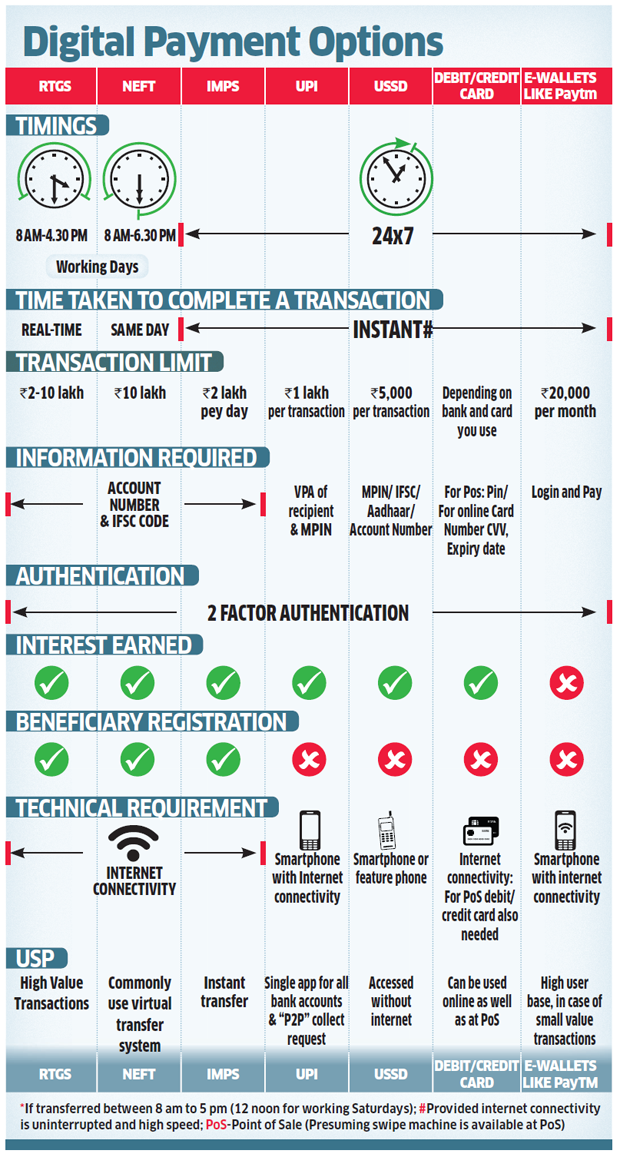
Post demonetisation: Which digital payment method to use? Here’s how to choose


By Taruna Nagi ET Dec 26 2016

Since November 8, every Indian has only one thing on mind: the dilemma of choosing a safe, secure, convenient and cashless payment option. Currently available cashless payment systems include credit/debit cards, e-wallets such as Paytm, Unified Payment Interface (UPI), IMPS, USSD, RTGS, and NEFT. Which one should you use and for what
kind of transactions? Here’s how you can decide. 

We have compared them all on eight different parameters to help you choose what suits you best: 

1. Time taken to complete a transfer/payment; 
2. The maximum amount you can transfer; 
3. The financial details/information (e.g. account number etc) that you need to complete the transfer; 
4. How is the transaction validated/authenticated; 
5. Whether you will earn interest on the money kept in reserve in the payment system? 
6. Whether you need to specify who the money is being transferred to in advance i.e. register the beneficiary (recipient) of the money (beneficiary registration); 
7. What infrastructure/technical support is a must for the transfer to happen 
8. And lastly, what are the costs involved There is no single ‘best’ payment option for everyone and all transactions.

However, you could try to pick a payment option suitable for your purpose. Below is an overview of the comparison analysis. 

VALUE OF TRANSACTION 
One way of choosing a payment option is to base your decision on the value of the transaction. As opening user accounts, creating passwords for various payment solutions is very cumbersome; a practical way would be to choose at least two of these applications — one for high- value transactions and other for small value transactions. You could divide the payment solutions into two categories and choose from RTGS/NEFT/debit and credit cards for transactions of over, say, Rs 10,000 and from– IMPS/UPI/USSD/e-wallets for payments below Rs 10,000. However, the value of transaction is not the only deciding factor: safety and ease of use are some of the other important parameters. 

AUTHENTICATION 
In terms of authentication, standard security procedure, which is two-factor authentication, is followed in case of all these alternatives. It refers to login ID and password set up by you coupled with something that only you can provide — a PIN or an OTP (normally sent to your registered mobile number or email address). In the upcoming versions of UPI, an additional level of authentication i.e. biometric authentication (using your smartphone  scanners) is proposed to be introduced. 

NETWORK SAFETY 
Apart from this, how safe your transaction is would also depend upon where and which network (public/private Wi-Fi or mobile data) you are using to make the payment transfer. Most people have several apps installed on their smartphones and almost all phone apps require access to various information/data stored on your phone. In such instances, smartphones could be more susceptible to hacking/internet virus/malware etc depending on the type of firewall  installed on them. 

Consequently, it would be wise to restrict using your smartphone to make money transfers to smaller amounts. The Reserve Bank of India has already limited the maximum amount that can be transacted via e-wallets and USSD to smaller values – Rs 20,000 per month and Rs 5000 per transaction, respectively. 

Transaction limit for UPI is slightly higher than these but still limited in comparison to NEFT/RTGS etc. 

TECHNICAL REQUIREMENTS FOR MAKING THE DIGITAL TRANSACTION 
All the digital and cashless payment alternatives mentioned above require internet connectivity except for USSD —the only payment system usable on smartphones or feature phones without internet connection. National Unified USSD Platform (or NUUP) is a mobile banking service based on USSD technology launched by NPCI. NUUP or*99#, as it is commonly called, is perhaps more suitable for the population with limited or no internet connection at minimal charges that are capped by TRAI at Rs 0.50 per transaction. 

PRESENCE OF THIRD PARTY OR INTERMEDIARIES 
Paying through an e-wallet means presence of a third party between the payer and the payee. One should keep in mind, that regulations governing e-wallet providers are different from those governing banks. However, there is an added advantage in case of e-wallets i.e. they provide an e-commerce platform as well (e-wallets such as Paytm and Freecharge also sell goods and services online just like Amazon and Flipkart), which is not  the case with any otheralternative discussed here. 

The sudden cash crunch due to demonetisation of Rs1000 and Rs 500 notes required a payment platform that was used by all. In our case, ewallets such as Paytm and Mobikwik were quick to grab this opportunity. Paytm currently has over 160 million users and is accepted by around 15 lakh merchant locations, as reported on December 13,2016. These figures are huge in comparison to the user base of similar solutions provided by National Payments Corporation of India (NPCI) such as Unified Payment Interface and USSD based National Unified USSD Platform (those figures are in lakhs and thousands). 

INFORMATION REQUIRED TO MAKE THE PAYMENT 
Sharing financial credentials on virtual platforms tends to always have some inherent risk. Cyber crimes in India have surged around 350% between 2011 and 2014, according to a joint study by Assocham and PwC released in August 2016. Requirement of the hour is robust and resilient security protocols coupled with minimum amount of credentials shared on these platforms. 
Unified Payment Interface, or UPI, provided by various banks could be considered safer than other modes in this respect. In case of UPI, one needs to enter only the Virtual Payment Address, or VPA, of the recipient, which is more secure and easy than sharing credentials such as account numbers and IFSC codes. 

How it Works In UPI, money directly goes to and from your bank account kicking out the intermediary i.e. e-wallet operators. Money stays in your account until the transaction is complete, which means you earn interest on it. To make a transaction on this platform, a Virtual Payment Address, or VPA, is generated, which can be unique for all your linked bank accounts on the interface or only one account — your choice. In case you want to have a different VPA for every account, be ready to remember all of them. All you are sharing with other people/merchants is your virtual ID, instead of important credentials. Launched with a
bang, this e-payment tool is yet to gain popularity in the already congested digital payments market. One reason may be that it has been taken as just another app for digital payments by users. Once the flexibility of this application is better understood, its user base is expected to go through the roof, beating e-wallets. 

Costs Due to demonetisation, the government has been frequently slashing fees or commissions charged by various e-payment solution providers to encourage a cashless economy. As of date, these are the maximum fees/commission your bank/intermediary could charge to transact virtually. However, charges are leviable on use of debit card: charges for online payments of up to Rs 2,000 are capped at 0.75% and for payments above Rs 2,000 charges are capped at 1%. Transaction charges on credit cards average around 2.5%. 

As for e-wallets, currently there are no charges for transactions. However, fees could be charged if you transfer money back from your wallet to your bank account. As of now, there are no such charges. The objective of having no charges in case of UPI and ewallets such Paytm is capturing user base. Once a substantial chunk of the market is captured and sustained by them, these payment systems could increase their fees gradually, although such an an increase is unlikely before this cash crunch is over. 

In terms of cost, for instant digital payments up to Rs 1 lakh, UPI and e-wallets seem like better option and above Rs 5 lakh, NEFT is cheaper, but there is a trade off with the time taken to complete the transaction. 

Sunday, December 25, 2016

*TEAM SPIRIT* -TOGETHER EVERYONE ACHIEVES MORE.

*TEAM SPIRIT*
A business man gets stranded in a lonely highway in the US. The tyres of his car get stuck badly in a mud pool. He looks around for help and finally finds an old farmer. This businessman goes to him asking for help to get his car out of the mud. Farmer gauges the situation, and agrees to help him and says, let us take the help of warwick. Warwick was an old bull around, but the helpless business man agrees.
The farmer ties the bull to the car and start shouting loudly,’ FRED, PULL!.. JACK, PULL!.. JOHN, PULL... WARWICK, PULL’. As the farmer keeps shouting these words, the bull Warwick gets the car out of the pool of mud. Businessman is relieved but has a doubt in his mind. He thanks the farmer and asks him,’ you said the bull’s name was Warwick, and he was alone, then who were these Fred, Jack & John?’ Farmer coolly answered, "See, Warwick is old and is also blind. He does not know he is pulling this car alone. The moment he hears the other names, he thinks he is in a team, and he gives his best".
*MORAL*: So is the case with all of us. The very thought that there are people to help us blesses us with a great deal of comfort, hope, confidence and enthuses us to put our heart and soul into any task that we undertake. Indeed, greatest civilizations have always been built on the foundations of a greater level of cooperation from their citizens, and the smartest animals we know — apes, elephants, wolves, dolphins, and crows — tend to live together in cooperative groups and work together for survival. As H.E.Luccock said, “No one can whistle a symphony. It takes an orchestra to play it.” It's not without reason that the very word *TEAM* is said to stand for *"Together Everyone Achieves More"*.


Saturday, December 24, 2016

Putin shrugs off Donald Trump's nuclear plans, says Democrats sore losers

MOSCOW: Russia's Vladimir Putin said on Friday he was unfazed by President-elect Donald Trump's plans to boost the U.S. nuclear arsenal, praising Trump for being in touch with U.S. public opinion while branding the Democrats sore election losers. 


Speaking at his annual news conference in Moscow, the Russian president said earlier comments he had made about his country's own military modernisation had been misunderstood in the United States and that he accepted that the U.S. military, not Russia's, was the most powerful in the world. 


Putin said on Thursday Russia's military was "stronger than any potential aggressor". Trump later tweeted that the United States "must greatly strengthen and expand its nuclear capability until such time as the world comes to its senses regarding nukes." 

Asked to clarify his comments on Friday, MSNBC reported that Trump had said: "Let it be an arms race. We will outmatch them at every pass and outlast them all." 

But Putin said he did not regard the United States as a potential aggressor and had only been talking about countries he thought might realistically launch an attack on Russia. 

"I was a bit surprised by the statements from some representatives of the current U.S. administration who for some reason started to prove that the U.S. military was the most powerful in the world," Putin said, referring to State Department comments from Thursday. 


"Nobody is arguing with that." 

Putin said he saw nothing new or remarkable about Trump's own statement about wanting to expand U.S. nuclear capabilities anyway. 

"In the course of his election campaign he (Trump) spoke about the necessity of strengthening the U.S. nuclear arsenal, and strengthening the armed forces. There's nothing unusual here," said Putin. 

"(We are talking about) a party which has clearly forgotten the original meaning of its own name. They (the Democrats) are losing on all fronts and looking elsewhere for things to blame. In my view this, how shall I say it, degrades their own dignity. You have to know how to lose with dignity." 

The Obama administration and U.S. intelligence officials have accused Russia of trying to interfere with the U.S. election by hacking Democratic Party accounts. Information from those hacks was leaked online, causing political problems for Democratic candidate Hillary Clinton. 

Putin dismissed suggestions Moscow had helped Trump to victory in any way however. 


"It's not like that," he said. "All of this (the accusations) speaks of the current administration's systemic problems." 

Putin, who spoke positively of Trump before his election win, said that only Moscow had believed in his victory however. 

"Trump understood the mood of the people and kept going until the end, when nobody believed in him," Putin said, adding with a smile. "Except for you and me." 


Putin said he would be willing to visit the United States if Trump invited him and expected U.S.-Russia ties to return to normal now, particularly in the security and economic spheres. 

He was more cagey when it came to his own political future though, saying he needed time before deciding whether he would run for president again in 2018. Most Kremlin-watchers believe he will stand and win again. 


"I will look at what's going on in the country, in the world," said Putin coyly, calling a reporter who had asked him to provide reasons why people would want to vote for him again "a provocateur". 


Read more at:


EY, PwC, Deloitte and KPMG lose big as 800 mid and senior executives bid adieu in 2016

At a time when the audit firms are trying every trick in the book to contain attrition, an all-time high 800 mid and senior executives from the Big Four - EY, PwC, Deloitte and KPMG - including partners and directors have jumped ship to join competition in 2016. 

The audit firms have not only increased gardening leaves which is sometimes six months to one year for senior executives now but in the last one year they have become much stricter in its imposition including holding back capital for an extended period, yet this year the Big Four saw mass exodus not seen in the last 4-5 years. 

While joining competition and poaching is common among the Big Four where sometimes the entire team has moved from one firm to another, the attrition number this year is about 30-40% higher than what was seen in the last 2-3 years due to people demand driven by scaling up and regulatory changes including GST, audit rotation and taxation (direct tax), said industry sources. “With so much more movement happening today companies are looking at gardening leave more seriously and imposing it more in recent times to ring fence clients,” said Navnit Singh, chairman and managing director of India for leading global executive search consultant Korn/Ferry International.
 
The idea is to keep you away from clients and markets while the company rebuilds relationships,” he adds. However, this is not deterring senior executives to move sometimes with the entire team. 

In October, about 200 plus executives, including 20 partners, were on their way out from KPMG to join Deloitte, which is looking to strengthen its advisory practice team, the biggest such movement in the audit and consultancy space in the last five years. 

In September, PWC poached five top executives including partners and directors from KPMG's private equity tax practice moved with their teams. Among the Big Four, a partner normally heads a 12-13 member team. 


The last time the audit firms had seen such high rate of attrition was about five-six years ago when such mass movement happened. The firms are aggressively hiring also due to some regulatory change, said Industry experts. 

Every firm currently is increasing the size of their GST teams. Also due to audit rotation many firms are strengthening their audit teams. While some others like Deloitte are strengthening their advisory practice as they are set to lose some marque clients from their audit practice. 

While in the past several executives would leave surreptitiously without the current employer knowing about his next employment, with the poaching war heating up this year companies have become much stricter in implementation when some senior executive or a star performer quits to join a competitor. In many cases the firms are also holding back capital money which is part of partners’ salary when they quit. 

“The idea is to prevent the person who is leaving from using information that they have gathered during their stay in the company by extending the period of confidentiality,” said Poorvi Chothani, managing partner of LawQuest, which helps clients with employment related issues in India. 

Gardening leave can be imposed if it is a part of the employment contract however it is not necessarily an effective retention tool, she said. 

Attrition remains a big challenge as the competitors, which again in most cases are the big four, are getting innovative to get around the long gardening leave period. 

In a recent case one of the senior partners in a big four firms resigned to join a competitor. His firm has not only asked him to serve a 12-month notice period but in all probability he may not get his capital money or in best case scenario, his capital money will be disbursed two years down the line. 


“The partner will be paid a joining bonus which is equal to his one year salary in the new organisation. This would take care of his capital money part,” said a senior official in the new firm he is joining. This would mean that when the partner joins the new firm he will already have some money to invest the firm as capital money. 

In desperation to attract talent, new executives and partners joining the firms are offered similar terms of appraisals. 

With a hope to attract the best talent from competitors, the Big Four are tweaking terms in employee contracts wherein the newly-joined partners and executives get fixed appraisals for the first two years of joining, irrespective of their performance. 


By Rica Bhattacharyya & Sachin Dave, ET Bureau | Dec 24, 2016, 06.39 AM IST 


Read more at:


.. 


Wednesday, December 21, 2016

Feeling down? Taking a break from Facebook may help

IANS Dec 21, 2016, 06.04 PM IST

NEW YORK: If you are feeling blue and cannot figure out why, taking an occasional break from Facebook might do wonders, suggests a research. 
The study showed that regular use of social networking such as Facebook can negatively affect your emotional well-being and satisfaction with life, but you do not have to quit Facebook altogether. Simply changing your social networking behaviour and taking an occasional break from Facebook may lift your spirits, said the study published in the journal Cyber psychology, Behaviour, and Social Networking. 

In the study, Morten Tromholt  from the University of Copenhagen, Denmark, described an experiment in which he gave more than 1,000 participants a pre-test and then randomly assigned them to one of two conditions -- continue using Facebook as usual or stop using Facebook for a week.


After one week without Facebook, the treatment group showed statistically significant improvement in well-being, with gains varying depending on the amount of time they previously spent on Facebook and whether or not they were passive users and tended to envy others on Facebook.