
In the last one year, gold prices in India (rupee terms) are up 38%, dwarfing the measly 3% return of the benchmark Nifty 50 during the same period. The relentless rally in gold has happened despite a strong dollar, with the dollar index, DXY, up around 4% in the last one year – negating the historical inverse relationship with the greenback. There are reports that the Bank of England’s fortified underground vaults, holding the world’s second-largest depository of gold, are being emptied out fast as investors and central banks are seeking physical delivery of the yellow metal.
Gold prices have hit a high of USD2,940 per ounce. How far can the yellow metal actually go?
The yellow shine
Last week, UBS raised its gold forecasts to USD3,000/oz over the next 12 months, up from USD2,850 previously. The central banks’ buying for 2024 has reached 1,045 metric tons (mt), on par with levels seen in the previous two years and double the average of around 500mt between 2011 and 2021, according to UBS. Citigroup also upgraded its price target for gold at USD3,000 per troy ounce likely within three months as the “gold bull market looks set to continue under Trump 2.0.”
Egon Von Greyerz, founder Von Greyerz, an advisory firm on precious metals, is extremely bullish on gold. “If you take the total value of gold in the world, it works out to USD17 trillion which is about 200,000 tonnes. The top 10 US companies are valued at USD18 trillion. Basically, 10 companies are valued more than all the gold ever mined. This means it’s the only real money in the world and the rest is paper money, and yet nobody in the West buys gold. Microsoft’s market capitalisation is at USD3 trillion, and all the gold held by central banks is also USD3 trillion. This makes sense to me. We are going to see a revaluation of gold not too far away,” said Von Greyerz on a social-media post recently.
Now, many will argue that gold does not serve any economic purpose, and it is not a good idea to compare it with the market capitalisation of companies that contribute real services and utility to the real world. But we also need to look at the world going through uncertain times. Gold has time and again proven that it is an asset class for uncertainty and more often goes up when capital markets are not in their best health.
Uncertainty regarding tariffs and trade wars is possibly driving prices higher, as also the expectations that commodity inflation will return sooner than later. A strong US economy and insipient signs of China revival are fuelling this narrative.
Investors are piling on to gold not only as a hedge against uncertainty and geopolitical risks, but also as an inflation and dollar hedge. In Delhi’s Kucha Mahajani market in Chandni Chowk, bullion traders have never had it so good. There is no stopping the gold bulls despite record prices. In January, gold exchange-traded funds (ETF) received the highest monthly inflows ever, with net inflow of INR3,751.42 crore, as against INR640 crore in December.
Investors’ favourite?
Not only are retail and institutional investors putting money in gold, even global central banks are key buyers. According to the World Gold Council data, central banks bought more than 1,000 tonnes of gold in 2024, for a third year in a row. The Reserve Bank of India (RBI) too added 72.6 tonnes to its gold reserves in 2024, taking its total gold holdings to 876.18 tonnes as of end December 2024. Incremental additions totalled 18 tonnes in 2023.
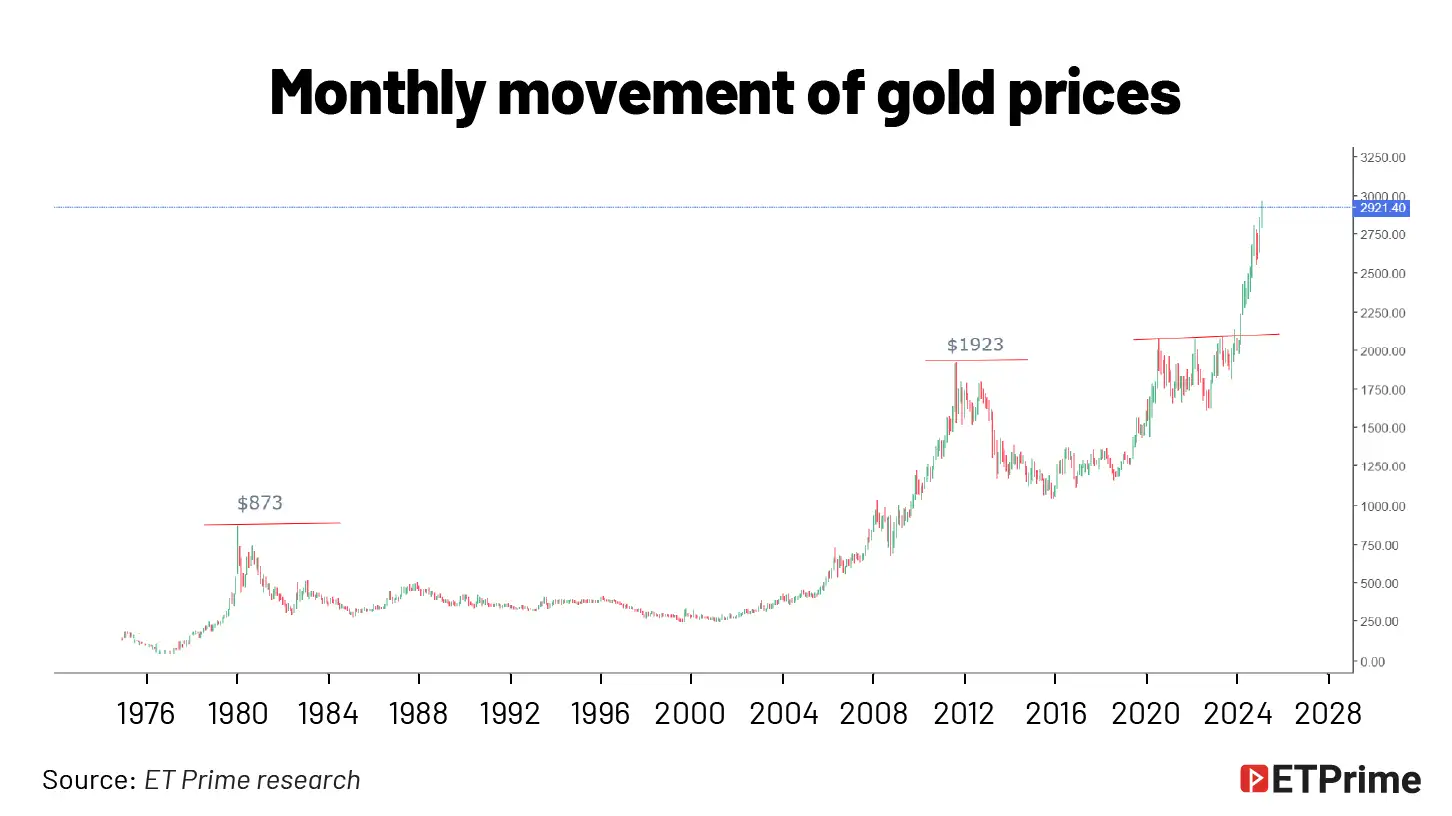
The USD3,000 per troy ounce has both psychological and historical significance from an investing perspective. In the past, the gold bull run had hit a significant wall of resistance before each millennial level – first around USD1,000 per ounce level in 1980 and then around USD2,000 levels in 2010. Gold prices corrected significantly for several years during these two past phases. With prices now within a touching distance of USD3,000 per ounce, will the rally halt at this key psychological level? This is the topmost question on investors’ minds.
“Gold fell short of USD1K on its run to this level. Gold fell short of USD2K on its run to this level. Will gold now fall short of USD3k???? Gold has stopped before each millennial level,” commodity and forex trader Peter Brandt wrote on X on February 6.
The outlook
Gold prices went up nearly 10x between 1976 and 1980. They started correcting thereafter and were falling for nearly 22 years till 2002. New highs of USD1,033 an ounce was made briefly in March 2008 but didn’t sustain and prices fell in the following months.
A fresh rally started in 2009 and pushed the prices to a peak of USD1,923 in 2011. Thereafter, a long correction ensued till 2019. Between 2020 and 2024, it took four attempts for gold to decisively close above the USD2,000 mark – interspersed with sharp falls in prices during those four years. Seen from this historical lens, first crossing and then sustaining above the USD3,000 mark will be crucial for the bullion rally to sustain. That is where the risk and the caution lie.
Several large investors are cautious in buying gold at these levels.
S Naren, CIO, ICICI Prudential AMC, says it’s better to put money in fixed deposits and debt at this point of time. “In the US, for example, one of the investors we all admire has the largest holding of Treasury bills today. So, taking a cue from him, you have to put money in debt at this point of time, not in gold because gold has gone up substantially,” he said in a conversation with the Economic Times on February 11.
“So, you do not put money in an asset class which is at an all-time high at this point of time and say that is your strategic asset allocation. You do strategic asset allocation in an asset class which has not done well like debt or fixed deposits,” he said

No comments:
Post a Comment